How Fast Is the Retro Gaming Market Growing? Real Market Size—and Where Individuals Still Have Room
2026年2月12日
TL;DR
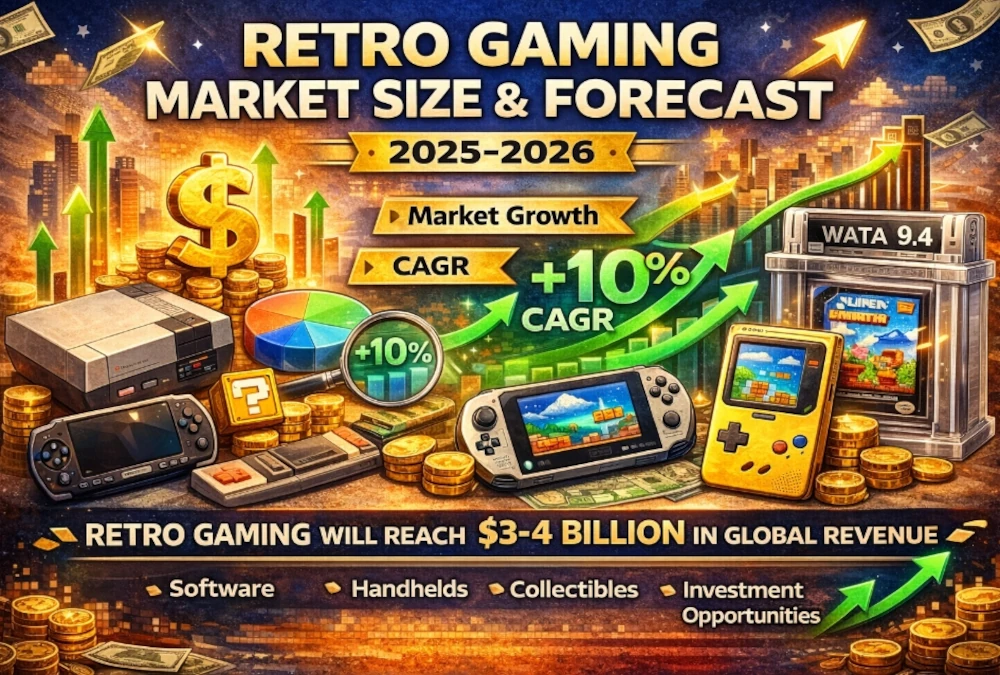
Most credible estimates peg the global retro segment at roughly $3–4B in 2025, expanding at about ~10% YoY—roughly double mainstream console growth—driven by official re-releases/subscriptions, the explosion of retro handhelds, and a collectibles lane where sealed or first-print items act like cultural assets. It’s not a gold rush, but there’s still room at the edges if you play where demand compounds quietly.
Retro gaming is now a multi-billion-dollar niche growing faster than the broader video game industry, supported by catalog monetization, hardware accessibility, and institutionalized collectibles demand.
Retro Gaming Market Size in 2025
Multiple trackers and market round-ups converge on a retro gaming market in the low-single-digit billions: approximately $3.8B in 2025.
Growth is projected to continue into 2026 and beyond at roughly ~10% annual expansion, significantly outpacing the 3–5% growth typically cited for the broader console segment.
Translation for investors: retro remains a small market, but one expanding faster than the platform mainstream due to structural tailwinds—distribution, hardware access, and collectibles infrastructure.
Retro Gaming Industry Growth Rate & CAGR
Projected CAGR sits in the 9–11% range depending on how retro is defined (software only vs hardware + collectibles inclusion).
Key growth characteristics:
- Faster than console software growth
- Comparable to premium collectibles categories
- Supported by recurring subscription revenue
- Boosted by hardware accessibility
This positions retro gaming as a high-growth niche within a mature industry rather than a speculative bubble.
Key Growth Drivers
Subscription Libraries & Official Re-Releases
Nintendo’s subscription ecosystem has normalized licensed retro consumption across:
- NES
- SNES
- Game Boy / Color
- N64
- Game Boy Advance
- GameCube (Expansion tier rollout)
Catalog libraries now function as recurring revenue engines rather than nostalgia marketing.
Why it matters:
Official release calendars reliably stimulate secondary demand—used titles, franchise merchandise, and adjacent media often see measurable uplift following digital re-introductions.
While subscription libraries and handheld hardware drive retro access, new consumption environments are emerging inside metaverse gaming platforms, where players can experience legacy titles within virtual arcade venues. This fusion of nostalgia and persistent virtual economies may open new monetization and engagement layers for retro gaming.
One emerging case worth watching is a metaverse MMORPG ‘Earthlings Land’ currently in development, designed around persistent arcade hubs and legacy title integration.
→‘Big Time’ and ‘Earthlings’! Which of the two great blockchain MMORPGs is more fun! 4 great features! The best PC-game!
Retro Handheld Hardware Expansion
Dedicated retro handhelds—Retroid, Anbernic, AYANEO and peers—have transformed retro gaming from collector hobby to daily portable consumption.
Category characteristics:
- Frequent device refresh cycles
- Global export distribution
- Emulation support ecosystems
- Sub-$200 entry pricing
While tariffs and import duties create margin pressure, underlying demand remains structurally strong due to frictionless access.
Collectibles & Graded Game Assets
On the asset side, sealed and first-print games continue to post record auction sales.
Market signals include:
- Six-figure sealed game transactions
- Institutional auction house participation
- Population-tracked grading systems
- Cultural asset framing alongside comics and trading cards
However, liquidity is episodic rather than continuous.
Risk note:
Grading credibility debates, fee structures, and label transitions require diligence before capital deployment.
Retro Gaming vs Mainstream Console Market
Segment comparison:
Retro Gaming
Growth: ~10%
Scale: Small
Console Gaming
Growth: 3–5%
Scale: Large
Mobile Gaming
Growth: 6–8%
Scale: Massive
Takeaway: retro grows faster but from a smaller base, making it a high-velocity niche rather than a dominant revenue pillar.
Investment & Individual Opportunity Areas
This is not a “buy anything retro” market. Edges that still work are licensed, visible, and operationally simple.
Secondary Demand Around Official Drops
When legacy titles hit subscription libraries or licensed re-issues, adjacent demand follows:
- Used games in the same series
- Companion art books
- Franchise accessories
Predictable, repeatable, IP-safe.
Handheld-Adjacent Accessories & Services
Examples:
- Carry cases
- Screen protectors
- Charging docks
- Controllers
- Refurbishment / repair services
Accessory layers turn faster and face less tariff exposure than hardware.
Licensed Physical Re-Issues
Publishers like Limited Run Games continue expanding retro physical pipelines, creating legitimate scarcity without IP infringement risk.
Selective Collectibles
Viable only when:
- First-print verified
- Condition graded
- Population known
- Exit venue defined
Blind sealed speculation remains high-friction.
Risks & Market Constraints
Key operational risks include:
- Import tariffs on handheld hardware
- Device model obsolescence
- Warranty / return logistics
- Grading turnaround times
- Auction fee structures
- Limited-run supply spikes
“Grade = liquidity” should never be assumed.
Market Structure: Three Parallel Economies
Retro gaming operates across three semi-independent lanes:
- Play Economy — subscriptions & licensed access
- Hardware Economy — handheld devices
- Asset Economy — collectibles & graded games
Because these sectors rarely contract simultaneously, the category compounds steadily even when individual lanes soften.
Future Forecast (2026–2028)
Growth is forecast to continue through the late-decade window driven by:
- Subscription catalog expansion
- Hybrid handheld hardware innovation
- IP remaster pipelines
- Institutional collectibles demand
Expected trajectory:
- Continued ~8–11% CAGR
- Increasing subscription share
- Rising auction headline sales
- Hardware commoditization at entry tiers
Retro is transitioning from nostalgia subculture into infrastructure-supported market vertical.
Across combined software, hardware, and collectibles segments, retro gaming is expected to sustain an estimated 8–11% CAGR through the late decade.
A Practical Framework (60-Minute Setup)
- Calendar — Track 90-day subscription and re-release schedules
- Channel — Select one accessory niche with stable supply
- Collectible — Acquire one documented, high-conviction asset only
Focus on repeatable edges rather than speculative spikes.
Soft Takeaway
Retro gaming functions as a steady multi-lane market rather than a hype cycle.
Durable participation comes from:
- Riding licensed release calendars
- Servicing hardware ecosystems
- Collecting selectively with defined exits
Approached structurally, retro shifts from nostalgia into investable cultural infrastructure.
Sources & Primary Research
Market Size & Industry Growth
Newzoo — Global Games Market Intelligence Hub
https://newzoo.com/resources
Summary:
Industry reports covering global games revenue, platform growth rates, and subscription monetization trends.
Statista — Video Game & Retro Market Data
https://www.statista.com/
Summary:
Retro/classic segments generate low-billion revenues with high-single to low-double-digit CAGR depending on category scope.
Subscription Libraries & Catalog Monetization
Nintendo — Switch Online Service
https://www.nintendo.com/switch/online-service/
Summary:
Expanding retro libraries across multiple legacy platforms via subscription tiers.
Nintendo — Investor Relations
https://www.nintendo.co.jp/ir/en/
Summary:
Financial disclosures highlight catalog IP monetization and subscription growth.
Hardware Expansion
Niko Partners — Gaming Market Reports
https://nikopartners.com/
Summary:
Portable gaming hardware demand rising across Asia and export markets.
IDC — Gaming Device Shipments
https://www.idc.com/
Summary:
Handheld and hybrid hardware categories expanding globally.
Collectibles & Auctions
Heritage Auctions — Video Games Search Archive
https://comics.ha.com/c/search-results.zx?Ntt=video+games
Summary:
Historical auction results for sealed and graded retro games.
Goldin Auctions — Pop Culture Assets
https://goldin.co/
Summary:
Video games positioned alongside sports cards and comics as cultural assets.
Grading Infrastructure
PSA — Video Game Grading
https://www.psacard.com/services/video-games
WATA Games Certification
https://www.watagames.com/
Summary:
Authentication and grading standardize resale trust and valuation benchmarks.
Notes and Additional Information
※This article is not intended to provide investment advice.
This content is based on official materials and presents a fact-based overview of industry trends.