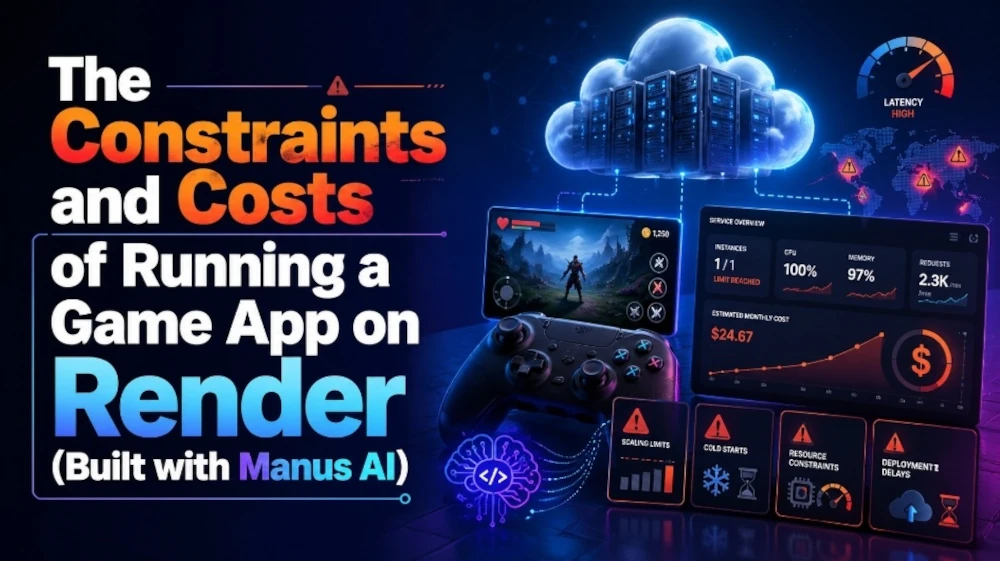
The Constraints and Costs of Running a Game App on Render (Built with Manus AI)
2026年4月26日
Conclusion First: For demo releases, Render’s free tier was enough.
But honestly, what impressed me most wasn’t Render’s limits or pricing.
It was the fact that, using Manus AI’s free tier, I was able to build and publicly deploy a full-stack game app in a very short time.
And this wasn’t even a polished product.
It has bugs. It has rough edges.
Yet it reached the point where it wasn’t just running locally — it became a live demo others could access.
That says a lot about how much the generative AI era is changing software creation.
What I Built
This was a full-stack game application, not just frontend-only.
It included backend logic and actually ran as an application.
Development time?
About one hour.
Tools used?
Manus AI free tier.
And under those constraints, something working and deployable was created.
That is a big deal.
Not long ago, building a full-stack game solo usually meant handling:
- Frontend implementation
- API development
- State management
- Deployment configuration
- Environment variables
- Production checks
That stack of work added up quickly.
Getting all the way to public release was not trivial.
This time, that barrier felt dramatically lower.
Constraints When Deploying a Demo on Render
Render’s free tier is good for demos.
For serious production use, it has limits.
That should be accepted honestly.
With the free plan:
- Cold starts can cause waiting time on first access
- Always-on performance isn’t guaranteed
- It’s not designed for seamless production-grade delivery
So for this demo, I assumed from the start I’d include something like:
“Please wait a moment while the app starts.”
Yes, that’s a weakness.
But it’s also the tradeoff for putting something online at almost no cost.
At the early stage, what matters isn’t perfect operational quality.
It’s getting something in front of people and collecting reactions.
Viewed that way, Render’s free tier was rational.
The Money Side
In solo development, the burden isn’t only technical.
There’s also a psychological barrier:
“I want to publish this, but I don’t want to spend money yet.”
Free deployment removes that.
If payment is required from day one, experimentation feels heavier.
If publishing is free, you can:
- ship first
- observe reactions
- decide later whether scaling is worth paying for
That’s the real value.
Not “cheap because it’s free,” but:
Being able to reach the validation stage at almost zero cost.
That matters enormously for indie development.
The Bigger Story: Manus AI’s Free Tier Made Full-Stack Development Possible
This is really the main point.
Render’s limits are easy to understand.
But the bigger story is this:
A full-stack game was built using Manus AI’s free tier.
That’s more than “code generation is fast.”
It suggests the barrier to full-stack development itself is dropping.
Before, solo developers often stopped at:
- frontend prototypes
- local experiments
- unfinished proof-of-concepts
Going public meant hitting infrastructure and deployment walls.
Now generative AI changes that.
It raises:
- implementation speed
- multi-layer prototyping ability
- deployment accessibility
- feasibility of full-stack solo projects
And again—
This was done on a free tier.
That matters.
This isn’t:
“I used expensive AI tooling to move fast.”
It is:
Even free-tier AI is enough for individuals to build and release full-stack games.
That’s significant.
Reflection: Difficulty Didn’t Disappear — It Changed
Generative AI doesn’t make everything easy.
Bugs still happen.
You still get stuck.
This project has rough spots too.
But one thing feels increasingly true:
The era where “building a full-stack game solo is inherently too hard” is ending.
More precisely—
The nature of difficulty changed.
Before, the hard part was:
Can you build it at all?
Now the harder questions are:
- What should you build?
- What is “good enough” to publish?
- Do you launch with bugs?
- How do you iterate afterward?
- When do you move from free tools to paid tools?
The advantage is shifting from:
“Can you code it?”
to
“Can you decide, ship, and iterate?”
That is a major change.
Why This Demo Matters
What I published is not a finished product.
It has bugs.
It has free-tier latency.
Still, it matters.
Because what it demonstrates is not polish.
It demonstrates a fact:
With generative AI, an individual can build and publicly release a full-stack game in a very short time.
That matters beyond this single project.
It’s not just a successful experiment.
It’s evidence of a broader shift.
Full-stack development is no longer reserved only for highly advanced developers.
At least for prototyping, launching, and validating—
it has become realistic for individuals.
Full-Stack Game Demo Site
Try the Live Full-Stack Game Demo
Yokohama-Chinatown-Brawl-demo
Experience the experimental full-stack game built in about one hour with Manus AI and deployed on Render. It may have bugs, but that is part of the point — seeing how fast generative AI can turn ideas into playable public demos.
Since this demo page is hosted on the free plan, it may take about a minute to load.
Latest Game SteamRunner
Play SteamRunner and earn rewards you can use in future MMORPGs
This retro-inspired running action game, with echoes of Pac-Man and Space Invaders, is fun on its own — but it also sparks a bigger question about where games may be heading. As you play, you can earn in-game currency tied to a future blockchain MMORPG, along with crypto rewards that may be converted into stablecoins. While that MMORPG’s AI direction is still unknown, it is hard not to wonder how deeply AI may shape the future of games — in development, world design, NPC behavior, and player experiences. That intersection is still blurry, but it may be one of the most exciting frontiers in gaming.
Summary
The biggest takeaway from this experiment was simple:
Using Manus AI’s free tier, I built a buggy but working full-stack game in one hour, and pushed it to a public demo on Render.
Yes, Render free hosting has limitations.
But for demo purposes, those limitations were acceptable.
And more importantly:
Even full-stack games can now be built and shipped quickly by individuals using generative AI.
The difficulty hasn’t vanished completely.
But the barrier to building and shipping has clearly dropped.
And that means modern indie development may be less about perfection, and more about:
- speed over polish
- validation over completeness
- shipping ideas instead of endlessly preparing
And that may be the biggest shift of all.