What Is Metroid (1986/1987)? A Beginner-Friendly Guide to Its Story, Release History, Gameplay, and Lasting Appeal
2026年3月22日
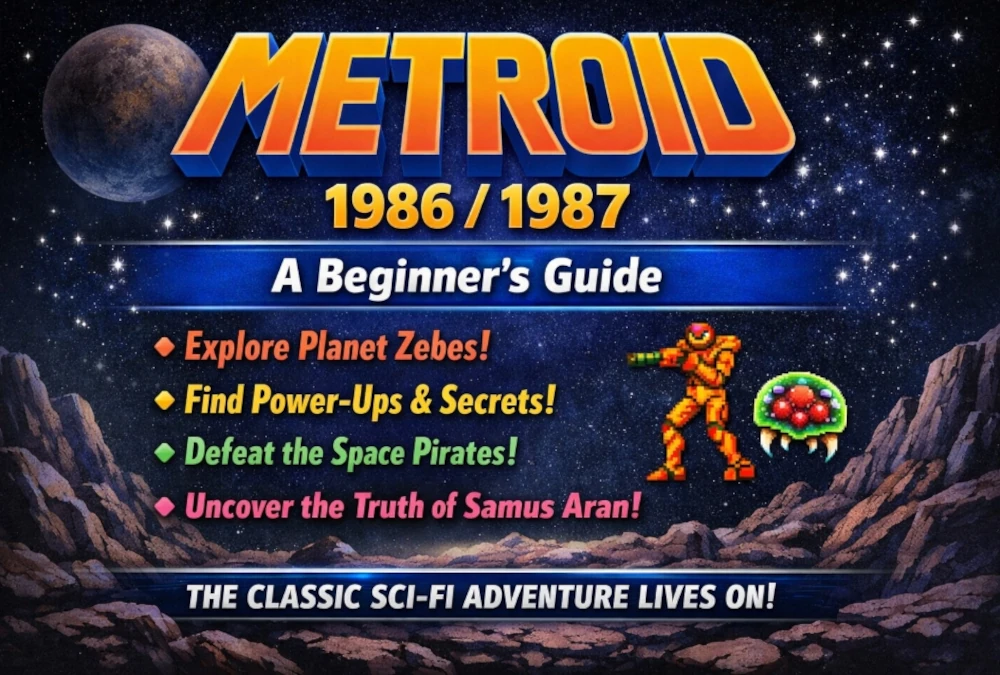
Metroid is Nintendo’s original sci-fi exploration classic: first released in Japan in 1986 for the Famicom Disk System and internationally on the NES in 1987. For new players, the simplest way to understand it is this: you land on a hostile planet, explore a maze-like world, find permanent upgrades, and gradually unlock the path to the final objective. This guide breaks down the game’s release history, story, structure, password system, and the reasons it still feels important today.
Metroid (1986/1987) at a Glance
| Category | Information |
|---|---|
| Title | Metroid |
| First release | August 6, 1986 (Japan, Famicom Disk System) |
| International release | August 15, 1987 (North America, NES) / January 15, 1988 (Europe, NES) |
| Platforms | Famicom Disk System / Nintendo Entertainment System (NES) |
| Genre | Single-player action-adventure |
| Core structure | Exploration, permanent upgrades, and backtracking |
| Setting | Planet Zebes |
| Protagonist | Samus Aran |
| Main objective | Destroy Mother Brain and stop the Metroid threat |
| Password system | Password-based continuation |
| Modern availability | Nintendo Switch Online |
Quick Facts About Metroid (1986/1987)
- Original release (Japan, Famicom Disk System): August 6, 1986.
- NES release (North America): August 15, 1987.
- NES release (Europe): January 15, 1988.
- Genre and format: single-player action/adventure built around exploration and upgrades.
- Save style on NES: password-based continuation (not battery saves).
- Modern access: included in Nintendo’s official NES classics lineup on Switch Online, listed as “Metroid (1987)”.
Metroid Story Summary: What Happens on Planet Zebes?
The story opens with a classic sci‑fi emergency: a deep‑space research ship is attacked, and a capsule containing an unknown life-form from Planet SR388 is stolen by Space Pirates.
That life-form can multiply rapidly if exposed to beta rays for 24 hours, which turns the theft into a potential galaxy-wide catastrophe.
The pirates’ headquarters is discovered on Planet Zebes, described as a natural fortress with a complicated maze-like interior.
A direct assault fails, so the last-resort plan is to send one elite hunter in alone: Samus Aran, tasked with destroying the central control entity known as Mother Brain.
A beginner-friendly way to think about the plot: it’s not about complicated politics; it’s a “break in, stop the bio-weapon, shut down the brain” mission with a strong sense of urgency.
The manual also plays coy about Samus, calling the true identity “shrouded in mystery,” and even uses male pronouns in places—one of those old-school twists that became legendary later.
How Metroid Gameplay Works
Metroid isn’t a straight line of levels. It’s a connected world made of zones linked by doors and elevators, where routes fold back on themselves like a big, hostile subway map.
The game’s design pushes exploration by placing obstacles that are impossible at first, then making them doable after you find the right upgrade.
The official manual emphasizes “hunt out the Power Items” because upgrades are the real keys—more than raw reflexes.
Early Samus has limited range and limited options; later Samus becomes mobile, tanky, and dangerous, and the planet starts feeling smaller in a satisfying way.
Backtracking is a feature, not busywork. New abilities often unlock multiple earlier doors or hidden routes, so old rooms turn into shortcuts, treasure stops, or gateways deeper into the planet.
That design also means the game naturally supports different routes: experienced players can reach areas earlier than “intended,” which later fed the speedrunning culture around the series.
Why the NES Version of Metroid Uses Passwords Instead of Saves
On NES, Continue brings up a password entry screen, and a password is shown when the game ends so you can resume later.
That’s not just a cute retro quirk—passwords were a common solution when cartridges didn’t include persistent save hardware.
The manual even teaches the process step-by-step: choose START or CONTINUE, enter letters/numbers with the cursor, and retry if the entry is wrong.
This matters for beginners because it changes the rhythm: progress is measured by what you discovered and which upgrades you secured, then encoded into a password so the game can reconstruct a restart state later, rather than relying on an autosave file.
The password system also helped create a side culture of famous codes and strange effects—some legitimate, some accidental, some chaotic.
Even if you never use any special passwords, understanding that your progress is “encoded” explains why the game feels different from modern checkpoint-heavy design.
What Is the Goal in Metroid?
The mission goal is straightforward: destroy Mother Brain in the planet’s central base and prevent the Metroid life-form from being weaponized.
Getting there is the real adventure: Zebes is a maze, and the path forward is blocked by threats, gates, and environmental challenges that require upgrades to overcome.
The manual breaks the planet into major zones and frames progression as clearing the early regions before pushing into the central base.
A beginner-friendly mental model:
- Explore → get stronger → reach deeper areas → repeat, until the central base finally opens up.
That structure is why the game can feel “aimless” for the first hour and then suddenly feel very directed—because the direction comes from what your new tools let you do.
Once the route clicks, the game’s pace accelerates, and the earlier confusion turns into confident movement across areas you used to fear.
Metroid Endings Explained: Why Completion Time Matters
Metroid explicitly ties the “final outcome” to how long the mission took, as stated in the official manual.
That design decision quietly encourages replays: once you finish, the game naturally invites the question, “How much faster can this be?”
This time-based ending concept also reinforced the idea that routes and efficiency matter, not just survival.
Later sources document more detailed thresholds and multiple ending variants, but the key confirmed point is the existence of time-based outcome changes.
For beginners, the best takeaway is simple: the game is happy to reward improvement. Finishing once is the “graduation,” and finishing cleaner/faster becomes the fun extra challenge.
That replay-friendly structure is one reason Metroid remained culturally loud long after the original hardware era ended.
Why Samus Is Called a “Space Hunter”
Nintendo’s Japanese catalog description refers to Samus as a space hunter, anchoring the term as part of the franchise’s early identity.
That label fits the premise: Samus is essentially hired to do what fleets can’t—surgical infiltration and total shutdown.
Retrospectives citing developer interviews also mention “Space Hunter” as an early working title before “Metroid” was finalized, often explained as a blend of “metro” and “android.”
That naming story matches how the game feels: underground corridors and tech-heavy sci‑fi vibes, with a protagonist that early materials treat as more “mysterious cyborg” than “fully defined character.”
The manual’s language around Samus also reflects that early ambiguity—identity kept vague, pronouns inconsistent, mystery emphasized.
All of this helped create one of gaming’s most famous early surprises without needing a big cinematic reveal.
Where to Play Metroid Today
Nintendo’s official Switch Online NES classics page lists Metroid (1987) among the included games, keeping the original readily accessible.
That modern availability is important because it preserves the original experience while removing the hardest part of retro gaming: tracking down working vintage hardware and cartridges.
Playing it today also helps explain why later entries (2D and otherwise) treat upgrades, exploration, and atmosphere as sacred.
The game still stands as a clear example of “power-up gated exploration,” where the map is a puzzle box that opens gradually as your kit expands.
It also remains a neat historical contrast: modern games often mark objectives and map everything, while Metroid expects you to learn the planet like a place you’ve actually been.
That difference is exactly why some players bounce off… and why others get totally hooked.
If you’re comparing Nintendo Switch Online with other modern game subscription services, this broader guide breaks down how it stacks up against Game Pass, PlayStation Plus, and Apple Arcade in 2026: The Ultimate 2026 Guide to Game Subscriptions (US).
Why Metroid Is Still So Fun
The “From Fragile to Fearsome” Power Curve
Metroid starts with Samus underpowered—short range, limited options, and lots of danger per step.
Then upgrades arrive, and each one feels like a personal cheat code you earned: longer reach, better mobility, and more ways to survive Zebes’ nastiness.
The manual directly calls out the importance of collecting Power Items and describes how they add new attack methods and strengthen Samus.
That design makes progress feel physical: you can remember the exact moment the game went from “please don’t touch me” to “okay, I’m the problem now.”
Exploration That Feels Like Solving a Location
Zebes works like a maze with logic: doors, corridors, and elevators connect big regions, and your understanding of how they link becomes a skill.
Instead of giving constant hints, the game uses obstacles and gating to teach you what you need, then dares you to find it.
The fun comes from building a mental map: “this door needs missiles,” “this hallway has a suspicious block,” “this elevator connects the next zone.”
Once you know the layout, the same world that felt confusing becomes a playground for routing and efficient movement.
Atmosphere: Isolation With Teeth
The manual sets the stage as a fortress planet with traps and enemies waiting around corners, which matches the game’s lonely, hostile feel.
Metroid’s world design leans into tension: narrow corridors, sudden threats, and the constant sense that you’re deep inside something that doesn’t want you there.
Even without modern cinematic storytelling, the premise—one hunter versus a planet—creates strong mood through pacing and layout alone.
That atmosphere became a core identity for the franchise and is still recognizable in later entries.
Replay Value Built Into the Ending
Because completion time affects the ending outcome, the game rewards mastery naturally.
That makes replays feel purposeful: faster routes, fewer mistakes, better upgrade order, cleaner execution.
This design also nudges you into experimenting: alternative paths, early pickups, and “can I reach that area sooner?” thinking.
It’s one of the early console examples of a game gently encouraging speed and efficiency without calling it a “mode.”
The Joy of Finding “The One Item”
Some upgrades don’t just make you stronger—they change what the world means. Suddenly a previously useless corridor becomes a gateway.
That moment—when a new item makes the map “click”—is the heartbeat of Metroid’s design.
The manual’s guidance about finding hidden rooms and power items lines up with how the game rewards curiosity.
The satisfaction isn’t only beating enemies; it’s realizing you’ve outsmarted the planet and unlocked another layer of it.
If you’re curious why games like Metroid still matter beyond nostalgia, this market overview explains how retro gaming has grown into a fast-expanding niche with room for collectors, resellers, and genre-focused sites: How Fast Is the Retro Gaming Market Growing? Real Market Size—and Where Individuals Still Have Room.
FAQ
What is Metroid (1986/1987)?
Metroid is the first game in Nintendo’s sci-fi action series. It began on the Famicom Disk System in Japan in 1986 and later released on the NES internationally in 1987, combining action, exploration, hidden upgrades, and backtracking in a way that became hugely influential.
When was the original Metroid released?
The original Metroid launched in Japan on August 6, 1986 for the Famicom Disk System. It released in North America on August 15, 1987 for the NES, and in Europe on January 15, 1988.
What is the story of Metroid?
The story centers on the theft of a dangerous life-form called Metroid from Planet SR388. The Space Pirates take it to Planet Zebes, where they plan to weaponize it, and Samus Aran is sent in alone to infiltrate the planet and destroy Mother Brain.
How does Metroid gameplay work?
Metroid is built around exploration. Players move through a connected world, find permanent upgrades, revisit earlier areas, and use new abilities to open paths that were previously blocked. Progress comes from learning the map as much as from defeating enemies.
Does the NES version of Metroid have saves?
Not in the modern sense. The NES version uses a password system instead of battery-backed saves, letting players continue by entering a code that reconstructs a restart state based on their progress.
Why does Metroid feel confusing at first?
Because the game gives very little direct guidance. It expects players to experiment, test suspicious walls, revisit old areas after getting upgrades, and slowly build a mental map of Zebes. That lack of hand-holding is part of the design.
Why is Metroid still important today?
It helped establish the template for exploration-focused action games built around permanent upgrades and nonlinear progression. Its structure, atmosphere, and progression loop are a major reason later games were described with the genre label “Metroidvania.”
Can beginners still enjoy Metroid today?
Yes, but it helps to know what kind of game it is. Metroid rewards patience, curiosity, and backtracking more than constant forward momentum. Players who enjoy exploration and discovery usually find that it becomes more satisfying the longer they play.
Primary Sources
1) Official NES Instruction Booklet (Nintendo PDF)
URL: https://www.nintendo.co.jp/clv/manuals/en/pdf/CLV-P-NAAQE.pdf
Summary: Explains the SR388 discovery and theft, beta-ray multiplication risk, Zebes infiltration plan, and the mission to destroy Mother Brain; provides detailed START/CONTINUE password instructions; notes that the total time taken changes the final outcome.
2) Nintendo Official Store Page — NES Classics on Switch Online
URL: https://www.nintendo.com/us/store/products/nintendo-entertainment-system-nintendo-classics-switch/
Summary: Official product page describing access to a curated NES library for Switch Online members; the included list displays “Metroid 1987,” confirming its placement and public availability through the service.
3) Nintendo Official Japan Famicom Software Page —
URL: https://www.nintendo.com/jp/famicom/software/fmc-met/index.html
Summary: Official Nintendo JP catalog entry for the Famicom version; highlights Samus Aran and the start of the mission and describes Samus with the “space hunter” label.