Everything You Need to Know About FireRed & LeafGreen Glitches: The Complete Guide to Tricks, Bugs, and Exploits
2026年7月12日

The screen flickered for only a second.
At first, everything looked normal. The music of Kanto played softly, the grass moved in the wind, and the next trainer waited beside the road. Then, without warning, the game did something it was never meant to do.
First, a Nugget appeared again. Next, a battle message arrived in the wrong order. Soon after, a Pokémon vanished from the map. Meanwhile, deep inside the PC, a Mail entry pointed toward data that no ordinary player was supposed to reach.
Some glitches were harmless. For example, a few only changed sounds, images, or message order. Others, however, offered rare items, faster routes, or impossible discoveries. Because of this, they could be useful as well as dangerous. Still, one wrong step could create a Bad Egg, corrupt a box, or damage the entire save.
On the surface, FireRed and LeafGreen may look familiar. However, hidden beneath their bright routes and quiet towns is another version of Kanto. It is a world shaped by bugs, tricks, risks, and secrets. Therefore, every glitch leads to the same question: how far are you willing to go?
Bugs, Glitches & Tricks: Overview
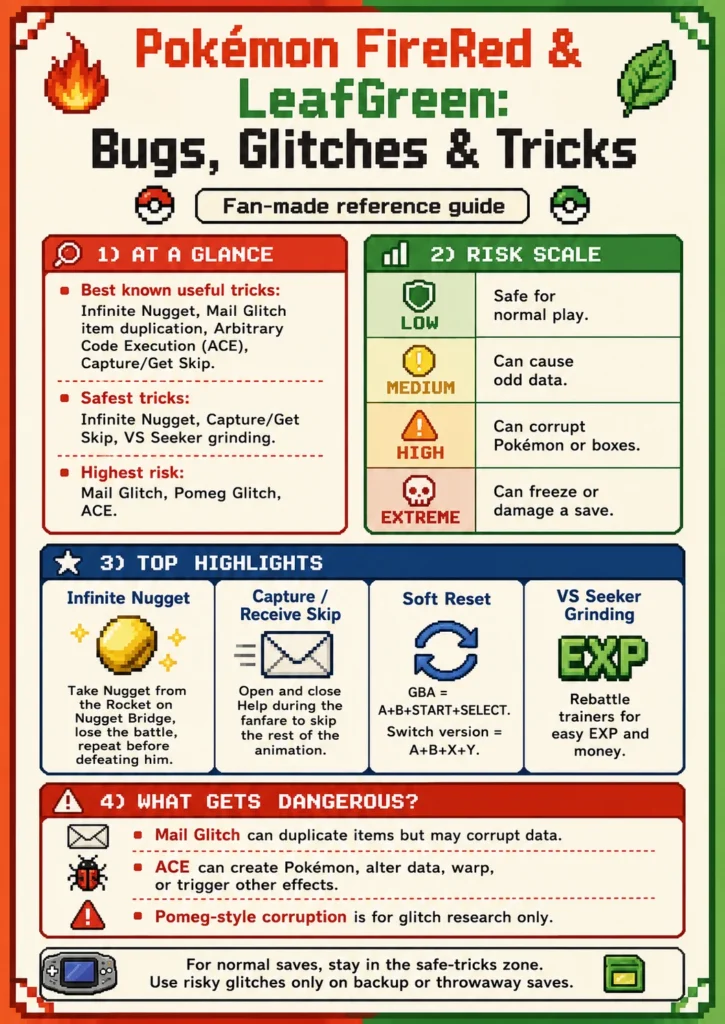
Pokémon FireRed and LeafGreen include useful tricks, harmless oddities, and dangerous glitches. Some methods are safe for normal play. For example, players can use the Infinite Nugget trick, the Capture or Receive Skip, Soft Resetting, and VS Seeker grinding. These techniques do not intentionally damage game data.
However, the risk rises with the Mail Glitch, item duplication, Pomeg-style corruption, and Arbitrary Code Execution. These advanced methods can change Pokémon, items, PC boxes, event flags, and other save data. As a result, even a small mistake may create Bad Eggs, freeze the game, or cause permanent data loss.
Therefore, players should use only low-risk techniques on a main save. In contrast, high-risk and extreme-risk glitches should be tested only on a backup or disposable save file.
Overall Risk: Mixed, ranging from Low to Extreme.
Useful Tricks & Safe Methods
Several techniques in FireRed and LeafGreen give players useful advantages without harming the save file.
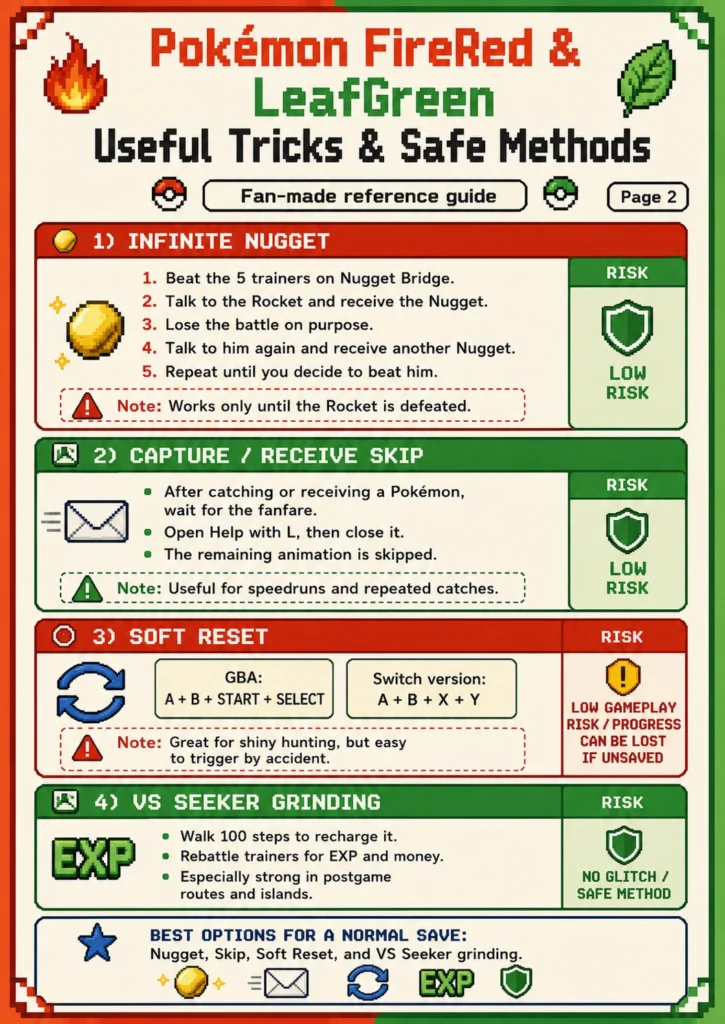
First, the Infinite Nugget trick lets the player collect more than one Nugget from the Team Rocket member at Nugget Bridge. After receiving the Nugget, the player loses the battle on purpose. Then, they return and speak to the Rocket member again. This process can continue until the player finally defeats him.
The Capture or Receive Skip is another useful technique. It shortens the fanfare that plays after obtaining a Pokémon. To use it, open and close the Help screen during the fanfare. As a result, the game may skip the rest of the animation. This makes the trick useful for speedruns and repeated captures.
Soft Resetting is also helpful. Players often use it for shiny hunting, Legendary Pokémon, and gift Pokémon. On the Game Boy Advance, press A + B + START + SELECT. On the Nintendo Switch version, press A + B + X + Y.
Finally, the VS Seeker is a normal game feature rather than a glitch. After walking 100 steps, the player can use it again. Therefore, certain trainers can be challenged repeatedly for experience points and money.
Risk: Low. However, an accidental reset can erase unsaved progress. Repeated battle losses may also cost money.
Mail Glitch, Item Duplication & ACE
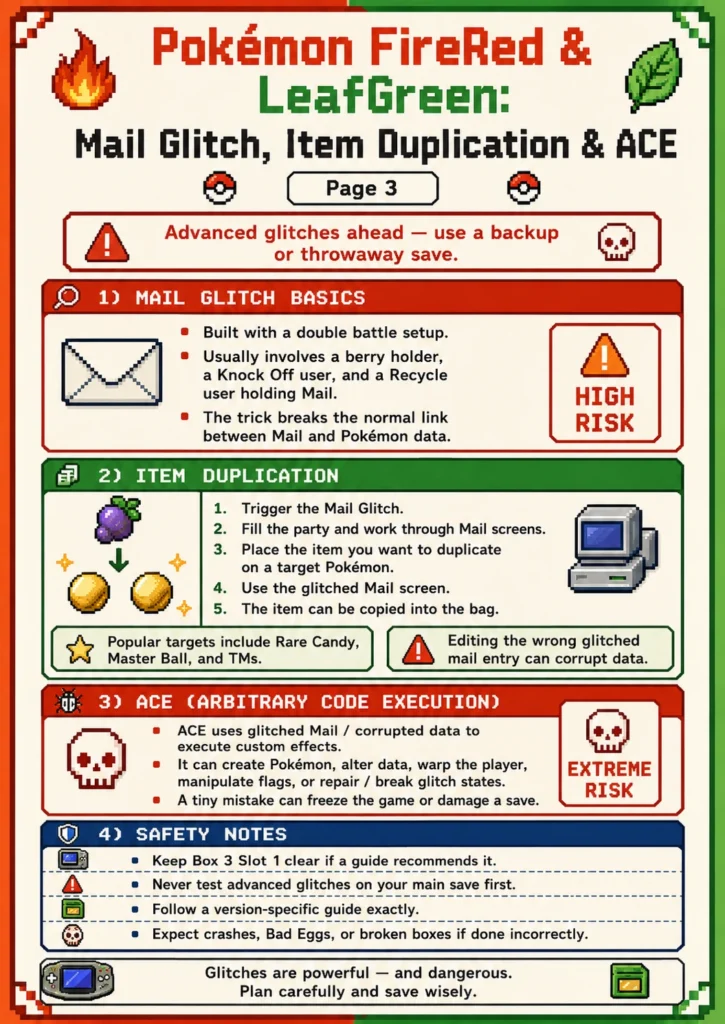
The Mail Glitch is powerful but dangerous. It uses a double battle, a consumed Berry, Knock Off, Recycle, and a Pokémon holding Mail. When it works, it breaks the link between the Pokémon and its Mail data.
Players can then use the broken Mail state to duplicate items. For example, they may copy Rare Candies, Master Balls, and TMs. However, the wrong Mail entry or Pokémon position can corrupt other data.
ACE, or Arbitrary Code Execution, is even riskier. It makes the game read altered save data as instructions. As a result, it can create Pokémon, change items, edit event flags, warp the player, or cause new corruption.
These methods require exact steps for the correct game version. One mistake can freeze the game, create Bad Eggs, corrupt PC boxes, or damage the save.
Risk: High for the Mail Glitch and item duplication. Extreme for ACE.
Other Known Glitches & Notes
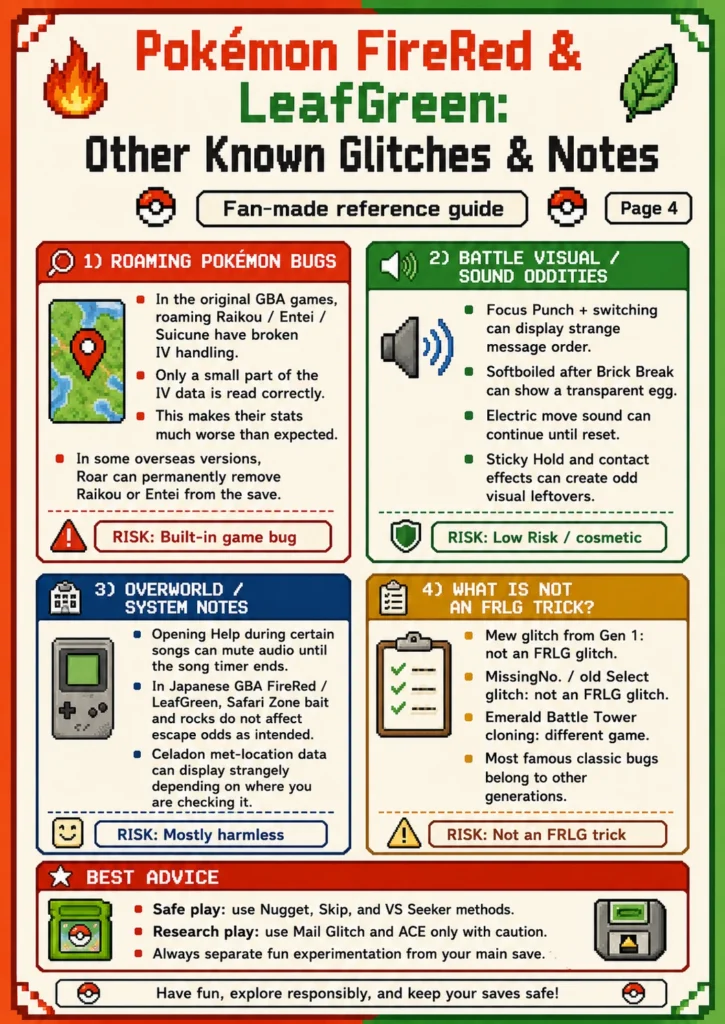
FireRed and LeafGreen include several built-in bugs and harmless visual oddities. First, the original Game Boy Advance versions handle roaming Raikou, Entei, and Suicune incorrectly. The game reads only part of their Individual Value data. As a result, these Pokémon often have much weaker stats than intended. In some overseas versions, the problem is even more serious. Raikou or Entei can disappear permanently after escaping with Roar.
Several battle glitches affect only graphics, sound, or message order. For example, using Focus Punch before switching can show messages in an unusual sequence. Also, Softboiled may briefly display a transparent egg after certain battle animations. In addition, some Electric-type move sounds can continue until the game resets. Meanwhile, Sticky Hold and item-stealing effects may leave visual remnants on the screen.
Other harmless issues appear outside battle. For instance, opening the Help screen during certain songs can temporarily mute the audio. In some Japanese versions, Safari Zone bait and rocks do not change escape rates as intended. Also, Pokémon obtained around Celadon City may show inconsistent met-location information.
However, many famous Pokémon glitches do not exist in FireRed and LeafGreen. The classic Mew Glitch, MissingNo., and early Select-button glitches belong to Generation I. Meanwhile, Battle Tower cloning belongs to Pokémon Emerald. Therefore, players should not expect those methods to work in FireRed or LeafGreen.
Risk: Most of these bugs are low-risk or cosmetic. However, the roaming Pokémon disappearance bug is more serious. It can make Raikou or Entei permanently unavailable.
Numbers Worth Knowing
Some FireRed and LeafGreen tricks are easier to understand when reduced to exact numbers. These figures show how much a technique can save, earn, or potentially damage.
| Number | What It Refers To | Why It Matters | Risk |
|---|---|---|---|
| 100 steps | VS Seeker recharge | The VS Seeker becomes usable again after walking exactly 100 steps. | None |
| 5,000 Pokédollars | Nugget selling price | Every duplicated or repeatedly obtained Nugget can be sold for 5,000 Pokédollars. | Low |
| 2.68 seconds | Capture or receive skip | On Switch, this skip saves about 2.68 seconds per use and roughly 1.5 minutes per full speedrun. | Low |
| 4 buttons | Soft Reset | The GBA combination is A + B + START + SELECT. The Switch combination is A + B + X + Y. Unsaved progress is immediately lost. | Low |
| 6 Pokémon | Question Mark Mail setup | The standard Mail Glitch workflow uses a full party of six Pokémon before the hidden Mail entry appears. | High |
| Box 3, Slot 1 | Mail Glitch data target | Question Mark Mail writes directly to this PC position. Keep it empty unless a guide specifically tells you to place a Pokémon there. | Extreme |
| 9 words | Glitched Mail fields | Question Mark Mail contains nine editable word fields, and each field can overwrite part of the data stored in Box 3, Slot 1. | Extreme |
| 8 IV-data bits | Roaming Pokémon IV bug | Only a small part of the roaming Pokémon’s IV data is preserved. HP can range from 0–31, Attack from 0–7, while Defense, Special Attack, Special Defense, and Speed are always 0. | Built-in bug |
| 30 Balls / 600 steps / 500 Pokédollars | FireRed and LeafGreen Safari Game | Each entry provides 30 Safari Balls and ends after 600 steps. In Japanese versions, bait and rocks affect the catch factor but not the flee chance as intended. | Low |
The Most Important Number
For advanced Mail Glitch or ACE tests, remember one key location: Box 3, Slot 1. Editing this slot by mistake can corrupt a Pokémon. It may also create unusable data.
For normal play, remember 100 steps. After walking 100 steps, the VS Seeker recharges. As a result, you can battle trainers again for more EXP and money.
FAQ — FireRed & LeafGreen Glitches and Tricks
Are these tricks safe to use on my main save?
The Infinite Nugget trick, Capture or Receive Skip, Soft Reset, and VS Seeker grinding are safe choices for a normal save. However, the Mail Glitch, item duplication, Pomeg-style corruption, and ACE carry much greater risks. Therefore, use those advanced methods only on a backup or disposable save file.
Can these glitches permanently damage the save file?
Yes. High-risk glitches can corrupt Pokémon, Mail entries, items, or PC boxes. Extreme-risk methods such as ACE may cause crashes, Bad Eggs, broken storage data, or a save that no longer works correctly.
Does the Infinite Nugget trick work forever?
No. It works only while the Team Rocket member at Nugget Bridge remains undefeated. Once the player defeats him, the repeated Nugget opportunity ends permanently.
Is VS Seeker grinding a glitch?
No. The VS Seeker is an intended game mechanic. It allows players to challenge certain trainers again after walking 100 steps to recharge it.
Does Soft Resetting damage the game?
Normally, no. A Soft Reset simply restarts the game. However, all progress made since the last save will be lost.
Can item duplication create unlimited Master Balls or Rare Candies?
The Mail Glitch may be used to duplicate held items, including valuable items. However, the process is dangerous and can corrupt data if the wrong Pokémon, Mail entry, or PC position is used.
What is Arbitrary Code Execution?
Arbitrary Code Execution, or ACE, makes the game interpret manipulated save data as instructions. It can produce powerful effects such as generating Pokémon, changing event flags, altering items, or warping the player.
Why is ACE considered extremely dangerous?
ACE requires exact data placement and version-specific instructions. A single mistake can execute the wrong effect, freeze the game, corrupt PC boxes, or permanently damage the save.
Are the roaming Pokémon bugs caused by the player?
No. The roaming Pokémon IV bug is built into the original game. In some versions, Raikou or Entei may also disappear permanently after using Roar.
Are MissingNo. and the classic Mew Glitch available in these games?
No. Those are primarily Generation I glitches. They do not work in FireRed and LeafGreen through the original methods.
What is the safest way to experiment?
Save first, avoid using an important file, and begin with low-risk techniques. Advanced corruption glitches should only be tested on a separate save that can be lost without consequence.
Explore the World of Pokémon Manga
Explore more stories, characters, and adventures from the world of Pokémon manga:
Official Sources
- Official Pokémon Game Page
General game information from The Pokémon Company. - Nintendo Switch FAQ
Official details about compatibility and features. - Official Pokémon Press Page
Release information and official media details.
Note: Official sources cover the games and platforms. Detailed glitch information mainly comes from technical testing and community research.