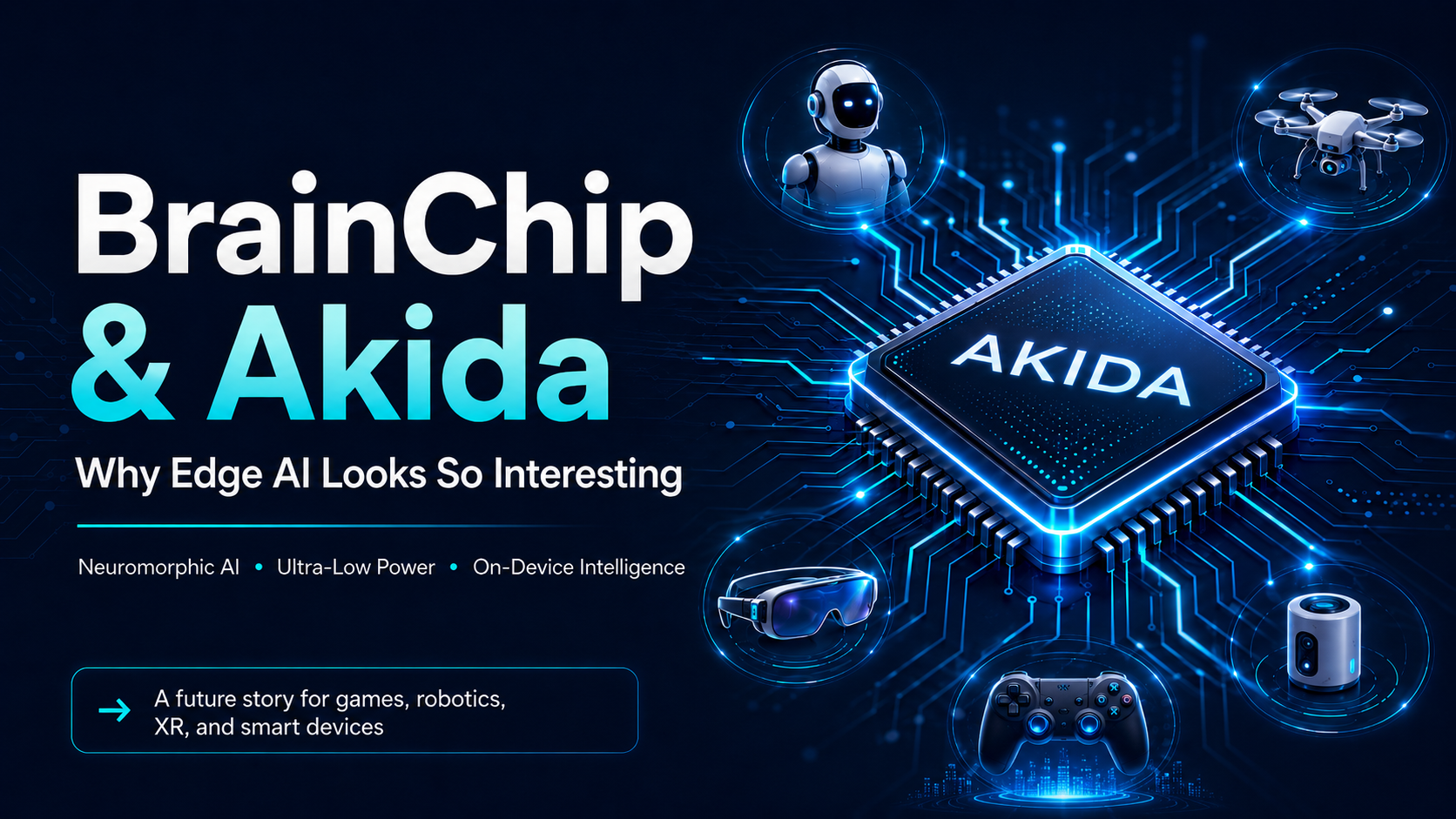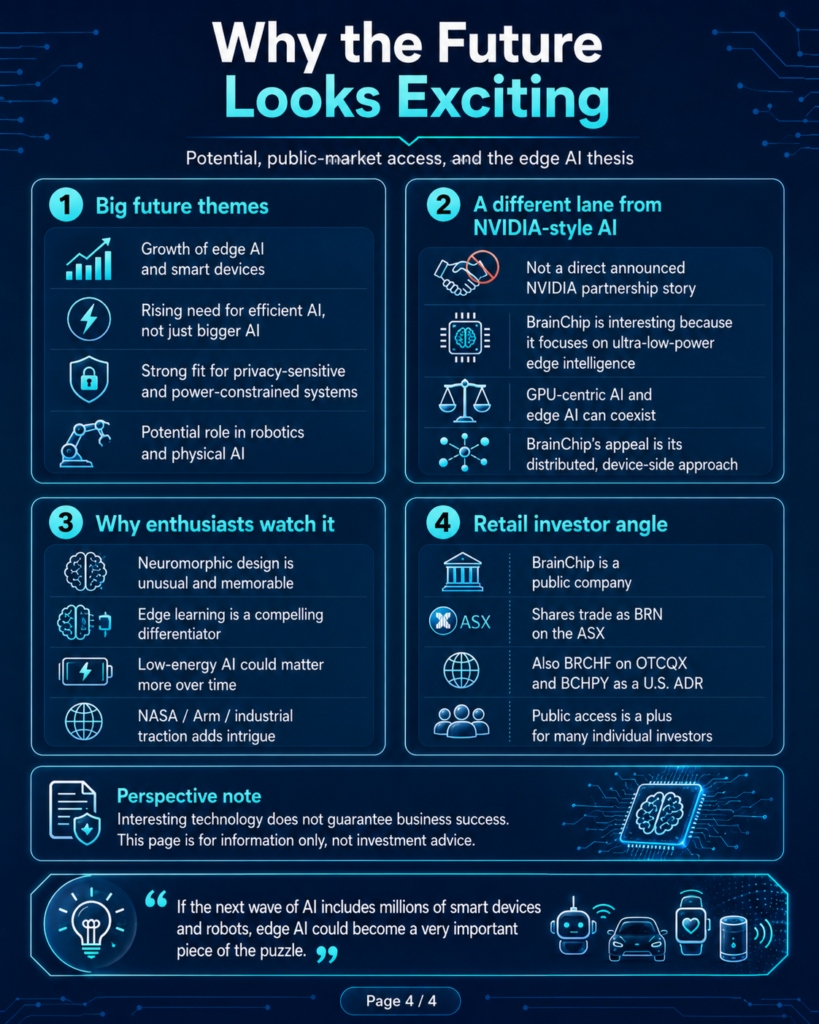
Akida Is Becoming More Than a Chip
BrainChip is not only building an AI chip story. Instead, its recent 2026 collaboration activity shows a broader ecosystem forming around Akida. This ecosystem covers software, IP licensing, SoC design, edge devices, autonomy, robotics, and defense-related sensing.
As a result, the key point is simple: BrainChip is trying to make Akida easier to deploy, easier to integrate, and more relevant for real-world edge AI applications.
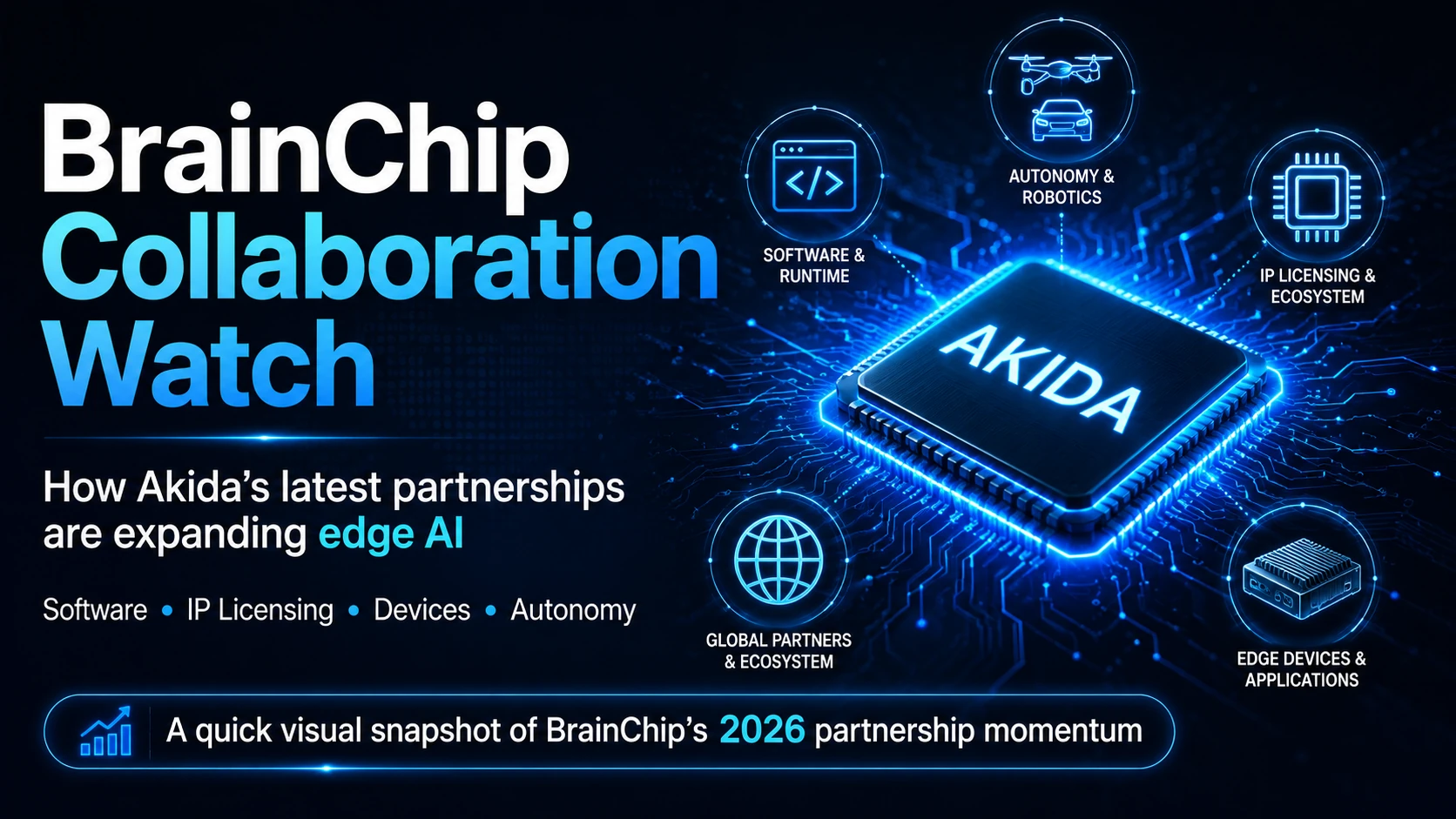
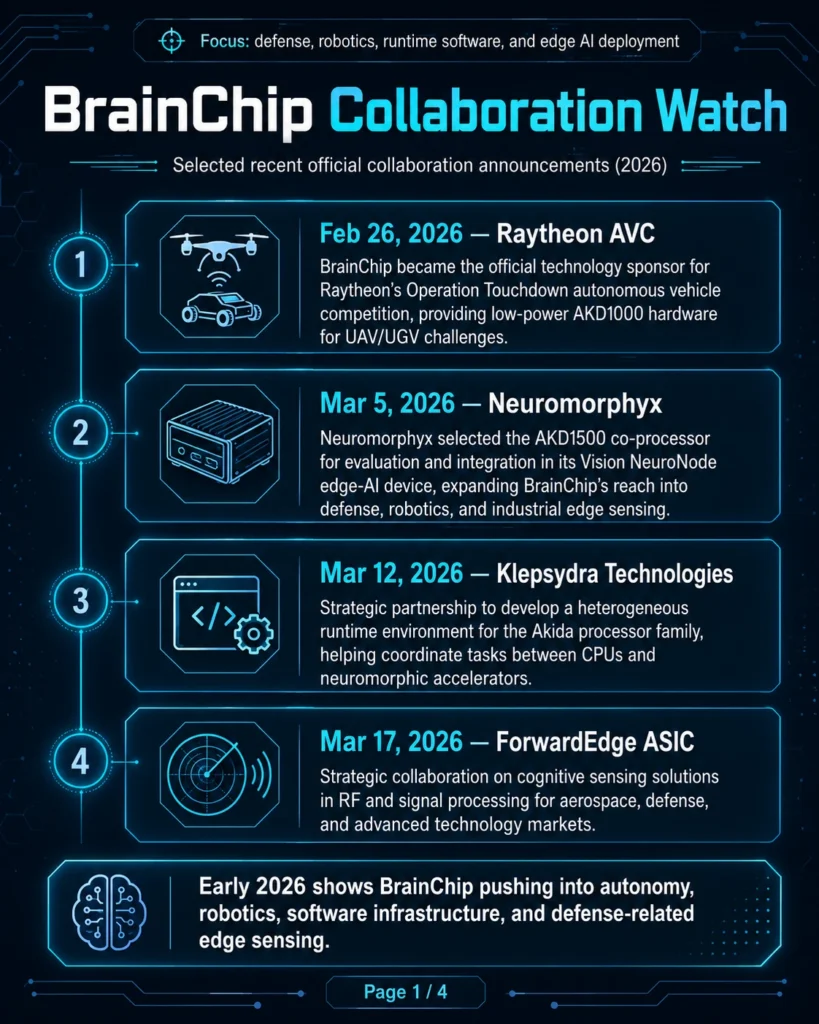
2026 Collaboration Snapshot
The latest collaboration wave includes several notable directions:
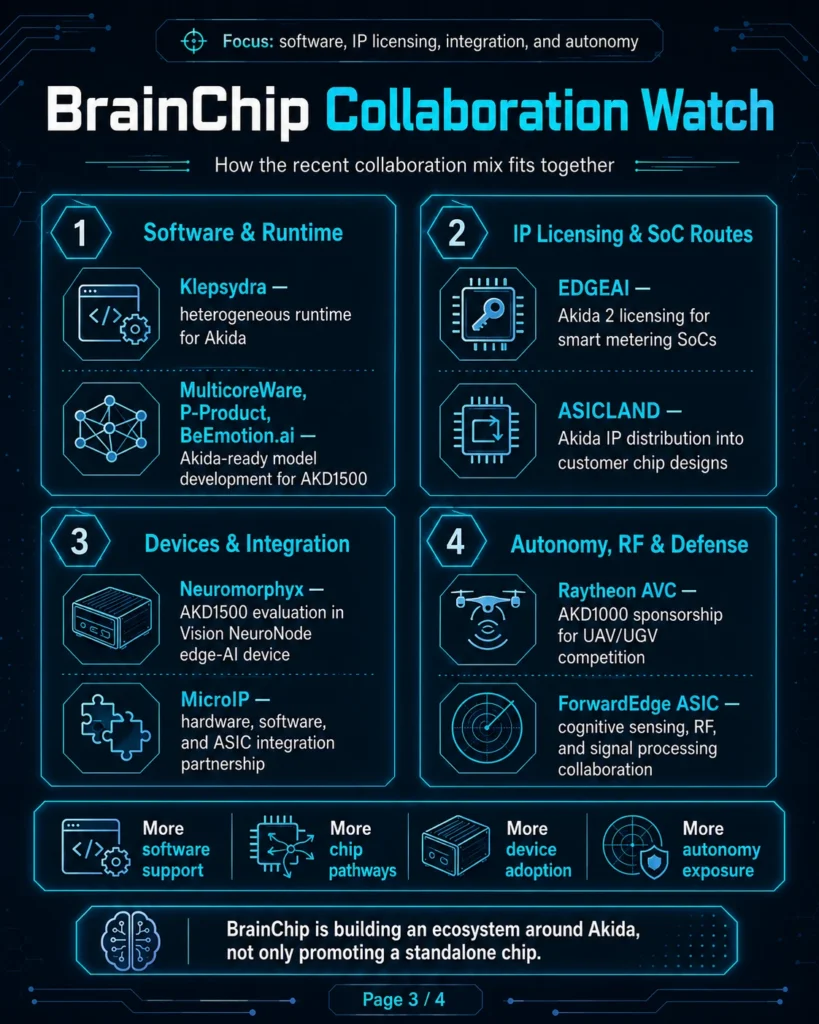
- Raytheon AVC: AKD1000 hardware for UAV / UGV autonomous vehicle challenges
- Neuromorphyx: AKD1500 evaluation for the Vision NeuroNode edge-AI device
- Klepsydra Technologies: heterogeneous runtime software for Akida processors
- ForwardEdge ASIC: cognitive sensing, RF, and signal-processing collaboration
- EDGEAI: Akida 2 IP licensing for smart metering SoCs
- Software partners: MulticoreWare, P-Product, and BeEmotion.ai for AKD1500 model development
- ASICLAND: Akida IP distribution into customer chip designs
- MicroIP: hardware, software, ASIC design, and electronics integration partnership
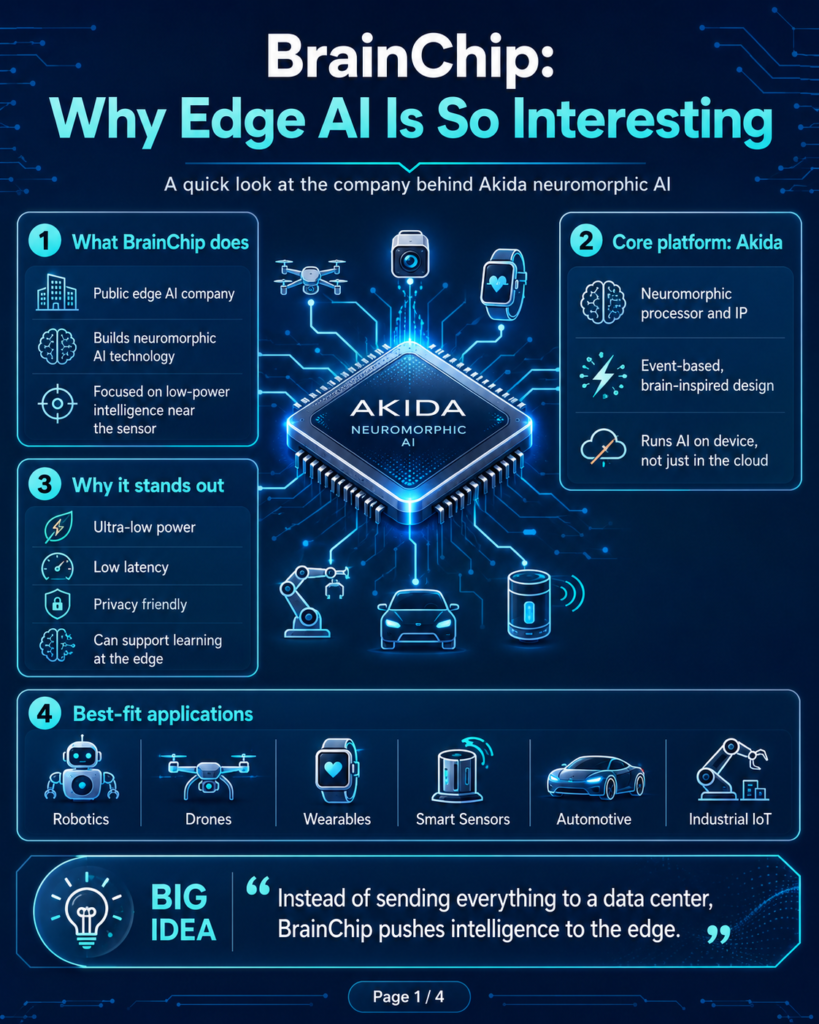
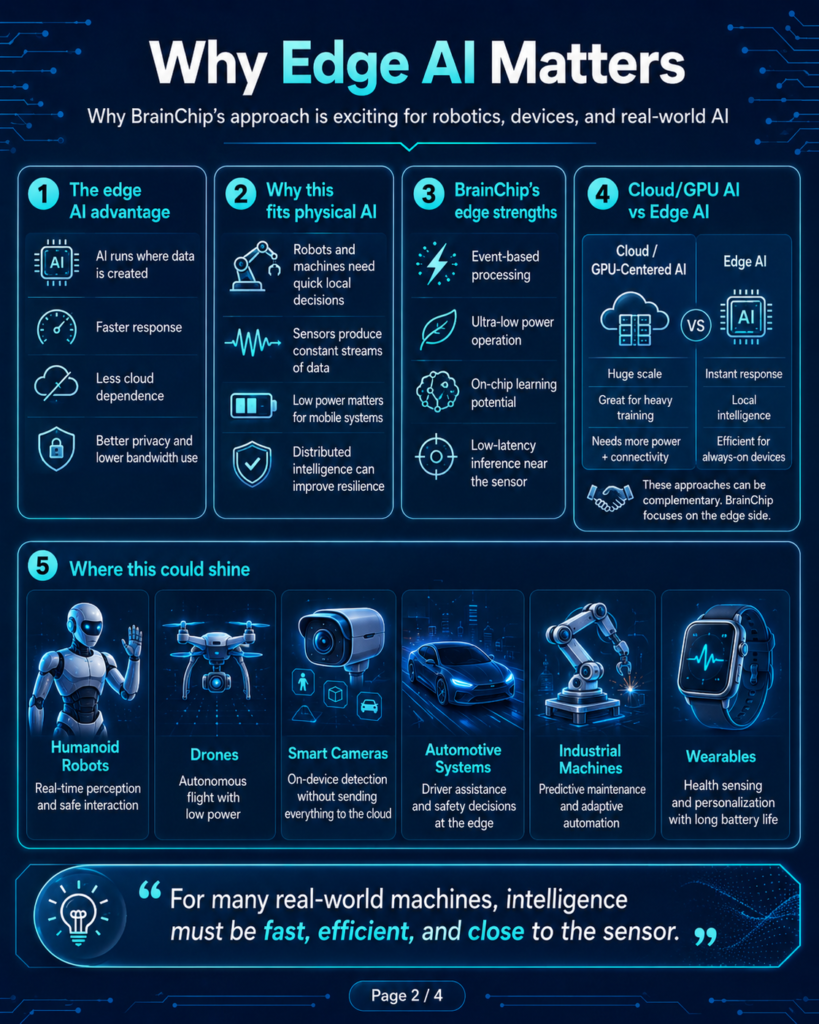
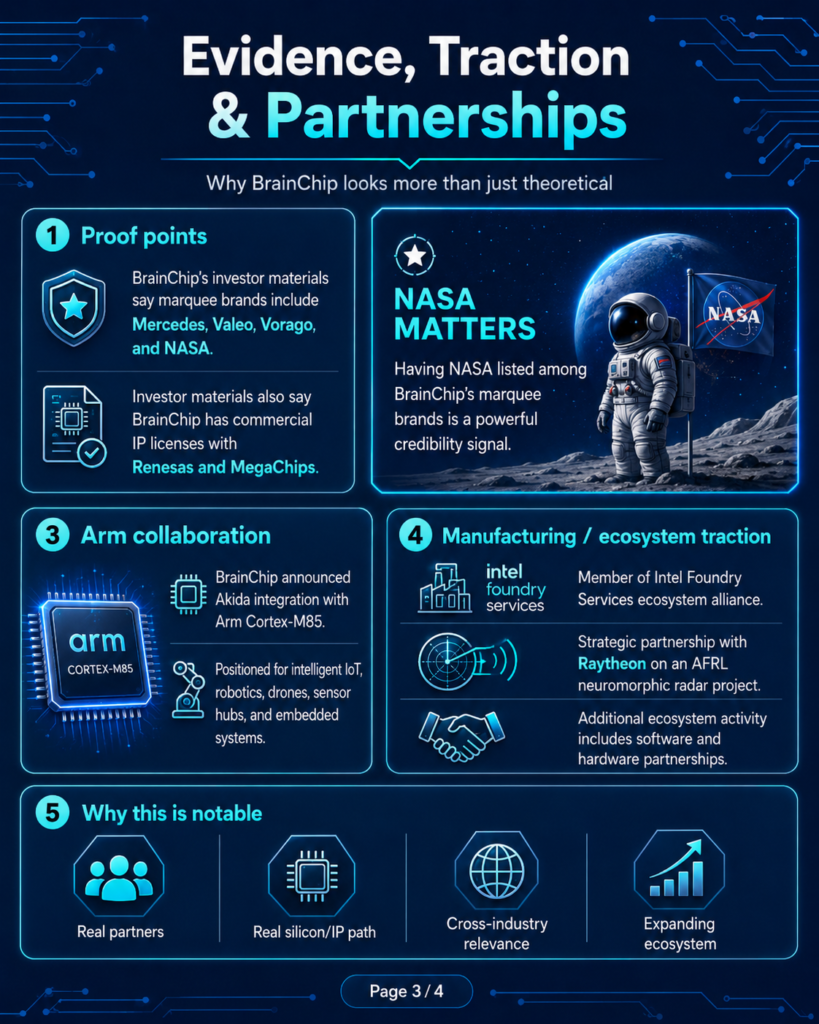
What the Images Show
The images summarize BrainChip’s recent partner activity across four themes:
- software and runtime support
- IP licensing and SoC routes
- device integration and edge deployment
- autonomy, robotics, RF, and defense-related sensing
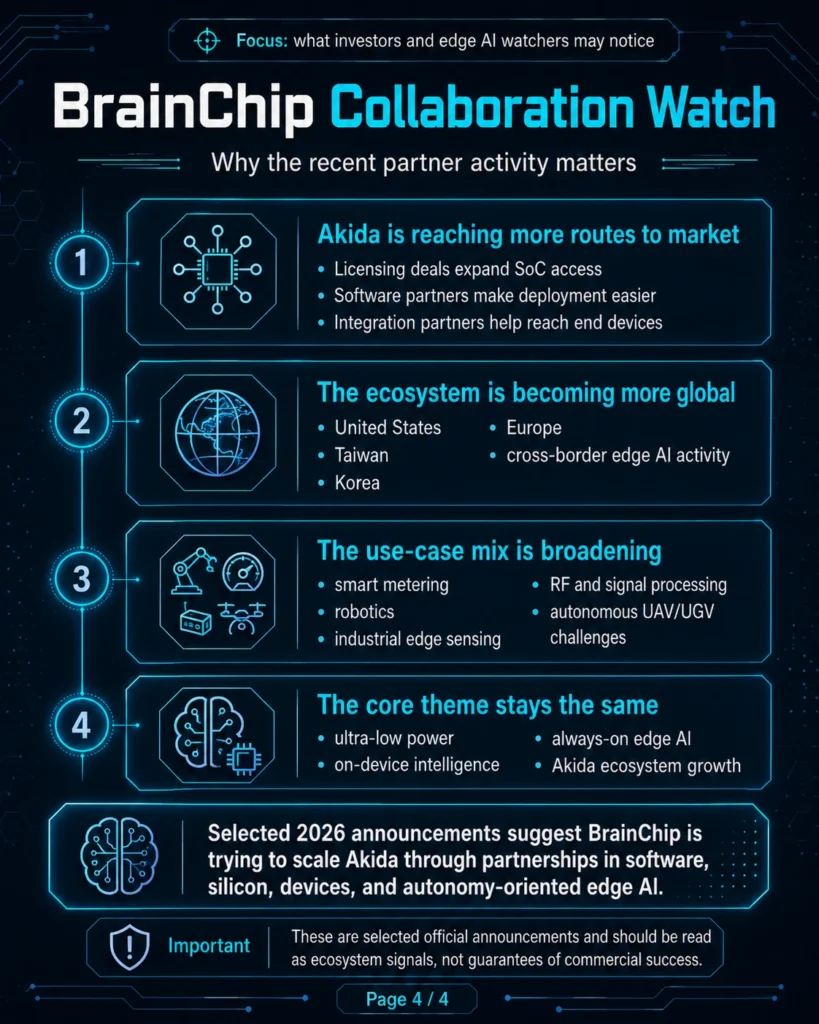
This matters because edge AI is not a single-market opportunity. For example, it can appear in smart meters, robots, drones, industrial sensors, automotive systems, aerospace applications, wearables, smart cameras, and future XR devices. As a result, the market may need many specialized solutions rather than one universal platform.
Why This Ecosystem Approach Matters
In addition, BrainChip’s collaboration activity matters because edge AI is not only about raw chip performance. It is also about deployment, software support, licensing routes, and real-world integration.
For example, a company may have strong AI hardware, but customers still need tools, models, runtime support, and SoC design paths before that technology can reach actual devices. Because of this, partnerships can become an important part of the edge AI story.
At the same time, edge AI use cases are very different from one another. Smart meters, drones, industrial sensors, robots, and XR devices do not all need the same solution. As a result, the market may reward companies that can adapt their technology across many environments.
However, this does not mean BrainChip is guaranteed to win. The field is competitive, and larger companies are also active in AI hardware. Still, BrainChip’s recent updates suggest that Akida is gaining more routes into software, silicon, devices, and autonomy-focused edge AI.
Overall, this is why the collaboration map is worth watching.
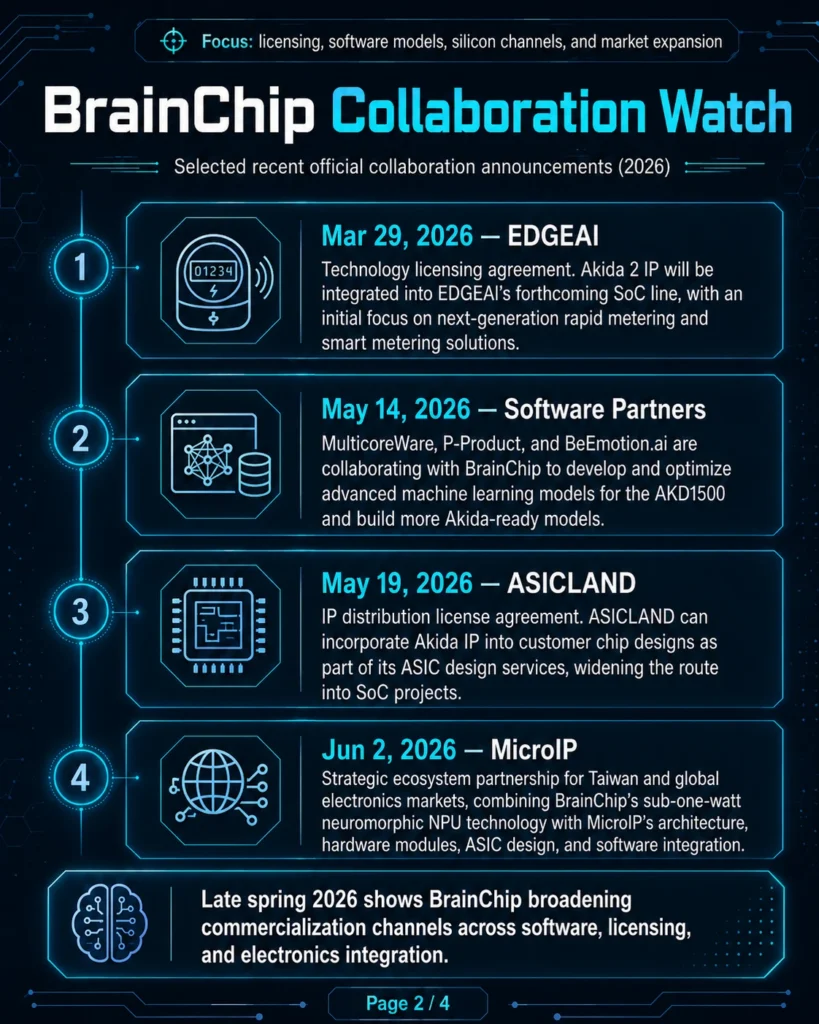
Learn More About BrainChip and Akida
For a broader overview of BrainChip, Akida, NASA-related credibility signals, Arm integration, and why edge AI matters for robotics, XR, and smart devices, see my earlier visual guide.
In addition, this guide gives more context for the bigger edge AI thesis behind this article:
BrainChip Akida: The Edge AI Future for Robotics, XR, and Smart Devices
My Take
BrainChip is interesting because Akida fits a future where AI is not only centralized in cloud data centers. It can also be distributed across machines, sensors, robots, devices, and embedded systems.
In addition, edge AI may not become a winner-takes-all market. Different regions, industries, regulations, devices, and use cases will need different kinds of optimization. As a result, multiple solutions can grow if they meet the required standards for power efficiency, latency, reliability, and integration.
Although BrainChip is still a small company in a competitive field, its recent collaborations suggest that Akida is moving beyond a standalone chip narrative. Instead, the company is building routes toward software support, silicon licensing, device adoption, and real-world edge AI applications.
This does not guarantee commercial success. However, for people interested in edge AI, robotics, XR, physical AI, and on-device intelligence, BrainChip is worth watching.
Sources / References
BrainChip – Official Technology Sponsor for Raytheon’s Operation Touchdown Autonomous Vehicle Competition
https://brainchip.com/brainchip-named-official-technology-sponsor-for-raytheons-operation-touchdown-autonomous-vehicle-competition/
BrainChip – Neuromorphyx Strategic Customer and Go-to-Market Partner for AKD1500
https://brainchip.com/brainchip-announces-neuromorphyx-as-strategic-customer-and-go-to-market-partner-for-akd1500-neuromorphic-processor/
BrainChip – Klepsydra Technologies Strategic Partnership for Akida Runtime
https://brainchip.com/klepsydra-technologies-and-brainchip-announce-strategic-partnership-to-deliver-heterogeneous-ai-runtime-for-akida-neuromorphic-processors/
BrainChip – ForwardEdge ASIC Strategic Collaboration
https://brainchip.com/forwardedge-asic-selects-brainchips-neuromorphic-computing-for-future-asics/
BrainChip – EDGEAI Akida 2 License for Smart Metering
https://brainchip.com/edgeai-to-revolutionize-smart-metering-with-brainchip-akida-2-license/
BrainChip – Strategic Software Partners for AKD1500
https://brainchip.com/brainchip-expands-ai-ecosystem-with-strategic-software-partners/
BrainChip – ASICLAND IP Licensing Deal
https://brainchip.com/brainchip-strikes-ip-licensing-deal-with-asicland/
BrainChip – MicroIP Strategic Ecosystem Partnership
https://brainchip.com/microip-and-brainchip-announce-strategic-ecosystem-partnership-to-deliver-advanced-edge-ai-hardware-and-software/
Disclaimer
This article is for informational and educational purposes only. It is not financial advice, investment advice, or a recommendation to buy or sell any security.