BrainChip and the Edge AI Thesis: Why Akida Looks Interesting
2026年6月14日
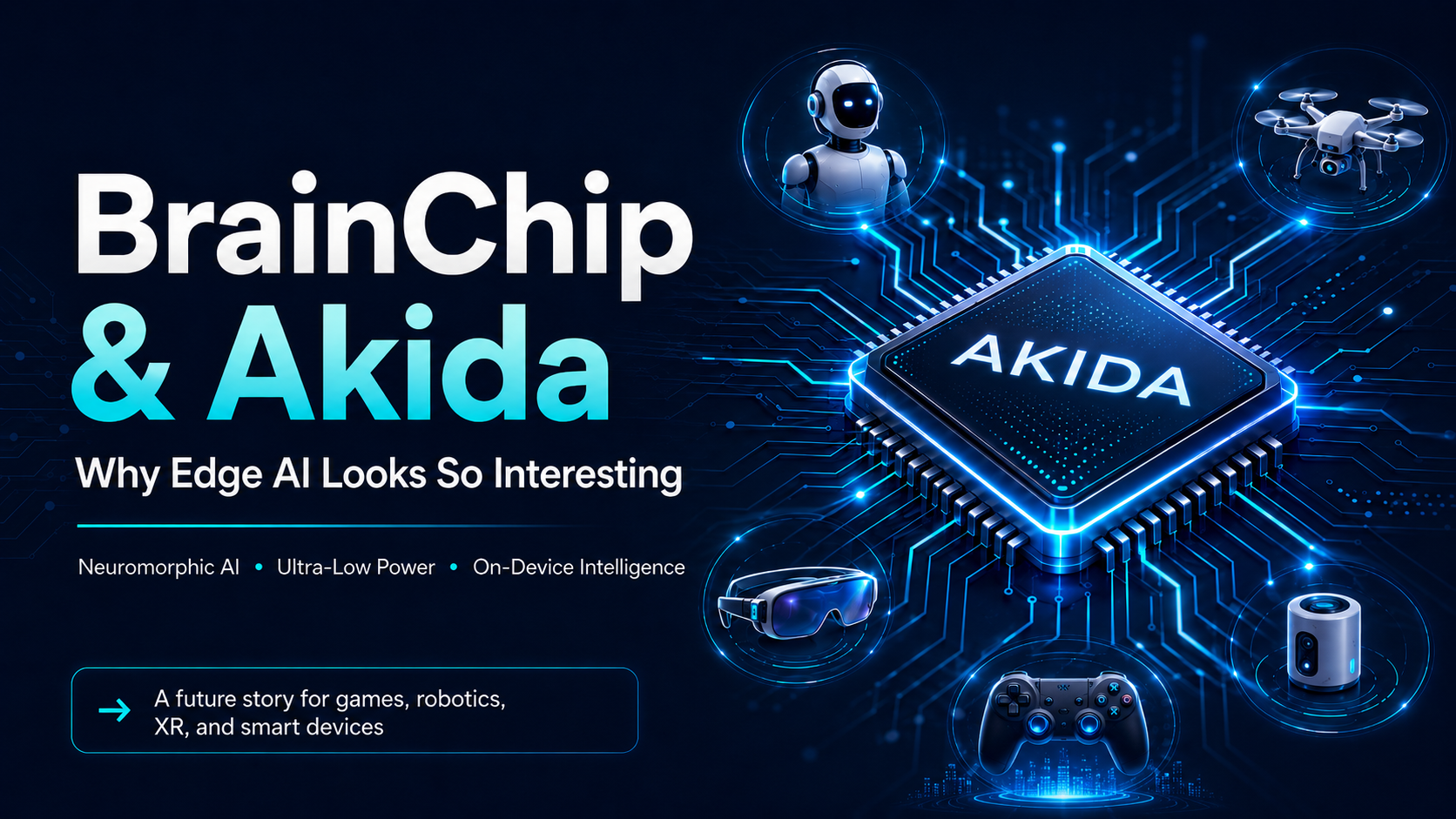
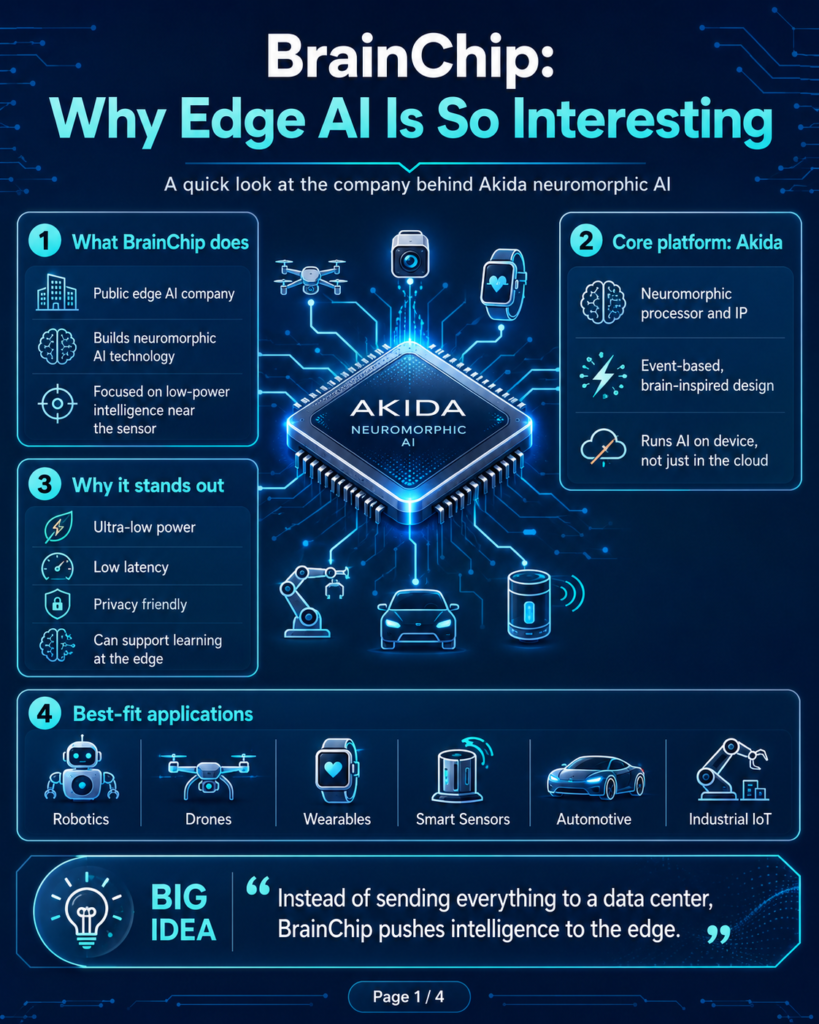
BrainChip is one of the more unusual companies in the edge AI space. Its Akida platform is built around neuromorphic, event-based AI processing — a design philosophy inspired by the brain and focused on low-power, low-latency intelligence near the sensor.
That matters because the next wave of AI may not live only inside giant cloud data centers. Robots, drones, cars, wearables, smart cameras, and industrial machines all need fast local decisions. For that kind of world, edge AI could become a critical part of the technology stack.
An Illustrated Guide to BrainChip
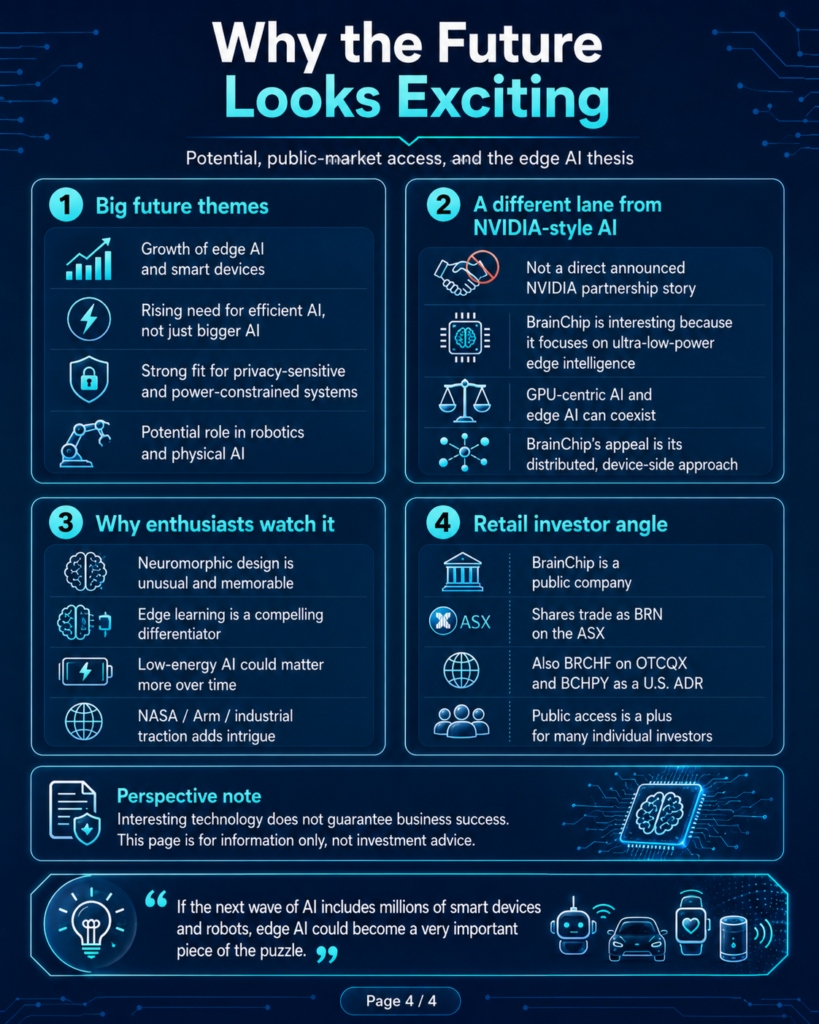
Main Article Summary
The core reason BrainChip is interesting is simple: not every AI workload belongs in the cloud.
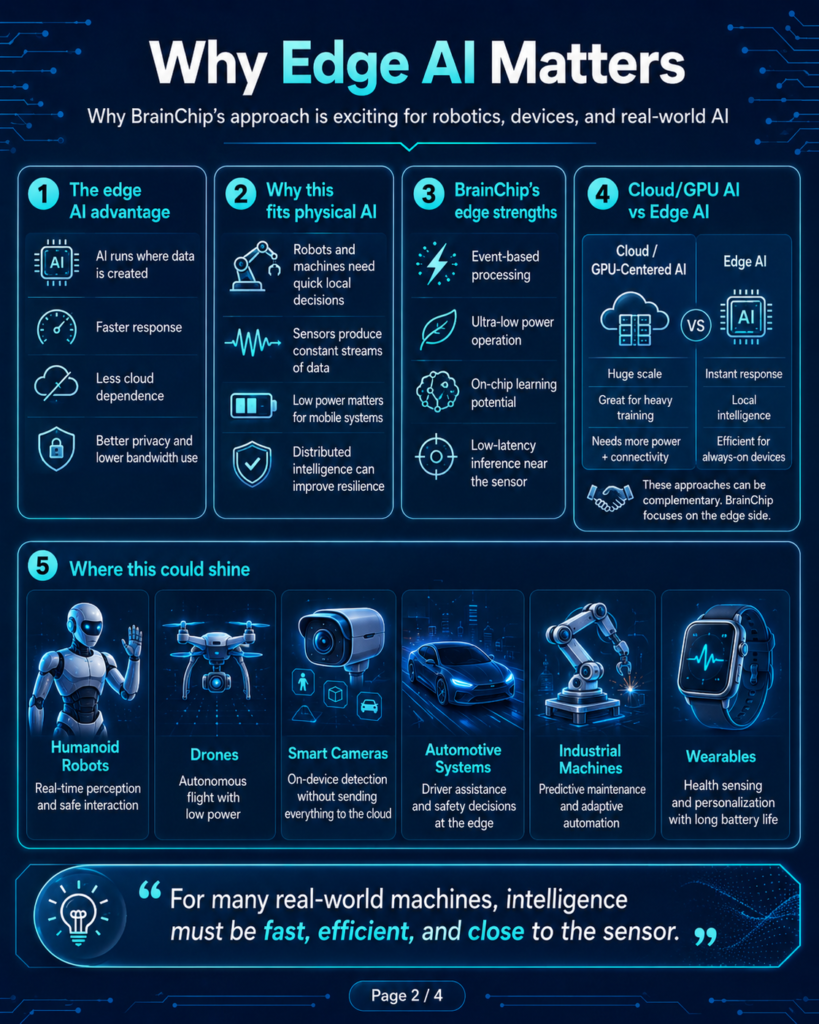
Cloud and GPU-centered AI are powerful for large-scale model training, massive inference workloads, and centralized compute. But physical AI — robots, drones, vehicles, smart sensors, wearables, and industrial machines — often needs intelligence close to where data is created.
That is where edge AI becomes important. Local AI can reduce response time, reduce bandwidth use, improve privacy, and allow devices to keep working even when cloud connectivity is limited.
BrainChip’s Akida platform is designed for this edge-first world. The company positions Akida as a neuromorphic, event-based AI processor and IP platform focused on low-power inference and on-chip learning near the sensor.
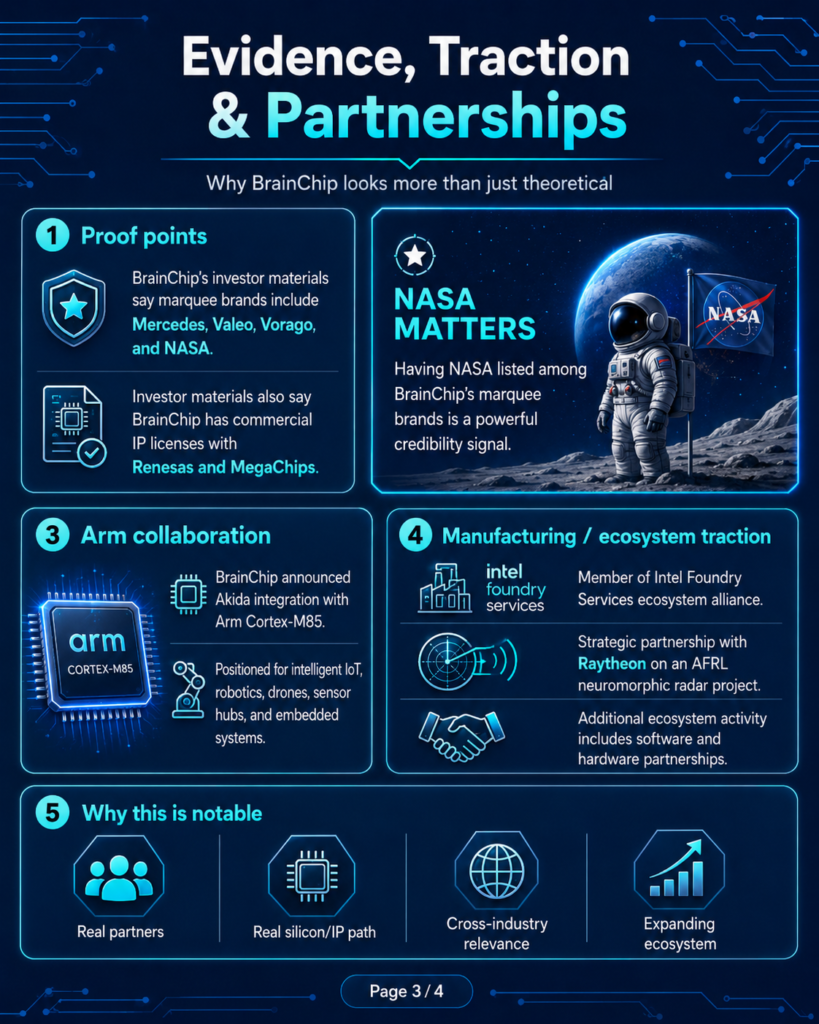
The traction is also part of the story. BrainChip has announced Akida integration with Arm Cortex-M85, participation in the Intel Foundry Services ecosystem alliance, and involvement with Raytheon on an Air Force Research Laboratory neuromorphic radar project.
NVIDIA Note
One important clarification: this is not a “BrainChip has an NVIDIA partnership” story.
The more useful framing is that BrainChip sits in a different lane. NVIDIA-style GPU AI is powerful for centralized, high-performance AI workloads. BrainChip’s appeal is its focus on ultra-low-power edge intelligence, where devices need fast local decisions.
These two approaches can coexist.
My Perspective: Why BrainChip Feels Ahead of Its Time
BrainChip’s Akida is interesting because it points toward a future where AI is not only centralized in data centers, but distributed across robots, devices, sensors, vehicles, wearables, and XR experiences.
Physical AI needs local intelligence. Real-world machines must be able to sense, decide, and act even when the cloud is not available.
That is why edge AI matters — and why Akida feels like a technology worth watching.
A Small Game Industry Angle
Although BrainChip is not primarily a game company, its edge AI direction could also matter for the future of games and digital entertainment.
As games evolve toward XR, AR, spatial computing, AI characters, smart devices, and real-world interactive experiences, more intelligence may need to run locally on devices. Low-power, low-latency, on-device AI could help future games respond faster, feel more personal, and blend more naturally with the physical world.
That is another reason BrainChip is interesting to watch. Akida is not only an edge AI story for sensors, robotics, automotive, and industrial systems — it may also connect to the long-term future of interactive entertainment.
Future Expectations and How to Follow Up
BrainChip is not guaranteed to become a major winner, and interesting technology does not automatically become a successful business. But as an edge AI story, it is genuinely unusual.
If the future of AI includes millions of smart devices, robots, cars, sensors, and machines making decisions locally, then low-power neuromorphic edge AI is a field worth watching.
Sources / References
BrainChip – Akida Neuromorphic Processor / IP
https://brainchip.com/technology/
BrainChip – Akida Integration with Arm Cortex-M85
https://brainchip.com/brainchip-integrates-akida-with-arm-cortex-m85-processor-unlocking-ai-capabilities-for-edge-devices/
BrainChip – Intel Foundry Services Ecosystem Alliance
https://brainchip.com/brainchip-joins-intel-foundry-services-to-advance-neuromorphic-ai-at-the-edge/
BrainChip & Raytheon – Neuromorphic Radar Project
https://brainchip.com/brainchip-and-raytheon-form-strategic-partnership-on-afrl-neuromorphic-radar-project/
NASA TechPort – Project 103038
Official NASA TechPort project record related to BrainChip / Akida technology.
https://techport.nasa.gov/projects/103038
ClickAIXR: On-Device Multimodal Vision-Language Interaction with Real-World Objects in Extended Reality
arXiv:2604.04905
A 2026 research paper about on-device AI for XR interaction with real-world objects. Useful as a source for the idea that future XR, AR, and real-world interactive entertainment may require local, privacy-preserving, low-latency AI.
https://arxiv.org/abs/2604.04905
Disclaimer
This article is for informational and educational purposes only. It is not financial advice, investment advice, or a recommendation to buy or sell any security. Always do your own research.