Prologue
The Door Was Open
Leon knew something was wrong before he reached the hill.
The grass remembered the path.
The stones remembered his boots.
Even the wind seemed familiar.
Months had passed since his first descent beneath the village, but he could still picture the dungeon as clearly as if he had left it yesterday.
The entrance corridor.
The room with four pillars.
The hidden passage.
The trapped chest.
The iron gate.
The staircase they had refused to descend.
The chapel.
The thing in chains.
He knew where the walls bent.
He knew where the floor betrayed careless feet.
He knew which rooms were empty and which ones only pretended to be.
For the first time in his life, Leon approached a dungeon without fear.
That should have frightened him.
It did not.
Not yet.
Garrick walked several steps behind, carrying the same weathered satchel and wearing the same ash-gray cloak.
“You’re smiling,” the old adventurer said.
Leon glanced back.
“I know this place now.”
Garrick did not return the smile.
“That is usually when a dungeon becomes dangerous.”
Leon laughed.
Then they reached the door.
And stopped.
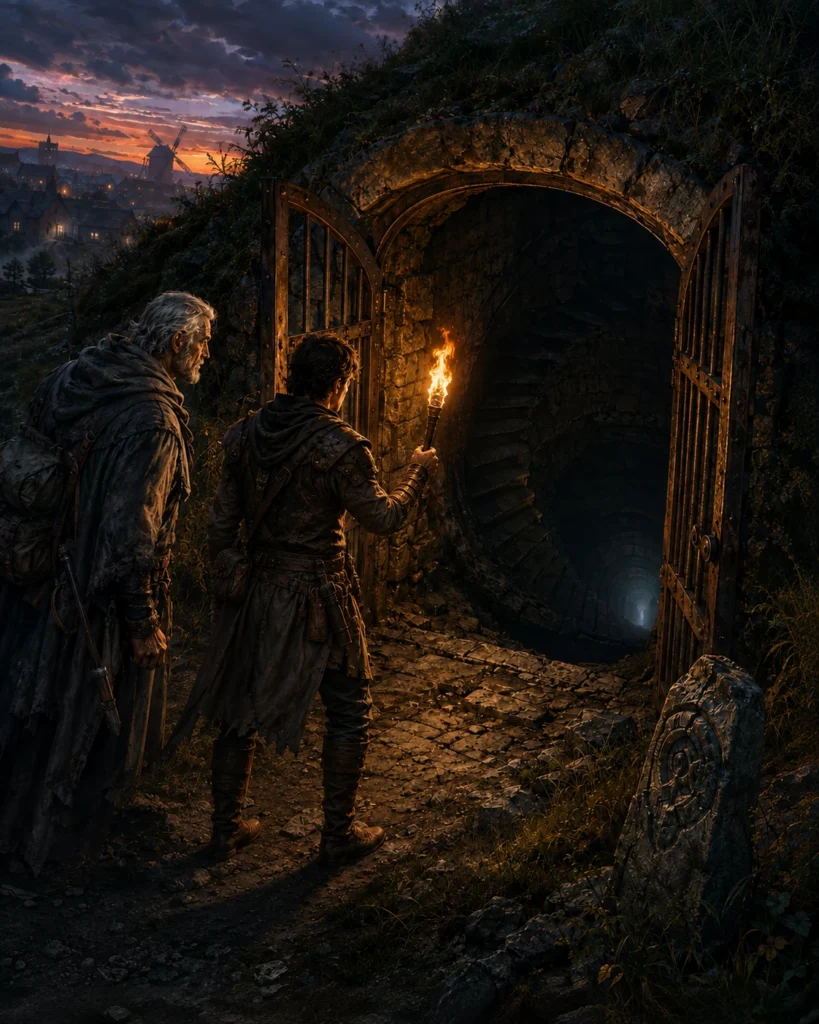
The iron-bound door beneath the hill—the door Leon remembered pulling open with both hands—was already standing wide.
Beyond it was darkness.
Not the darkness he remembered.
A different darkness.
The entrance corridor was gone.
In its place descended a spiral staircase.
Leon stared into it.
“That wasn’t there.”
“No,” Garrick said.
Leon looked at the stone around the doorway.
Same hill.
Same iron frame.
Same scratches.
Same broken marker beside the path.
But beyond the threshold was somewhere else.
Leon slowly lowered his torch.
“That’s impossible.”
Garrick stepped beside him.
“No,” he said quietly.
“Impossible would be comforting.”
Leon turned.
Garrick was staring into the staircase.
“This,” the old man said, “is worse.”
Chapter One
The Map That Lied
1. Confidence Is a Dangerous Torch
Leon entered first.
That alone was new.
Months ago, Garrick had always walked ahead when danger seemed uncertain.
Now Leon descended the spiral staircase with his sword loose in its sheath and his torch held high.
Twenty steps.
Thirty.
Forty.
The staircase should have reached the old entrance level long ago.
Instead it kept descending.
Leon counted to seventy-three before his boots finally touched a flat stone floor.
Ahead lay a corridor.
Three doors opened from it.
None existed on his old map.
Leon took out a folded sheet of parchment anyway.
Garrick watched.
“You brought it.”
“Of course.”
Leon unfolded the map of their first expedition.
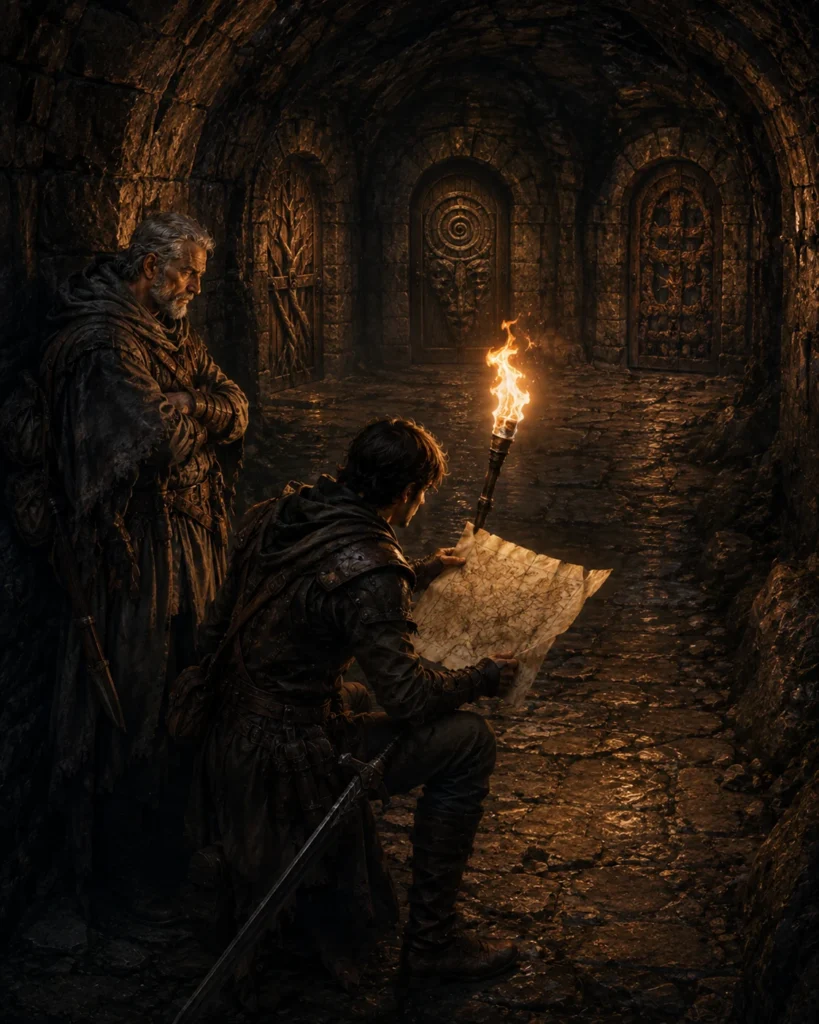
Lines.
Rooms.
Crosses.
Notes.
A circle marking the chapel.
A skull marking the chained creature.
The careful geometry of knowledge.
Leon had treasured the map because it proved something.
The dungeon had once been mysterious.
Then it had become understandable.
Now the map looked almost ridiculous.
He turned it sideways.
Then upside down.
Nothing matched.
Garrick leaned against the wall.
“How does it feel?”
Leon did not answer.
“I know that expression,” Garrick continued.
“What expression?”
“The one people wear when reality refuses to respect their preparation.”
Leon folded the map.
“I don’t like it.”
“Good.”
Leon glared at him.
Garrick smiled.
“You learned how to read a dungeon. Now you must learn something harder.”
“What?”
“How to stop believing yesterday’s answer.”
2. The First Rule Had Changed
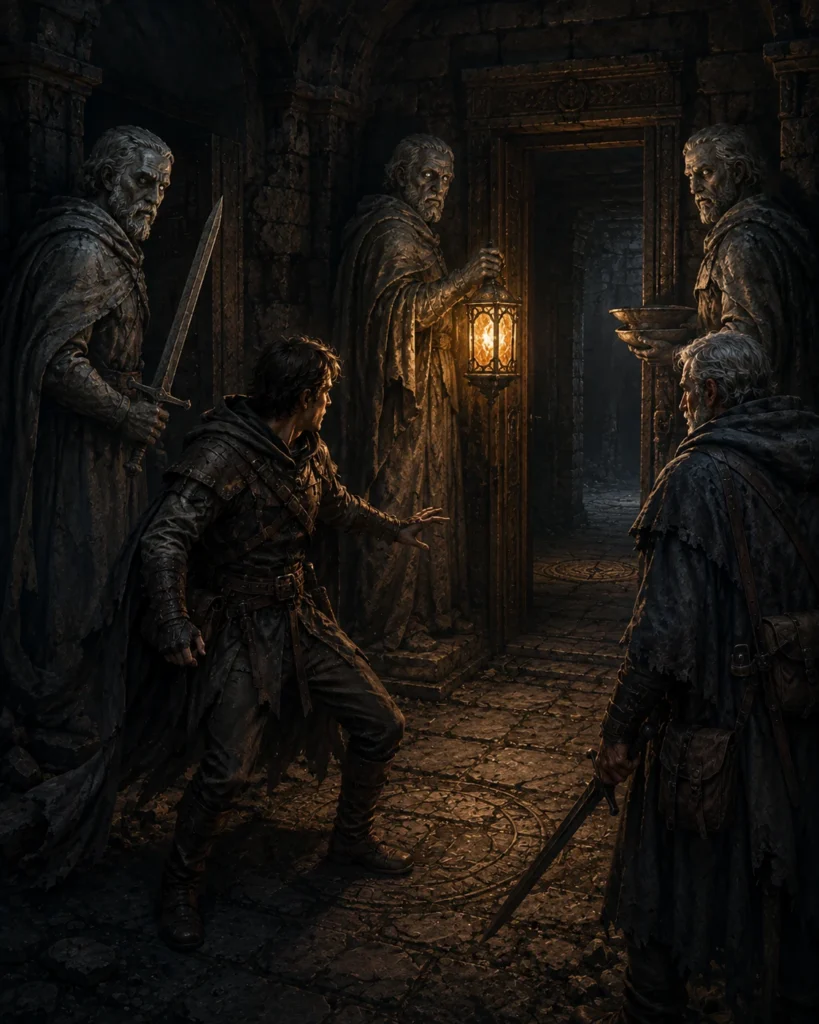
The left door led to a narrow chamber containing three stone statues.
Leon immediately stopped.
Statues meant mechanisms.
Sometimes switches.
Sometimes traps.
Sometimes enemies pretending not to be enemies.
He circled the room slowly.
No unusual floor tiles.
No holes in the walls.
No obvious pressure plates.
The statues faced north.
One held a sword.
One held a lantern.
One held an empty bowl.
Leon examined the bowl.
Nothing.
He rotated the lantern-bearing statue.
Nothing.
He pressed the sword.
Nothing.
Garrick remained by the doorway.
Leon frowned.
“This room wants me to do something.”
“Does it?”
“There are three statues.”
“That is true.”
“Why would someone put them here?”
Garrick said nothing.
Leon tried every mechanism he could imagine.
After several minutes, frustrated, he stepped toward the far door.
The instant his hand touched the handle—
the statues turned their heads.
Leon froze.
All three stone faces were looking directly at him.
Then the lantern statue spoke.
“You have been here before.”
Leon stumbled backward.
Garrick drew his sword.
The stone mouth moved again.
“You looked beneath the fourth pillar.”
Leon felt cold.
That had happened months ago.
In another room.
Another version of the dungeon.
The statue continued.
“You avoided the smiling mouth.”
The trapped chest.
“You opened the western wall.”
The chapel.
“You fled from the chained guardian.”
Leon whispered:
“It remembers us.”
The lantern in the statue’s hand ignited.
A new door appeared behind it.
Garrick looked at Leon.
“Apparently,” he said, “you made an impression.”
Chapter Two
A Dungeon That Watches
1. The Second Visit Is Never the First
Beyond the hidden door lay a corridor paved with black stone.
Leon moved more cautiously now.
Not because he knew less.
Because he knew the dungeon knew more.
That changed everything.
During his first expedition, the dungeon had been an object.
A structure.
A puzzle.
Something to observe.
Now Leon felt observed in return.
At the next intersection, he chose left.
A familiar habit.
He almost always chose left first.
The passage ended in a trap.
A wall slammed down behind them.
Garrick jumped forward.
Three spears shot from the right wall.
They missed Leon by inches.
He stared at the holes.
Garrick looked back at the sealed wall.
“You always go left.”
Leon said nothing.
The old man raised an eyebrow.
“Coincidence?”
Leon looked at the spear holes again.
“No.”
They escaped through a ceiling hatch and climbed into another corridor.
At the next intersection, Leon stopped.
Left.
Right.
Straight.
He felt the dungeon waiting.
Garrick stood behind him.
“Well?”
Leon smiled faintly.
Then he turned around and walked backward through the corridor they had just entered.
A section of wall opened behind them.
Garrick laughed.
“There you are.”
“What?”
“Thinking again.”
2. Patterns Are Useful Until They Become Prisons
For the next hour, Leon deliberately broke his habits.
He stopped checking every left wall.
He ignored one obvious chest.
He opened a door before searching for traps—after examining the ceiling first.
He walked past an intersection, doubled back, then took the center route.
At first it felt foolish.
Then something strange happened.
The dungeon became uncertain.
The traps grew less precise.
Enemies waited in rooms Leon never entered.
One corridor contained an ambush positioned perfectly to attack someone approaching from the west.
Leon entered from the east.
The creatures never saw him coming.
Later, they found a pressure plate placed exactly where Leon would normally step while inspecting a door.
He noticed it only because he had begun standing farther away.
“The dungeon isn’t just changing,” Leon said.
Garrick nodded.
“It’s responding.”
“To us.”
“To you, perhaps.”
Leon did not like that distinction.
But another feeling existed beneath the fear.
Excitement.
He had learned to read the dungeon.
Now the dungeon was learning to read him.
The game had changed.
Chapter Three
The Room That Was Different Every Time
1. Three Doors, Four Visits
They found the room by accident.
Circular.
Windowless.
One entrance.
Three doors.
Red.
Blue.
Black.
Leon chose red.
Beyond it was a treasure chamber containing six silver coins and a small healing vial.
They returned to the circular room.
The red door was gone.
Now there were four doors.
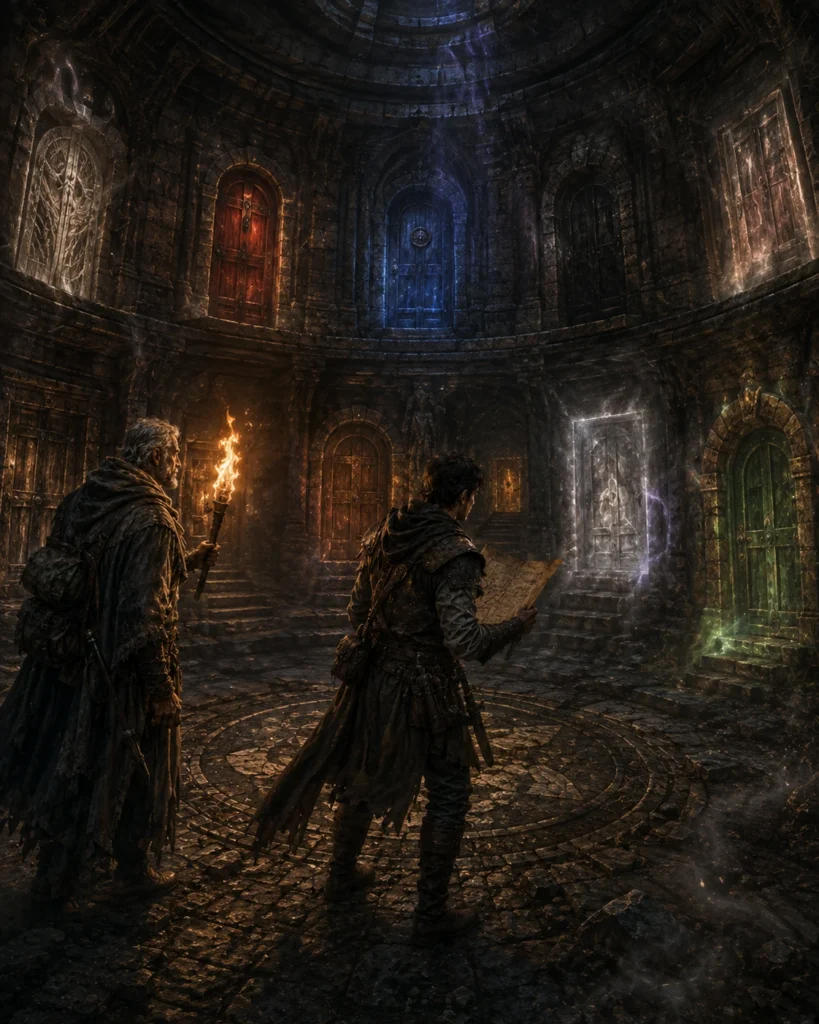
White.
Green.
Bronze.
A door made entirely of bone.
Leon stared.
“No.”
Garrick walked to the center.
“What?”
“This room changed while we were inside.”
“Yes.”
“That is not how rooms work.”
“An excellent observation.”
Leon ignored him.
They chose bronze.
Beyond it was a flooded corridor occupied by pale creatures that moved beneath the water.
They retreated immediately.
When they returned—
two doors.
Yellow.
Stone.
Leon laughed.
Not because it was funny.
Because there was suddenly no better reaction.
“What exactly am I supposed to map?”
Garrick took the parchment from Leon.
He looked at the circular room.
Then he drew a circle.
Inside it he wrote:
CHANGES.
He handed the parchment back.
Leon stared at the word.
“That’s your map?”
“It is accurate.”
2. Mapping Uncertainty
That night they camped inside a defensible storage room.
Leon spread the map across the floor.
He had begun using different symbols.
A solid line meant stable.
A dotted line meant uncertain.
A spiral meant changing.
A triangle meant observed behavior.
A double circle meant something that had remembered them.
His map no longer described only space.
It described probability.
“This corridor existed twice.”
He marked it heavily.
“This staircase appeared once.”
A dotted line.
“This room moved.”
A spiral.
“This door only appeared after we avoided the trap.”
A triangle.
Garrick watched without interrupting.
Eventually Leon leaned back.
“I understand.”
“That is usually dangerous.”
Leon grinned.
“My old map answered, ‘Where is everything?’”
“And this one?”
Leon tapped the parchment.
“‘What can I trust?’”
Garrick smiled.
“Better question.”
Chapter Four
The Pleasure of the Unknown
1. The Chest Leon Did Not Open
The dungeon eventually offered Leon a chest.
Beautiful.
Golden.
Untouched.
Sitting in the center of an empty chamber.
He stared at it.
Garrick stared at him.
Leon walked around it.
No pressure plates.
No holes.
No mechanisms.
No corpses.
No inscriptions.
No suspicious ceiling.
Nothing.
“This is worse,” Leon said.
“Why?”
“Because it knows I expect traps.”
He approached.
Stopped.
Retreated.
Approached again.
Nothing happened.
Finally he opened the chest.
Inside was a wooden spoon.
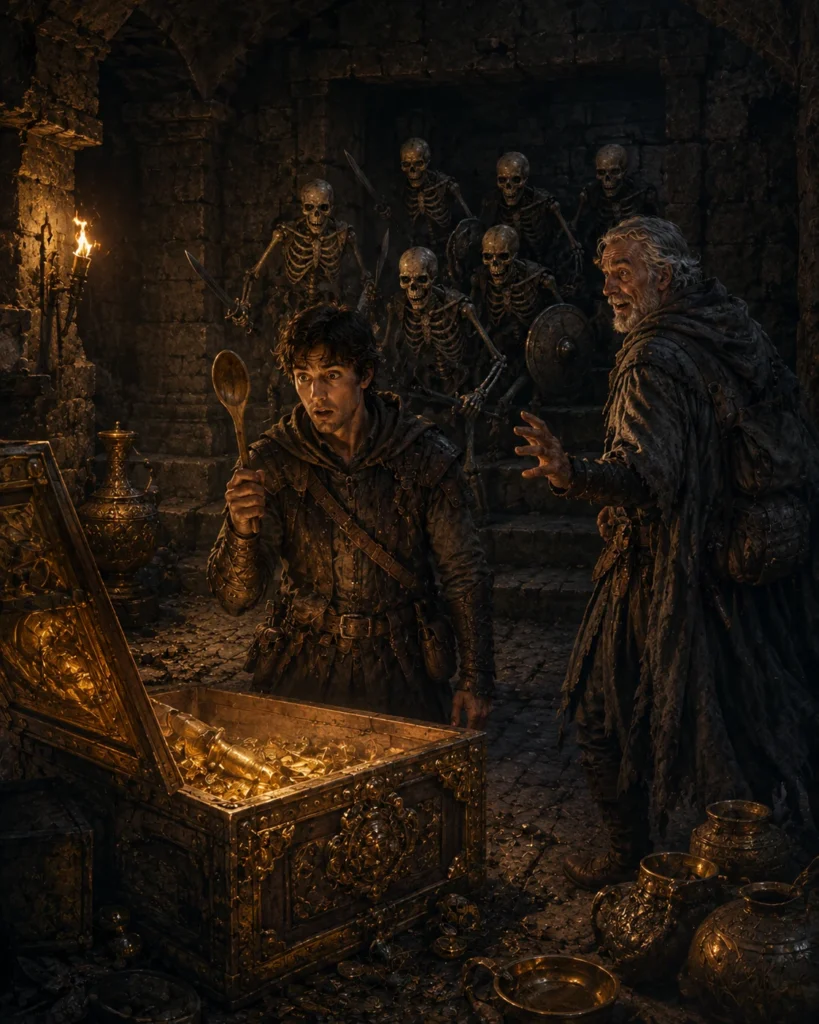
Leon stared at it.
Garrick began laughing.
The sound echoed through the chamber.
Leon picked up the spoon.
“That’s it?”
Behind them, a wall opened.
Beyond it stood six armed skeletons.
Leon looked at the spoon.
Then at the skeletons.
Then at Garrick.
“Still laughing?”
“A little.”
They ran.
2. Bad Runs Become Good Stories
They escaped by diving through a half-open gate.
Leon lost one glove.
Garrick lost two throwing knives.
Someone—neither would admit who—lost the wooden spoon.
They ended up trapped on a ledge above an underground river while skeletons searched the corridor above.
Leon sat against the wall, panting.
“That was terrible.”
“Yes.”
“We gained nothing.”
“Incorrect.”
“What did we gain?”
Garrick thought.
“A story.”
Leon looked at him.
The absurdity struck them both simultaneously.
They started laughing.
Quietly at first.
Then uncontrollably.
The great treasure.
The perfect chest.
The sophisticated trap analysis.
The reward:
a spoon.
Leon finally understood something he had never considered.
Not every expedition needed to be efficient.
Not every failure needed to feel wasted.
Sometimes the dungeon produced stories precisely because things went wrong.
And strangely, those were often the stories worth remembering.
Chapter Five
The Enemy Who Learned His Name
1. The Archer
On the third level, they encountered an archer wearing a red mask.
The first time, Leon defeated him easily.
The archer attacked from a balcony.
Leon rolled behind a pillar, waited for the next shot, then climbed the side stairs and struck from behind.
Simple.
The next day, they found him again.
Same red mask.
Different room.
This time there were no side stairs.
Leon used a broken table as cover and closed the distance.
Victory.
The third time, the red-masked archer appeared in a narrow gallery.
Before Leon could move behind cover, the archer fired at the pillar Leon intended to use.
Leon stopped.
The arrow struck exactly where his head would have been.
The archer tilted his mask.
Leon felt something almost like insult.
“He knew.”
Garrick drew his blade.
“Then teach him something new.”
2. Adaptation
Leon charged.
The archer expected it.
Leon stopped halfway.
The archer fired early.
Leon dropped.
The arrow passed overhead.
He threw his torch.
Not at the archer.
At the hanging tapestry behind him.
Flame climbed the cloth.
The archer turned.
Leon moved.
Three seconds later, the fight was over.
He stood over the fallen red mask.
Garrick approached.
“You changed your plan.”
“He changed his.”
“Yes.”
Leon stared down at the mask.
“So I changed mine.”
Garrick nodded.
“That is combat.”
Leon frowned.
“I thought combat was swordsmanship.”
“No. Swordsmanship is what your hands do.”
He tapped Leon lightly on the forehead.
“Combat happens here.”
Chapter Six
The Floor That Vanished
1. Nothing Belongs to You Forever
By the fourth day, Leon had begun feeling confident again.
Not because he knew the dungeon.
Because he had learned how to survive not knowing it.
That confidence lasted until the safe room disappeared.
They had used it twice.
Stone door.
Dry floor.
Single entrance.
No monsters.
Perfect.
They returned exhausted after a long expedition.
The door remained.
Leon opened it.
There was no room.
Only a vertical shaft.
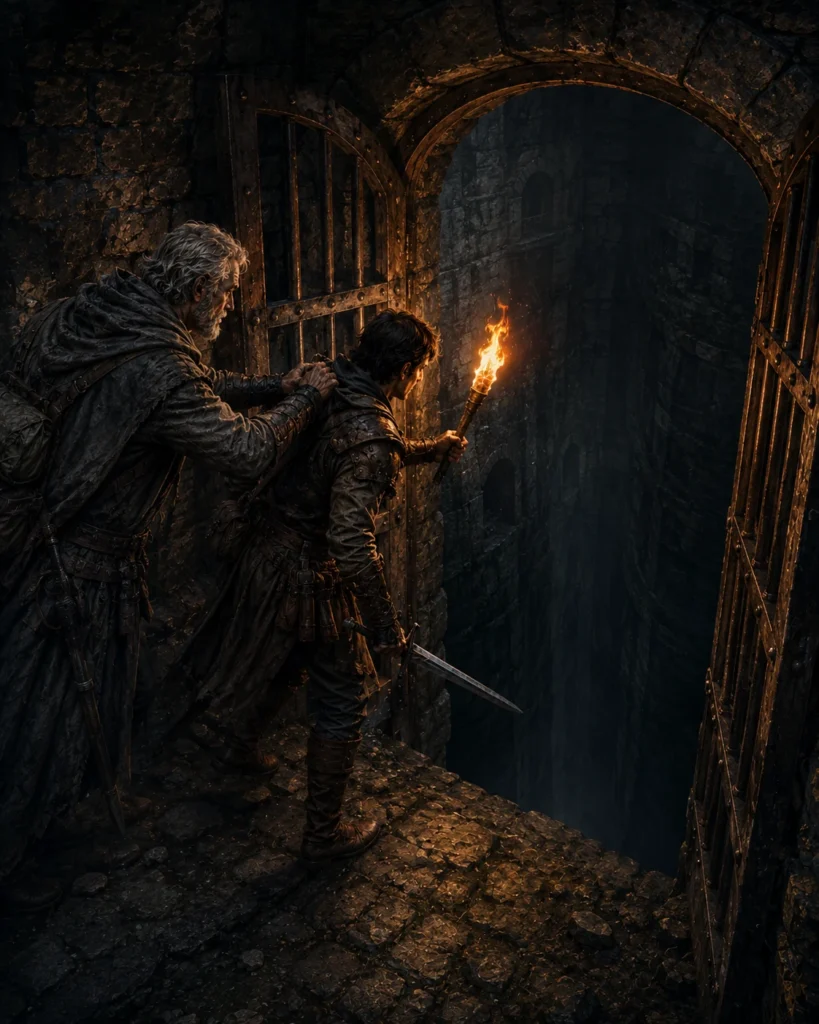
He nearly stepped into it.
Garrick caught his collar.
A stone fell from the edge.
They listened.
One second.
Two.
Three.
Four.
No sound.
Leon slowly backed away.
“Our safe room.”
“Was a safe room.”
Leon stared into the darkness.
“I hate this place.”
Garrick nodded.
“That means you respect it again.”
2. Temporary Safety
They slept that night beneath a staircase.
Poorly.
Every sound woke Leon.
Every scrape of stone suggested movement.
Every change in torchlight seemed like a doorway appearing behind them.
But in the morning, Leon felt something different.
Lighter.
He had stopped assuming the dungeon owed him permanence.
That freed him.
Rooms could vanish.
Doors could move.
Enemies could learn.
Maps could decay.
Plans could fail.
So what?
He still had observation.
Judgment.
Improvisation.
Curiosity.
Those could move with him.
A map was useful.
A safe room was useful.
A familiar route was useful.
But none of them were the real source of safety.
The real source was the ability to adapt when they disappeared.
Chapter Seven
The Door Made From Memory
1. The First Dungeon Returned
Deep beneath the hill, they found a familiar corridor.
Leon stopped immediately.
Same stones.
Same torch brackets.
Same wet floor.
Same long shape.
His first corridor.
The one he had entered months ago.
“That’s impossible.”
Garrick said nothing.
Leon walked slowly.
At the end:
the three-way chamber.
The chest.
The left passage.
The right passage.
The staircase.
Everything.
Exactly as he remembered.
He felt an unexpected ache.
This place had once terrified him.
Now it felt almost like home.
He entered the room with four pillars.
The secret wall stood open.
Inside sat the old skeleton.
Leon approached carefully.
Above it, the scratched message remained:
Not all treasure wishes to be taken.
He smiled.
Then the skeleton moved.
Its head turned toward him.
Leon stopped smiling.
The jaw opened.
“You came back.”
2. Memory Is Not the Same as Truth
The skeleton stood.
Not violently.
Almost politely.
Its bones clicked as it raised one hand.
“You remember this place.”
Leon drew his sword.
“Yes.”
The skeleton pointed toward the secret passage.
“Then tell me what lies beyond.”
Leon answered immediately.
“A small chamber.”
The skeleton shook its head.
“Again.”
“A chamber with arrows and a ring.”
“No.”
Leon frowned.
“That is what was there.”
“That is what you remember.”
The wall behind the skeleton opened.
Beyond it was not the old chamber.
It was a forest.
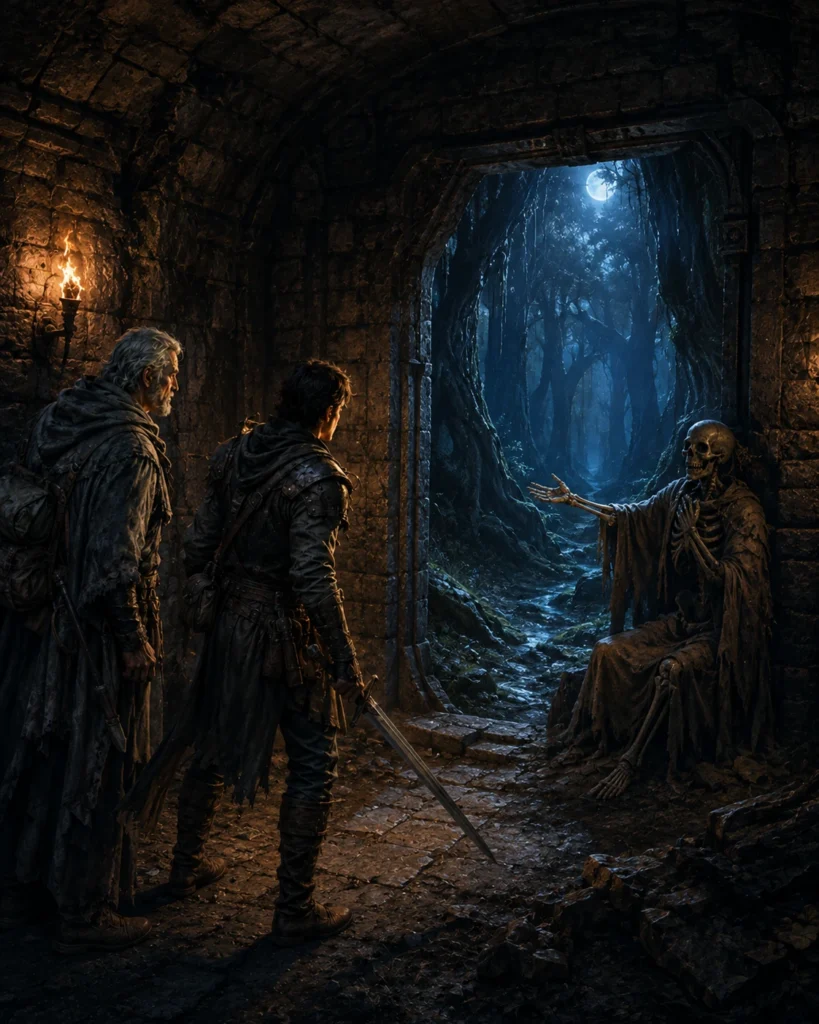
Trees.
Moonlight.
Wind.
Impossible underground sky.
Leon stared.
The skeleton stepped aside.
“A memory is a map of what was.”
It pointed into the forest.
“Not a prison for what may become.”
Chapter Eight
The Forest Beneath the Earth
1. A Dungeon Does Not Need Walls
Leon entered the forest.
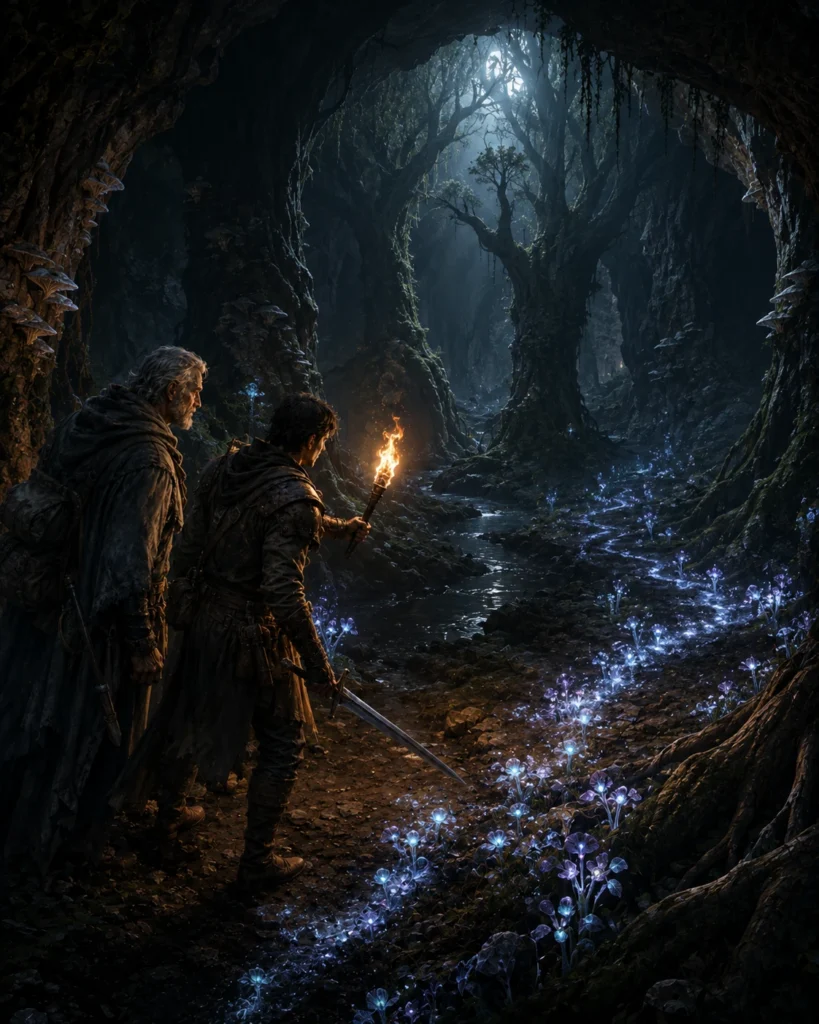
For several minutes he forgot they were underground.
Leaves rustled above.
Silver light passed through branches.
Insects moved in the grass.
A stream ran between roots.
Garrick followed.
“No ceiling,” Leon whispered.
“There must be.”
“I cannot see it.”
“Then for now, it does not matter.”
They walked.
There were no corridors.
No doors.
No obvious rooms.
Leon felt strangely vulnerable.
“How do I explore a dungeon without walls?”
Garrick looked amused.
“Did you think the walls were doing the exploring for you?”
Leon stopped.
He listened.
Water to the east.
Birds somewhere ahead.
Wind stronger to the north.
A faint orange glow behind the trees.
He smiled.
“No.”
They continued.
2. Reading Systems Instead of Rooms
The forest had rules.
The glowing flowers opened only when no torch was nearby.
Certain insects gathered near hidden water.
Wolves avoided trees marked with white fungus.
The stream always flowed toward structures buried beneath the roots.
Leon began to understand.
The dungeon had removed walls.
But not information.
It had changed its language.
He followed the insects.
Found water.
Followed the stream.
Found ruins.
Studied the fungus.
Avoided predators.
Watched flowers close around his torch.
Extinguished it.
A hidden path appeared.
Leon laughed.
The feeling returned.
That same old electricity.
Observation.
Hypothesis.
Experiment.
Discovery.
Different world.
Same joy.
Chapter Nine
The Chained Guardian
1. He Was Waiting
At the heart of the underground forest stood a chapel.
Leon knew it before he saw the door.
His hand tightened around his sword.
“No.”
Garrick saw his face.
“You remember.”
Leon nodded.
They entered.
Candles burned.
Stone saints watched.
Chains lay across the floor.
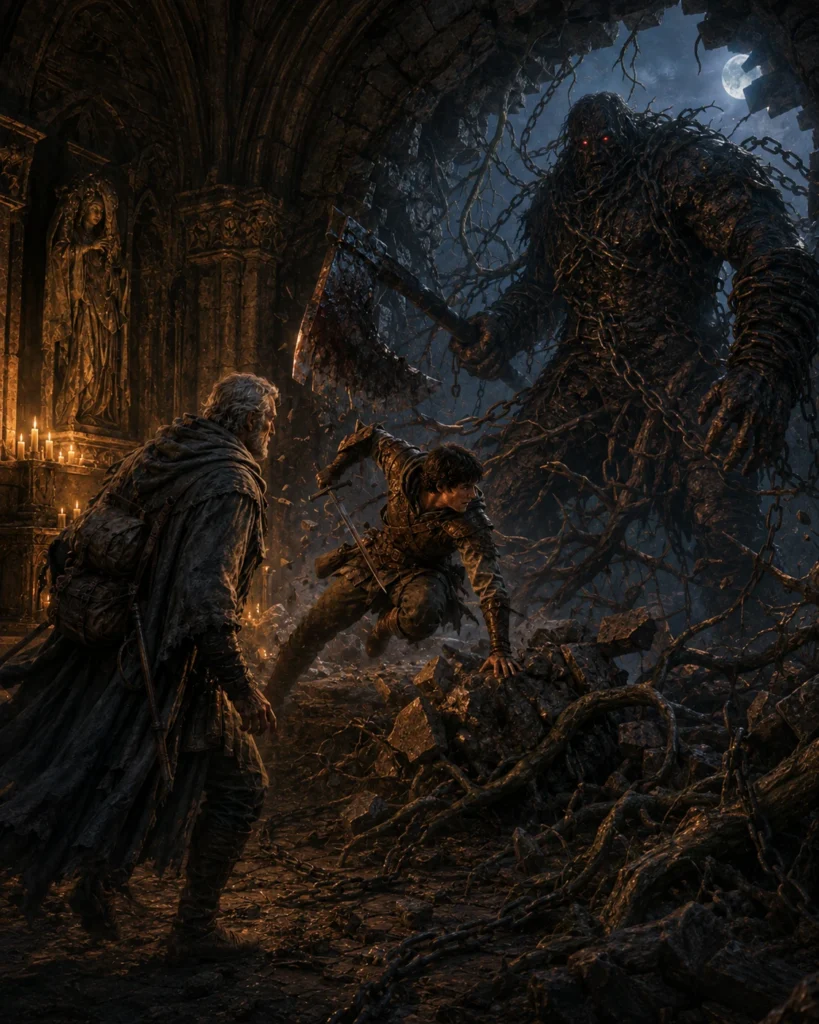
And at the far end stood the creature they had fled months ago.
The giant in old chain armor.
The enormous axe.
The red eyes.
The guardian.
But this time—
it spoke.
“Leon.”
The young adventurer went completely still.
Garrick’s sword left its sheath.
The guardian lowered the axe.
“You returned.”
Leon swallowed.
“You know my name.”
“I know your footsteps.”
The creature lifted its head.
“I know where you hide.”
A chain slid across the floor.
“I know when you retreat.”
Another step.
“I know what you learned.”
Leon raised his sword.
“And I know something about you.”
The red eyes narrowed.
“You always lead with the right hand.”
Silence.
Then the guardian charged.
2. The Fight He Could Not Win the Same Way Twice
Leon had imagined this battle many times.
He had imagined becoming stronger.
Faster.
Braver.
He had imagined returning and defeating the monster through superior skill.
But the guardian knew his habits.
It punished familiar dodges.
Blocked familiar strikes.
Expected retreat.
Expected aggression.
Every comfortable response failed.
Leon was forced into something he had never practiced.
Improvisation.
He kicked a candle stand.
Fire spread across spilled oil.
The guardian moved left.
Leon threw his sword right.
Not to hit.
To distract.
He ran toward the wall.
The creature pursued.
At the final instant, Leon jumped onto a hanging chain and swung.
The axe struck stone.
The chapel wall broke.
Moonlight from the impossible forest poured through.
Roots burst from the crack.
The guardian became entangled.
Leon landed badly, rolled, seized his sword, and stood.
The creature could still fight.
He could still attack.
Instead Leon lowered the blade.
Garrick looked at him.
“Why stop?”
Leon watched the struggling guardian.
“Because I don’t think this is a boss.”
Garrick smiled slightly.
“What is it?”
Leon looked at the broken wall.
“A door.”
Chapter Ten
The Dungeon Remembers Because You Do
1. The Heart
Behind the chapel lay no treasure chamber.
No king.
No demon.
No pile of gold.
There was only a vast room.
At its center floated thousands of fragments of stone.
Rooms.
Doors.
Staircases.
Broken statues.
Pieces of corridors.
The architecture of countless versions of the dungeon, rotating slowly in the darkness.
Leon saw places he recognized.
The trapped chest room.
The iron gate.
The first corridor.
The changing circle.
The forest.
And other places he had never seen.
Thousands.
Perhaps millions.
At the center of everything floated a small stone sphere.
Leon approached.
When he touched it—
the dungeon remembered him.
Not with words.
With moments.
His first frightened step through the door.
His hand finding the hidden tile.
His hesitation before the chest.
His retreat from the staircase.
His terror before the chained guardian.
His laughter over the wooden spoon.
His new maps.
His changing habits.
His mistakes.
His adaptations.
Every decision.
Every return.
Every lesson.
The dungeon had not merely changed around him.
It had changed because of him.
2. Why It Changes
Garrick stood beside him.
Leon kept his hand on the stone.
“I thought it was trying to defeat me.”
“Perhaps it was.”
“No.”
Leon shook his head.
“It was trying to stop me from becoming comfortable.”
Garrick said nothing.
Leon finally understood.
A dungeon that never changed eventually became a route.
A solved problem.
A memory.
Walk here.
Open this.
Avoid that.
Kill this.
Take that.
Done.
But this place refused to become dead knowledge.
It demanded attention again.
It demanded curiosity again.
It demanded that the explorer remain an explorer.
Leon smiled.
“The dungeon remembers so I can’t stop thinking.”
Garrick looked at the infinite fragments turning around them.
“Perhaps.”
Leon glanced at him.
“You knew?”
“I suspected.”
“And you didn’t tell me?”
“What would have been the fun in that?”
Leon laughed.
Epilogue
A New Map
They emerged beneath the hill six days after entering.
The village looked unchanged.
The windmill still turned.
Smoke still rose from chimneys.
Children still ran along the muddy road.
Leon sat beside the broken stone marker where Garrick had once stopped him before his first descent.
He unfolded his map.
It looked ridiculous.
Solid lines.
Dotted lines.
Circles.
Triangles.
Warnings.
Questions.
Rooms that no longer existed.
Rooms that might exist again.
Places whose locations changed.
Places whose rules changed.
Places that seemed to remember.
Leon considered throwing it away.
Instead he wrote something across the bottom.
Garrick leaned over.
“What did you write?”
Leon showed him.
A MAP IS NOT THE DUNGEON.
Garrick nodded.
“Useful.”
Leon added another line.
AND THE DUNGEON IS NEVER FINISHED.
The old adventurer smiled.
They sat quietly for a moment.
Then a grinding sound came from beneath the hill.
The iron-bound door moved.
Leon looked up.
The doorway had changed again.
Beyond it was no staircase.
No corridor.
No forest.
Only snow.
Cold wind blew outward.
A single footprint appeared in the white.
Then another.
Something inside was walking toward them.
Leon slowly stood.
Garrick sighed.
“We could go home.”
Leon looked at him.
“You don’t mean that.”
“No.”
Leon drew his sword.
This time he was smiling.
Not because he knew what waited beyond the door.
Because he didn’t.
And now—
that was the best part.
End of Book II
The dungeon had taught him how to read.
Now it had taught him why no great world should ever be completely readable.