Skip to content Skip to main navigation Skip to footer

Game-Inspired Fiction-and-earthlings-land

the-dungeon-that-remembers

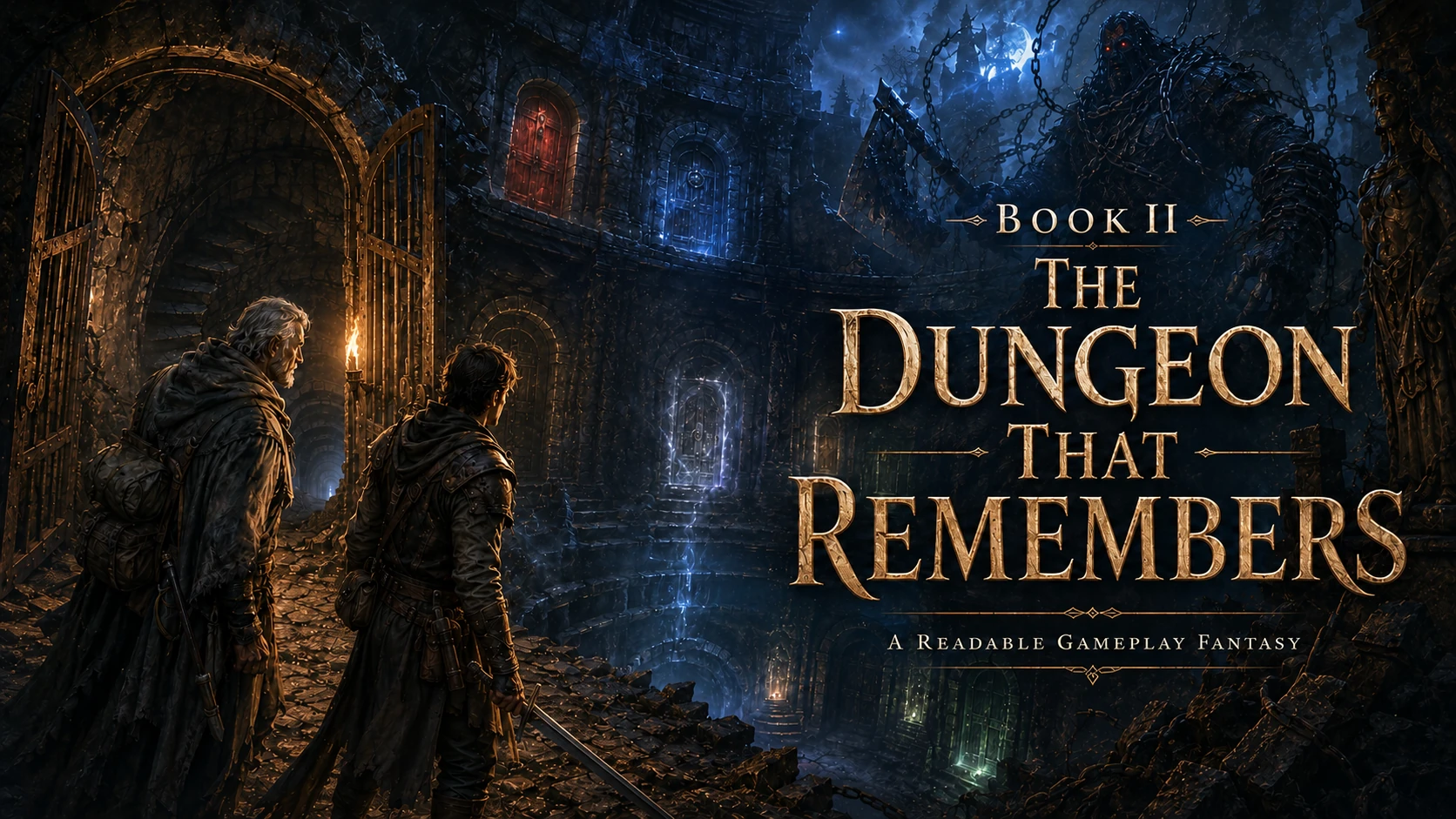
Book II The Dungeon That Remembers

Prologue

The Door Was Open

Leon knew something was wrong before he reached the hill.

The grass remembered the path.

The stones remembered his boots.

Even the wind seemed familiar.

Months had passed since his first descent beneath the village, but he could still picture the dungeon as clearly as if he had left it yesterday.

The entrance corridor.

The room with four pillars.

The hidden passage.

The trapped chest.

The iron gate.

The staircase they had refused to descend.

The chapel.

The thing in chains.

He knew where the walls bent.

He knew where the floor betrayed careless feet.

He knew which rooms were empty and which ones only pretended to be.

For the first time in his life, Leon approached a dungeon without fear.

That should have frightened him.

It did not.

Not yet.

Garrick walked several steps behind, carrying the same weathered satchel and wearing the same ash-gray cloak.

“You’re smiling,” the old adventurer said.

Leon glanced back.

“I know this place now.”

Garrick did not return the smile.

“That is usually when a dungeon becomes dangerous.”

Leon laughed.

Then they reached the door.

And stopped.
01_the_door_was_open

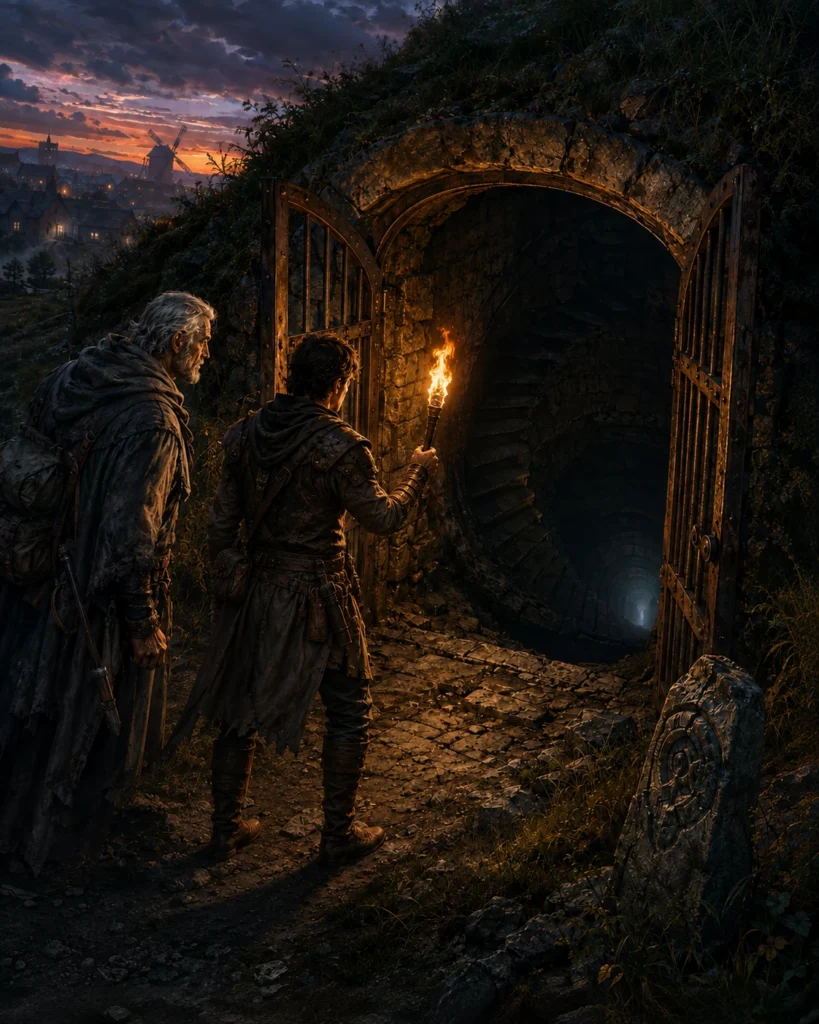
The iron-bound door beneath the hill—the door Leon remembered pulling open with both hands—was already standing wide.

Beyond it was darkness.

Not the darkness he remembered.

A different darkness.

The entrance corridor was gone.

In its place descended a spiral staircase.

Leon stared into it.

“That wasn’t there.”

“No,” Garrick said.

Leon looked at the stone around the doorway.

Same hill.

Same iron frame.

Same scratches.

Same broken marker beside the path.

But beyond the threshold was somewhere else.

Leon slowly lowered his torch.

“That’s impossible.”

Garrick stepped beside him.

“No,” he said quietly.

“Impossible would be comforting.”

Leon turned.

Garrick was staring into the staircase.

“This,” the old man said, “is worse.”


Chapter One

The Map That Lied

1. Confidence Is a Dangerous Torch

Leon entered first.

That alone was new.

Months ago, Garrick had always walked ahead when danger seemed uncertain.

Now Leon descended the spiral staircase with his sword loose in its sheath and his torch held high.

Twenty steps.

Thirty.

Forty.

The staircase should have reached the old entrance level long ago.

Instead it kept descending.

Leon counted to seventy-three before his boots finally touched a flat stone floor.

Ahead lay a corridor.

Three doors opened from it.

None existed on his old map.

Leon took out a folded sheet of parchment anyway.

Garrick watched.

“You brought it.”

“Of course.”

Leon unfolded the map of their first expedition.
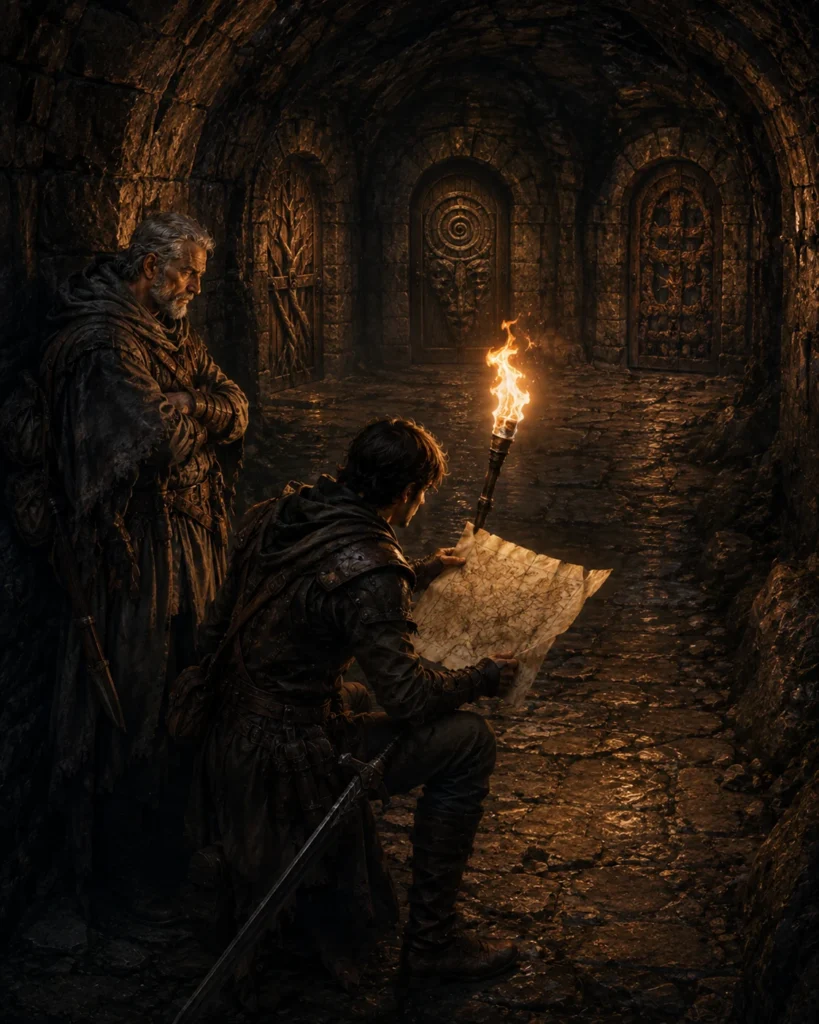
03_the_map_that_lied

Lines.

Rooms.

Crosses.

Notes.

A circle marking the chapel.

A skull marking the chained creature.

The careful geometry of knowledge.

Leon had treasured the map because it proved something.

The dungeon had once been mysterious.

Then it had become understandable.

Now the map looked almost ridiculous.

He turned it sideways.

Then upside down.

Nothing matched.

Garrick leaned against the wall.

“How does it feel?”

Leon did not answer.

“I know that expression,” Garrick continued.

“What expression?”

“The one people wear when reality refuses to respect their preparation.”

Leon folded the map.

“I don’t like it.”

“Good.”

Leon glared at him.

Garrick smiled.

“You learned how to read a dungeon. Now you must learn something harder.”

“What?”

“How to stop believing yesterday’s answer.”


2. The First Rule Had Changed

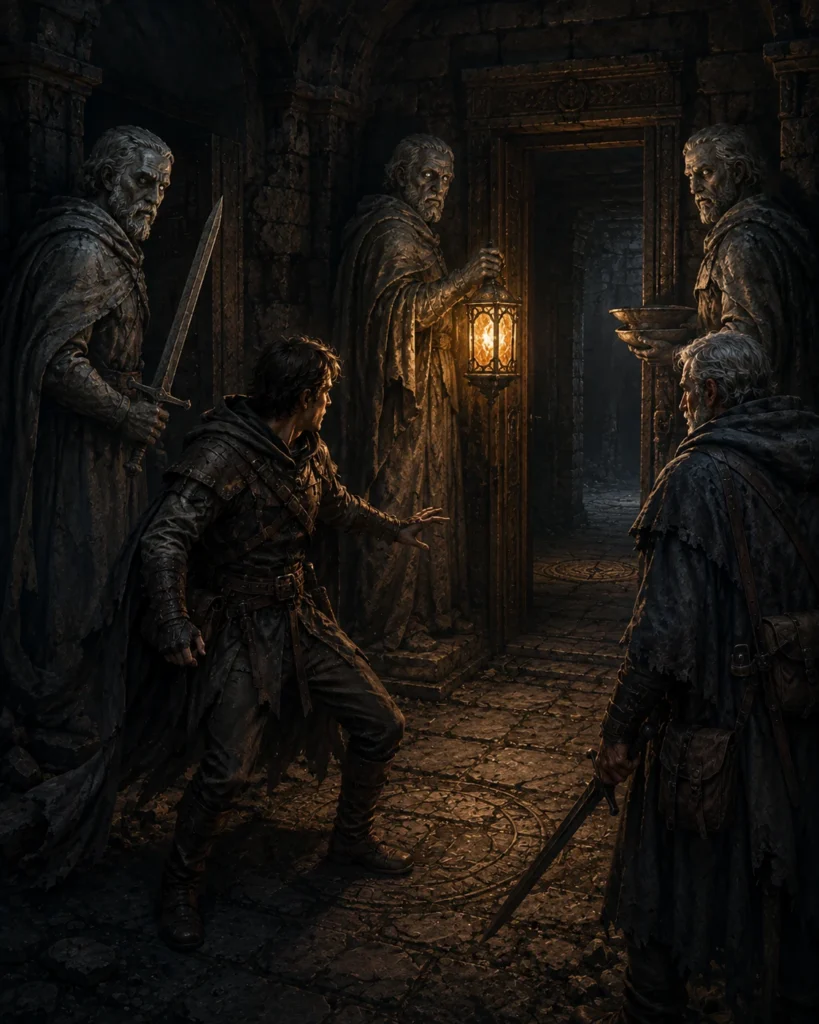
The left door led to a narrow chamber containing three stone statues.
02_the_first_rule_had_changed

Leon immediately stopped.

Statues meant mechanisms.

Sometimes switches.

Sometimes traps.

Sometimes enemies pretending not to be enemies.

He circled the room slowly.

No unusual floor tiles.

No holes in the walls.

No obvious pressure plates.

The statues faced north.

One held a sword.

One held a lantern.

One held an empty bowl.

Leon examined the bowl.

Nothing.

He rotated the lantern-bearing statue.

Nothing.

He pressed the sword.

Nothing.

Garrick remained by the doorway.

Leon frowned.

“This room wants me to do something.”

“Does it?”

“There are three statues.”

“That is true.”

“Why would someone put them here?”

Garrick said nothing.

Leon tried every mechanism he could imagine.

After several minutes, frustrated, he stepped toward the far door.

The instant his hand touched the handle—

the statues turned their heads.

Leon froze.

All three stone faces were looking directly at him.

Then the lantern statue spoke.

“You have been here before.”

Leon stumbled backward.

Garrick drew his sword.

The stone mouth moved again.

“You looked beneath the fourth pillar.”

Leon felt cold.

That had happened months ago.

In another room.

Another version of the dungeon.

The statue continued.

“You avoided the smiling mouth.”

The trapped chest.

“You opened the western wall.”

The chapel.

“You fled from the chained guardian.”

Leon whispered:

“It remembers us.”

The lantern in the statue’s hand ignited.

A new door appeared behind it.

Garrick looked at Leon.

“Apparently,” he said, “you made an impression.”


Chapter Two

A Dungeon That Watches

1. The Second Visit Is Never the First

Beyond the hidden door lay a corridor paved with black stone.

Leon moved more cautiously now.

Not because he knew less.

Because he knew the dungeon knew more.

That changed everything.

During his first expedition, the dungeon had been an object.

A structure.

A puzzle.

Something to observe.

Now Leon felt observed in return.

At the next intersection, he chose left.

A familiar habit.

He almost always chose left first.

The passage ended in a trap.

A wall slammed down behind them.

Garrick jumped forward.

Three spears shot from the right wall.

They missed Leon by inches.

He stared at the holes.

Garrick looked back at the sealed wall.

“You always go left.”

Leon said nothing.

The old man raised an eyebrow.

“Coincidence?”

Leon looked at the spear holes again.

“No.”

They escaped through a ceiling hatch and climbed into another corridor.

At the next intersection, Leon stopped.

Left.

Right.

Straight.

He felt the dungeon waiting.

Garrick stood behind him.

“Well?”

Leon smiled faintly.

Then he turned around and walked backward through the corridor they had just entered.

A section of wall opened behind them.

Garrick laughed.

“There you are.”

“What?”

“Thinking again.”


2. Patterns Are Useful Until They Become Prisons

For the next hour, Leon deliberately broke his habits.

He stopped checking every left wall.

He ignored one obvious chest.

He opened a door before searching for traps—after examining the ceiling first.

He walked past an intersection, doubled back, then took the center route.

At first it felt foolish.

Then something strange happened.

The dungeon became uncertain.

The traps grew less precise.

Enemies waited in rooms Leon never entered.

One corridor contained an ambush positioned perfectly to attack someone approaching from the west.

Leon entered from the east.

The creatures never saw him coming.

Later, they found a pressure plate placed exactly where Leon would normally step while inspecting a door.

He noticed it only because he had begun standing farther away.

“The dungeon isn’t just changing,” Leon said.

Garrick nodded.

“It’s responding.”

“To us.”

“To you, perhaps.”

Leon did not like that distinction.

But another feeling existed beneath the fear.

Excitement.

He had learned to read the dungeon.

Now the dungeon was learning to read him.

The game had changed.


Chapter Three

The Room That Was Different Every Time

1. Three Doors, Four Visits

They found the room by accident.

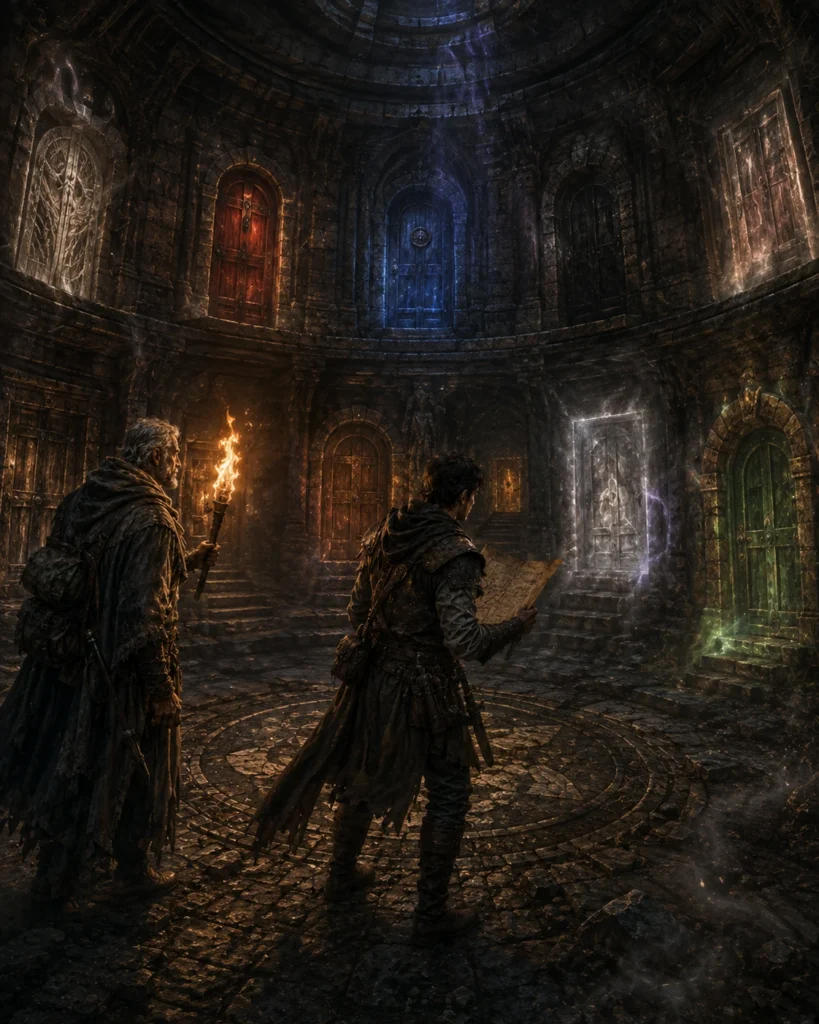
Circular.

Windowless.

One entrance.

Three doors.

Red.

Blue.

Black.

Leon chose red.

Beyond it was a treasure chamber containing six silver coins and a small healing vial.

They returned to the circular room.

The red door was gone.

Now there were four doors.
04_the_room_that_was_different_every_time

White.

Green.

Bronze.

A door made entirely of bone.

Leon stared.

“No.”

Garrick walked to the center.

“What?”

“This room changed while we were inside.”

“Yes.”

“That is not how rooms work.”

“An excellent observation.”

Leon ignored him.

They chose bronze.

Beyond it was a flooded corridor occupied by pale creatures that moved beneath the water.

They retreated immediately.

When they returned—

two doors.

Yellow.

Stone.

Leon laughed.

Not because it was funny.

Because there was suddenly no better reaction.

“What exactly am I supposed to map?”

Garrick took the parchment from Leon.

He looked at the circular room.

Then he drew a circle.

Inside it he wrote:

CHANGES.

He handed the parchment back.

Leon stared at the word.

“That’s your map?”

“It is accurate.”


2. Mapping Uncertainty

That night they camped inside a defensible storage room.

Leon spread the map across the floor.

He had begun using different symbols.

A solid line meant stable.

A dotted line meant uncertain.

A spiral meant changing.

A triangle meant observed behavior.

A double circle meant something that had remembered them.

His map no longer described only space.

It described probability.

“This corridor existed twice.”

He marked it heavily.

“This staircase appeared once.”

A dotted line.

“This room moved.”

A spiral.

“This door only appeared after we avoided the trap.”

A triangle.

Garrick watched without interrupting.

Eventually Leon leaned back.

“I understand.”

“That is usually dangerous.”

Leon grinned.

“My old map answered, ‘Where is everything?’”

“And this one?”

Leon tapped the parchment.

“‘What can I trust?’”

Garrick smiled.

“Better question.”


Chapter Four

The Pleasure of the Unknown

1. The Chest Leon Did Not Open

The dungeon eventually offered Leon a chest.

Beautiful.

Golden.

Untouched.

Sitting in the center of an empty chamber.

He stared at it.

Garrick stared at him.

Leon walked around it.

No pressure plates.

No holes.

No mechanisms.

No corpses.

No inscriptions.

No suspicious ceiling.

Nothing.

“This is worse,” Leon said.

“Why?”

“Because it knows I expect traps.”

He approached.

Stopped.

Retreated.

Approached again.

Nothing happened.

Finally he opened the chest.

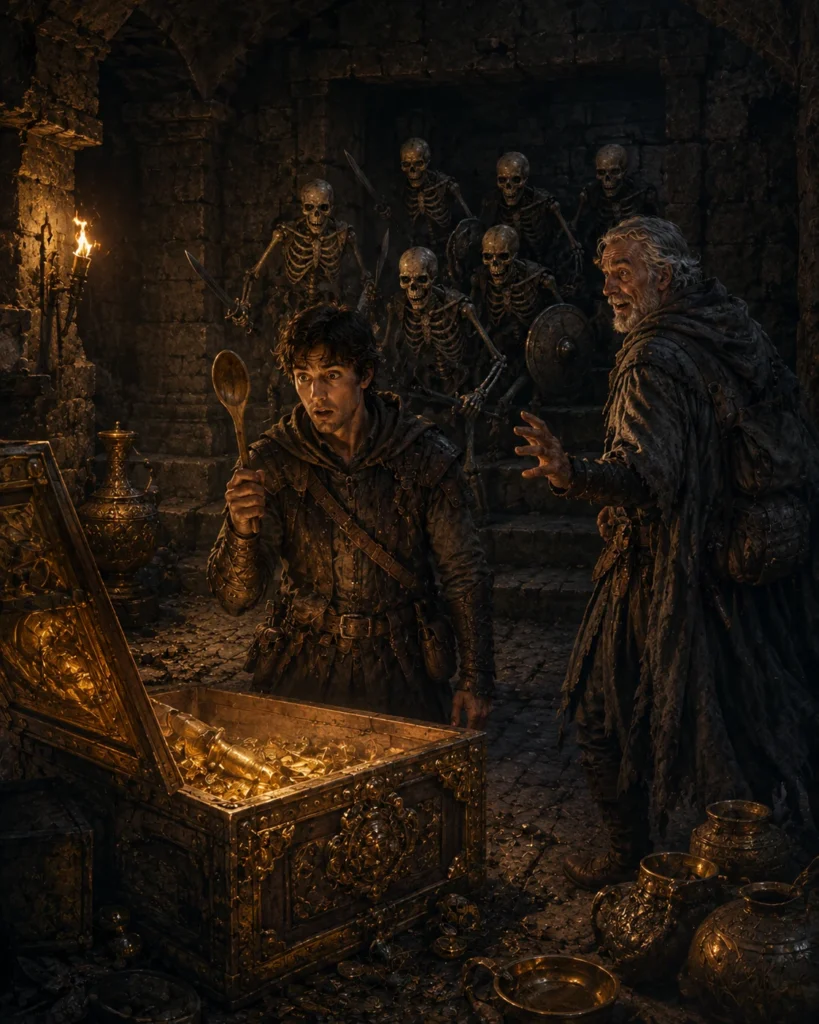
Inside was a wooden spoon.
05_the_chest_and_the_wooden_spoon

Leon stared at it.

Garrick began laughing.

The sound echoed through the chamber.

Leon picked up the spoon.

“That’s it?”

Behind them, a wall opened.

Beyond it stood six armed skeletons.

Leon looked at the spoon.

Then at the skeletons.

Then at Garrick.

“Still laughing?”

“A little.”

They ran.


2. Bad Runs Become Good Stories

They escaped by diving through a half-open gate.

Leon lost one glove.

Garrick lost two throwing knives.

Someone—neither would admit who—lost the wooden spoon.

They ended up trapped on a ledge above an underground river while skeletons searched the corridor above.

Leon sat against the wall, panting.

“That was terrible.”

“Yes.”

“We gained nothing.”

“Incorrect.”

“What did we gain?”

Garrick thought.

“A story.”

Leon looked at him.

The absurdity struck them both simultaneously.

They started laughing.

Quietly at first.

Then uncontrollably.

The great treasure.

The perfect chest.

The sophisticated trap analysis.

The reward:

a spoon.

Leon finally understood something he had never considered.

Not every expedition needed to be efficient.

Not every failure needed to feel wasted.

Sometimes the dungeon produced stories precisely because things went wrong.

And strangely, those were often the stories worth remembering.


Chapter Five

The Enemy Who Learned His Name

1. The Archer

On the third level, they encountered an archer wearing a red mask.

The first time, Leon defeated him easily.

The archer attacked from a balcony.

Leon rolled behind a pillar, waited for the next shot, then climbed the side stairs and struck from behind.

Simple.

The next day, they found him again.

Same red mask.

Different room.

This time there were no side stairs.

Leon used a broken table as cover and closed the distance.

Victory.

The third time, the red-masked archer appeared in a narrow gallery.

Before Leon could move behind cover, the archer fired at the pillar Leon intended to use.

Leon stopped.

The arrow struck exactly where his head would have been.

The archer tilted his mask.

Leon felt something almost like insult.

“He knew.”

Garrick drew his blade.

“Then teach him something new.”


2. Adaptation

Leon charged.

The archer expected it.

Leon stopped halfway.

The archer fired early.

Leon dropped.

The arrow passed overhead.

He threw his torch.

Not at the archer.

At the hanging tapestry behind him.

Flame climbed the cloth.

The archer turned.

Leon moved.

Three seconds later, the fight was over.

He stood over the fallen red mask.

Garrick approached.

“You changed your plan.”

“He changed his.”

“Yes.”

Leon stared down at the mask.

“So I changed mine.”

Garrick nodded.

“That is combat.”

Leon frowned.

“I thought combat was swordsmanship.”

“No. Swordsmanship is what your hands do.”

He tapped Leon lightly on the forehead.

“Combat happens here.”


Chapter Six

The Floor That Vanished

1. Nothing Belongs to You Forever

By the fourth day, Leon had begun feeling confident again.

Not because he knew the dungeon.

Because he had learned how to survive not knowing it.

That confidence lasted until the safe room disappeared.

They had used it twice.

Stone door.

Dry floor.

Single entrance.

No monsters.

Perfect.

They returned exhausted after a long expedition.

The door remained.

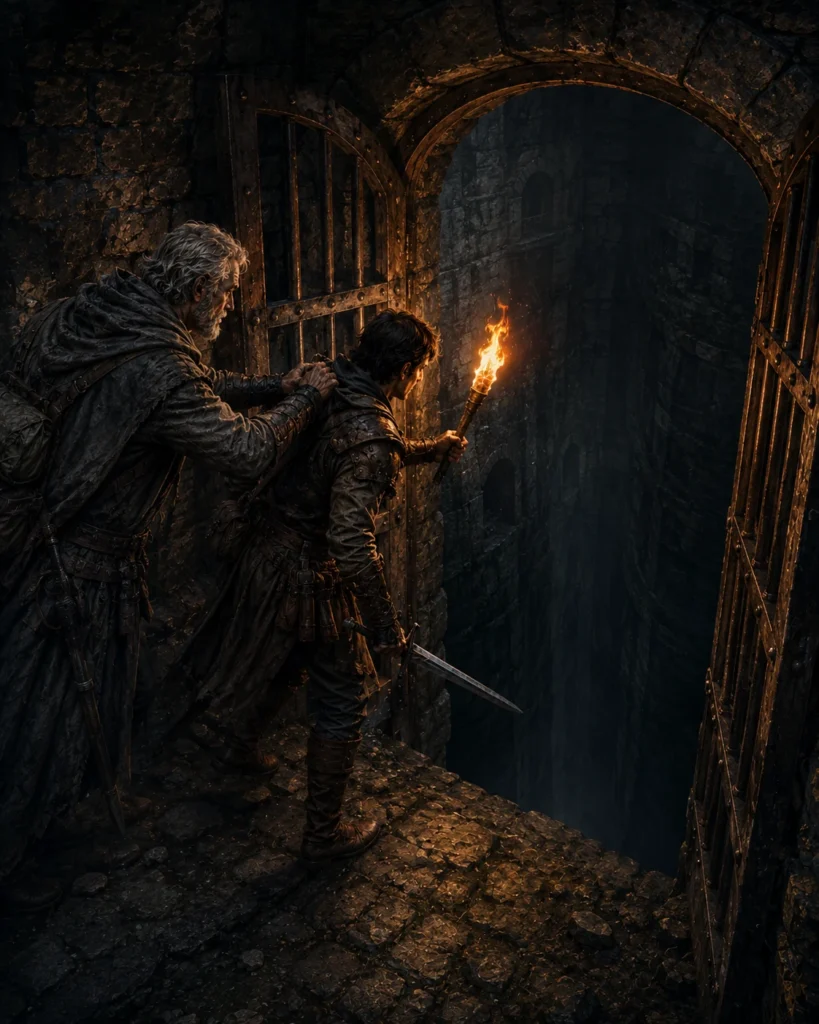
Leon opened it.

There was no room.

Only a vertical shaft.
06_the_floor_that_vanished

He nearly stepped into it.

Garrick caught his collar.

A stone fell from the edge.

They listened.

One second.

Two.

Three.

Four.

No sound.

Leon slowly backed away.

“Our safe room.”

“Was a safe room.”

Leon stared into the darkness.

“I hate this place.”

Garrick nodded.

“That means you respect it again.”


2. Temporary Safety

They slept that night beneath a staircase.

Poorly.

Every sound woke Leon.

Every scrape of stone suggested movement.

Every change in torchlight seemed like a doorway appearing behind them.

But in the morning, Leon felt something different.

Lighter.

He had stopped assuming the dungeon owed him permanence.

That freed him.

Rooms could vanish.

Doors could move.

Enemies could learn.

Maps could decay.

Plans could fail.

So what?

He still had observation.

Judgment.

Improvisation.

Curiosity.

Those could move with him.

A map was useful.

A safe room was useful.

A familiar route was useful.

But none of them were the real source of safety.

The real source was the ability to adapt when they disappeared.


Chapter Seven

The Door Made From Memory

1. The First Dungeon Returned

Deep beneath the hill, they found a familiar corridor.

Leon stopped immediately.

Same stones.

Same torch brackets.

Same wet floor.

Same long shape.

His first corridor.

The one he had entered months ago.

“That’s impossible.”

Garrick said nothing.

Leon walked slowly.

At the end:

the three-way chamber.

The chest.

The left passage.

The right passage.

The staircase.

Everything.

Exactly as he remembered.

He felt an unexpected ache.

This place had once terrified him.

Now it felt almost like home.

He entered the room with four pillars.

The secret wall stood open.

Inside sat the old skeleton.

Leon approached carefully.

Above it, the scratched message remained:

Not all treasure wishes to be taken.

He smiled.

Then the skeleton moved.

Its head turned toward him.

Leon stopped smiling.

The jaw opened.

“You came back.”


2. Memory Is Not the Same as Truth

The skeleton stood.

Not violently.

Almost politely.

Its bones clicked as it raised one hand.

“You remember this place.”

Leon drew his sword.

“Yes.”

The skeleton pointed toward the secret passage.

“Then tell me what lies beyond.”

Leon answered immediately.

“A small chamber.”

The skeleton shook its head.

“Again.”

“A chamber with arrows and a ring.”

“No.”

Leon frowned.

“That is what was there.”

“That is what you remember.”

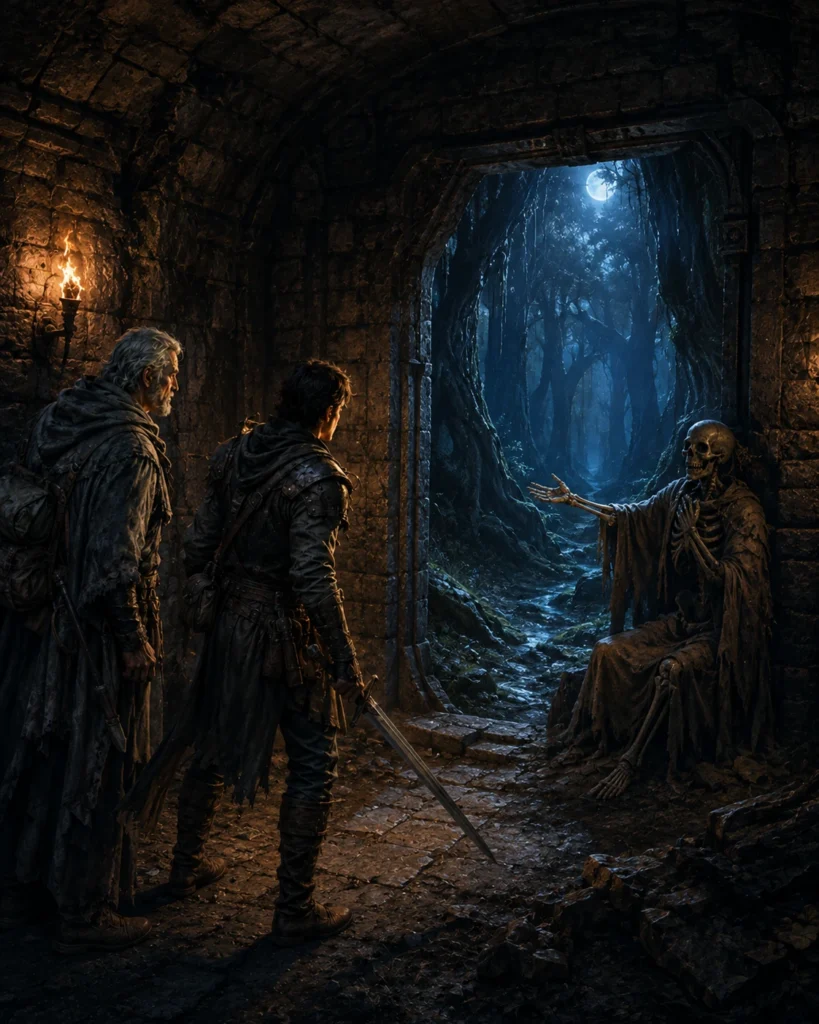
The wall behind the skeleton opened.

Beyond it was not the old chamber.

It was a forest.
07_the_door_made_from_memory

Trees.

Moonlight.

Wind.

Impossible underground sky.

Leon stared.

The skeleton stepped aside.

“A memory is a map of what was.”

It pointed into the forest.

“Not a prison for what may become.”


Chapter Eight

The Forest Beneath the Earth

1. A Dungeon Does Not Need Walls

Leon entered the forest.
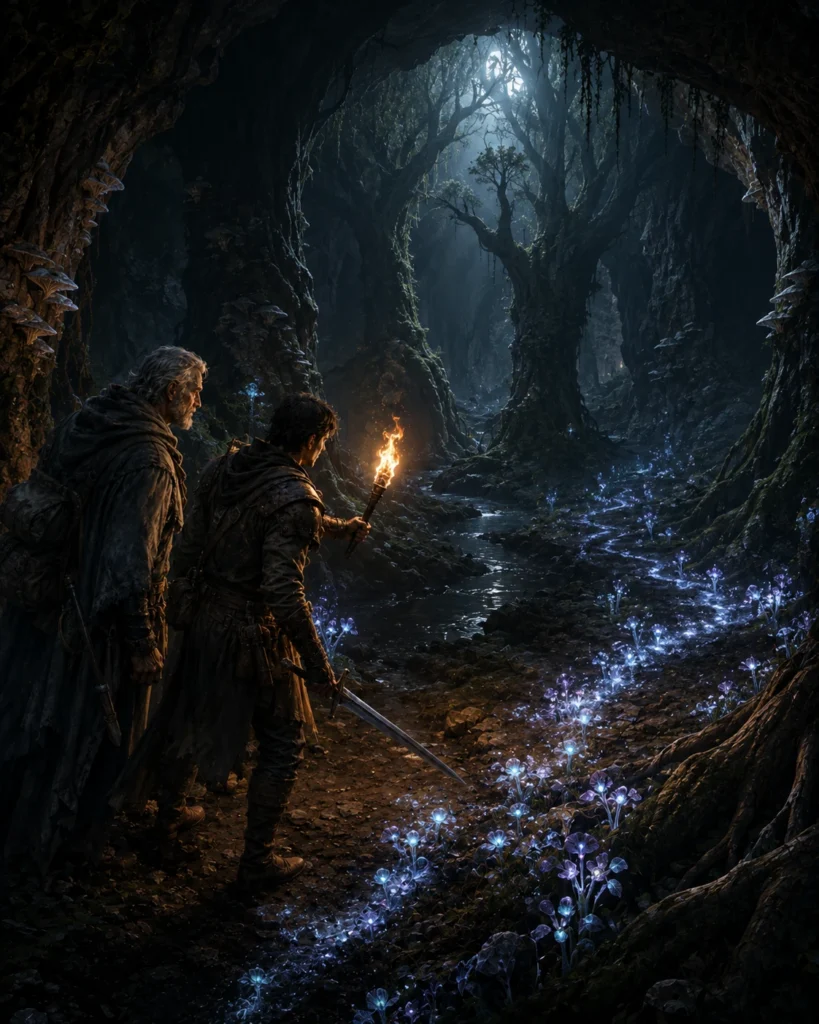
08_the_forest_beneath_the_earth

For several minutes he forgot they were underground.

Leaves rustled above.

Silver light passed through branches.

Insects moved in the grass.

A stream ran between roots.

Garrick followed.

“No ceiling,” Leon whispered.

“There must be.”

“I cannot see it.”

“Then for now, it does not matter.”

They walked.

There were no corridors.

No doors.

No obvious rooms.

Leon felt strangely vulnerable.

“How do I explore a dungeon without walls?”

Garrick looked amused.

“Did you think the walls were doing the exploring for you?”

Leon stopped.

He listened.

Water to the east.

Birds somewhere ahead.

Wind stronger to the north.

A faint orange glow behind the trees.

He smiled.

“No.”

They continued.


2. Reading Systems Instead of Rooms

The forest had rules.

The glowing flowers opened only when no torch was nearby.

Certain insects gathered near hidden water.

Wolves avoided trees marked with white fungus.

The stream always flowed toward structures buried beneath the roots.

Leon began to understand.

The dungeon had removed walls.

But not information.

It had changed its language.

He followed the insects.

Found water.

Followed the stream.

Found ruins.

Studied the fungus.

Avoided predators.

Watched flowers close around his torch.

Extinguished it.

A hidden path appeared.

Leon laughed.

The feeling returned.

That same old electricity.

Observation.

Hypothesis.

Experiment.

Discovery.

Different world.

Same joy.


Chapter Nine

The Chained Guardian

1. He Was Waiting

At the heart of the underground forest stood a chapel.

Leon knew it before he saw the door.

His hand tightened around his sword.

“No.”

Garrick saw his face.

“You remember.”

Leon nodded.

They entered.

Candles burned.

Stone saints watched.

Chains lay across the floor.

And at the far end stood the creature they had fled months ago.

The giant in old chain armor.

The enormous axe.

The red eyes.

The guardian.

But this time—

it spoke.

“Leon.”

The young adventurer went completely still.

Garrick’s sword left its sheath.

The guardian lowered the axe.

“You returned.”

Leon swallowed.

“You know my name.”

“I know your footsteps.”

The creature lifted its head.

“I know where you hide.”

A chain slid across the floor.

“I know when you retreat.”

Another step.

“I know what you learned.”

Leon raised his sword.

“And I know something about you.”

The red eyes narrowed.

“You always lead with the right hand.”

Silence.

Then the guardian charged.
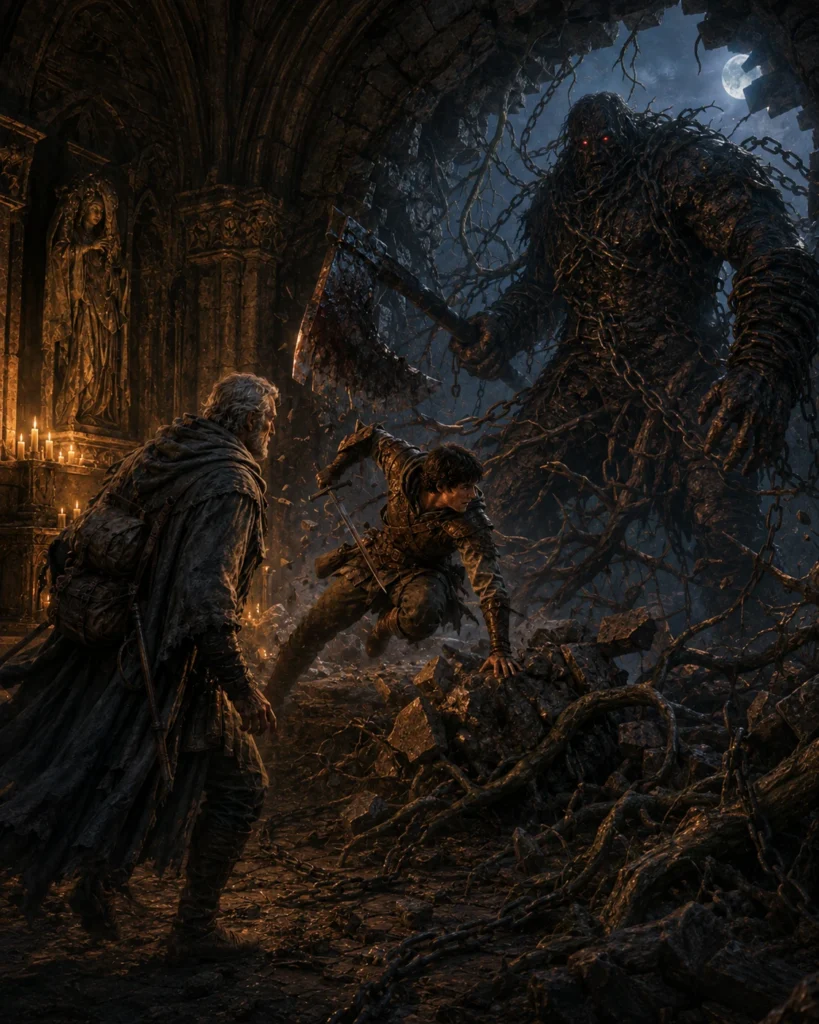
09_the_chained_guardian_rematch

2. The Fight He Could Not Win the Same Way Twice

Leon had imagined this battle many times.

He had imagined becoming stronger.

Faster.

Braver.

He had imagined returning and defeating the monster through superior skill.

But the guardian knew his habits.

It punished familiar dodges.

Blocked familiar strikes.

Expected retreat.

Expected aggression.

Every comfortable response failed.

Leon was forced into something he had never practiced.

Improvisation.

He kicked a candle stand.

Fire spread across spilled oil.

The guardian moved left.

Leon threw his sword right.

Not to hit.

To distract.

He ran toward the wall.

The creature pursued.

At the final instant, Leon jumped onto a hanging chain and swung.

The axe struck stone.

The chapel wall broke.

Moonlight from the impossible forest poured through.

Roots burst from the crack.

The guardian became entangled.

Leon landed badly, rolled, seized his sword, and stood.

The creature could still fight.

He could still attack.

Instead Leon lowered the blade.

Garrick looked at him.

“Why stop?”

Leon watched the struggling guardian.

“Because I don’t think this is a boss.”

Garrick smiled slightly.

“What is it?”

Leon looked at the broken wall.

“A door.”


Chapter Ten

The Dungeon Remembers Because You Do

1. The Heart

Behind the chapel lay no treasure chamber.

No king.

No demon.

No pile of gold.

There was only a vast room.

At its center floated thousands of fragments of stone.

Rooms.

Doors.

Staircases.

Broken statues.

Pieces of corridors.

The architecture of countless versions of the dungeon, rotating slowly in the darkness.

Leon saw places he recognized.

The trapped chest room.

The iron gate.

The first corridor.

The changing circle.

The forest.

And other places he had never seen.

Thousands.

Perhaps millions.

At the center of everything floated a small stone sphere.

Leon approached.

When he touched it—

the dungeon remembered him.

Not with words.

With moments.

His first frightened step through the door.

His hand finding the hidden tile.

His hesitation before the chest.

His retreat from the staircase.

His terror before the chained guardian.

His laughter over the wooden spoon.

His new maps.

His changing habits.

His mistakes.

His adaptations.

Every decision.

Every return.

Every lesson.

The dungeon had not merely changed around him.

It had changed because of him.


2. Why It Changes

Garrick stood beside him.

Leon kept his hand on the stone.

“I thought it was trying to defeat me.”

“Perhaps it was.”

“No.”

Leon shook his head.

“It was trying to stop me from becoming comfortable.”

Garrick said nothing.

Leon finally understood.

A dungeon that never changed eventually became a route.

A solved problem.

A memory.

Walk here.

Open this.

Avoid that.

Kill this.

Take that.

Done.

But this place refused to become dead knowledge.

It demanded attention again.

It demanded curiosity again.

It demanded that the explorer remain an explorer.

Leon smiled.

“The dungeon remembers so I can’t stop thinking.”

Garrick looked at the infinite fragments turning around them.

“Perhaps.”

Leon glanced at him.

“You knew?”

“I suspected.”

“And you didn’t tell me?”

“What would have been the fun in that?”

Leon laughed.


Epilogue

A New Map

They emerged beneath the hill six days after entering.

The village looked unchanged.

The windmill still turned.

Smoke still rose from chimneys.

Children still ran along the muddy road.

Leon sat beside the broken stone marker where Garrick had once stopped him before his first descent.

He unfolded his map.

It looked ridiculous.

Solid lines.

Dotted lines.

Circles.

Triangles.

Warnings.

Questions.

Rooms that no longer existed.

Rooms that might exist again.

Places whose locations changed.

Places whose rules changed.

Places that seemed to remember.

Leon considered throwing it away.

Instead he wrote something across the bottom.

Garrick leaned over.

“What did you write?”

Leon showed him.

A MAP IS NOT THE DUNGEON.

Garrick nodded.

“Useful.”

Leon added another line.

AND THE DUNGEON IS NEVER FINISHED.

The old adventurer smiled.

They sat quietly for a moment.

Then a grinding sound came from beneath the hill.

The iron-bound door moved.

Leon looked up.

The doorway had changed again.

Beyond it was no staircase.

No corridor.

No forest.

Only snow.

Cold wind blew outward.

A single footprint appeared in the white.

Then another.

Something inside was walking toward them.

Leon slowly stood.

Garrick sighed.

“We could go home.”

Leon looked at him.

“You don’t mean that.”

“No.”

Leon drew his sword.

This time he was smiling.

Not because he knew what waited beyond the door.

Because he didn’t.

And now—

that was the best part.

End of Book II

The dungeon had taught him how to read.

Now it had taught him why no great world should ever be completely readable.
The Boy Who Learned to Read the Dungeon

The Boy Who Learned to Read the Dungeon

Prologue

The Door Beneath the Hill

a_detailed_fantasy_medieval_scene_at_dusk_overall

At the edge of a wind-beaten village, beneath a hill that looked too ordinary to matter, there was a door bound in iron.

It did not shine.

It did not glow.

It did not announce itself as the beginning of an adventure.

It simply waited.

Travelers passed it and told stories. Some claimed there was treasure below. Others swore there were monsters, traps, curses, and long corridors that twisted like the inside of a sleeping beast. A few spoke of hidden chambers that could only be found by people who understood how to look. Many laughed, called it a hole in the ground, and went away.

A boy named Leon stood before that door one evening with a torch in one hand and a borrowed sword in the other.

He had never entered a dungeon before.

He had, however, heard enough tales to imagine what it would be like. He thought a dungeon was simple: walk in, fight monsters, take treasure, walk out. Perhaps it would be frightening. Perhaps it would be exciting. But surely the basic shape of it would be easy enough to understand.

He reached for the iron ring.

“Wait.”

The voice came from behind him.

Leon turned and saw an older adventurer sitting on a broken stone marker near the path. The man wore old armor softened by time, a travel cloak the color of ash, and the kind of expression worn by people who had survived too many bad ideas.

His name, as Leon would later learn, was Garrick.

“What?” Leon asked.

Garrick nodded toward the door. “If you go in there believing a dungeon is just a tunnel between battles, the place will make a fool of you.”

Leon frowned. “Isn’t that what dungeons are?”

Garrick smiled a little. “No. A dungeon is a question.”

Leon looked at the iron-bound door again.

“A question?”

“Yes,” Garrick said. “And every room below asks another one.”

He rose, adjusted the strap of his satchel, and stepped toward the entrance.

“If you like,” he said, “I’ll show you how to listen.”

Leon hesitated only a moment before following him into the dark.

Chapter One

The First Lesson: A Dungeon Is Not a Hallway

1. The Corridor That Asked Too Much

The first corridor was narrow, damp, and lined with stone blocks darkened by age. Water dripped somewhere ahead. Their footsteps echoed strangely, as though the hallway were larger than it appeared.

Leon took three quick steps and Garrick caught him by the shoulder.

“Slowly.”

Leon looked back. “There’s nothing here.”

“That,” said Garrick, “is the first mistake beginners make. They look, but they do not see.”

He pointed with two fingers, not at the far end of the corridor, but at the corridor itself.

“Tell me what you notice.”

Leon sighed, more from nerves than impatience. He looked. “Stone walls. Wet floor. Torches.”

“Again.”

Leon squinted. “The torches are uneven.”

“Good.”

He took another look. “The corridor is… longer than it needs to be?”

“Better.”

Leon crouched. “And the middle stones are more worn than the ones near the walls.”

Garrick nodded approvingly. “Now you are beginning.”

They walked forward slowly.

“This is the truth of every good dungeon,” Garrick said. “The walls are speaking. The floor is speaking. The shape of the corridor is speaking. The dungeon is never only the place where battle happens. The dungeon itself is part of the game.”

Leon ran his fingers along the wall.

“What is it saying here?”

Garrick smiled. “That is the right question.”

2. The Puzzle Hidden Inside the Place

At the end of the corridor, they came upon a small chamber with three exits. One led left, one right, and one down a staircase. In the center sat a chest.

Leon brightened immediately. “Treasure.”

“Possibly,” said Garrick.

Leon frowned. “What do you mean, possibly?”

Garrick folded his arms. “If a chest sits in the middle of a room like a king on a throne, you should ask why. Why place it here? Why so obvious? Why so easy? In a dungeon, even generosity can be suspicious.”

Leon stared at the chest with renewed caution.

“So what do I do?”

“You think. You observe. You ask why the designer put this here.”

That sentence stayed with Leon.

Why did the designer put this here?

At the time, he only half understood it. Before the night was over, it would become the key to everything.

Chapter Two

The Art of Looking

1. The Room That Felt Wrong

They chose not to open the chest yet. Instead Garrick led Leon into the left passage, where they found a square room with four cracked pillars and nothing else.

Leon turned in a slow circle. “Empty.”

Garrick gave him a long look.

Leon corrected himself. “Apparently empty.”

“Better.”

The room felt strange. Leon could not explain why. The walls were clean compared to the corridor outside. The cracks in the pillars all leaned inward. Dust had settled thickly in three corners, but the fourth was almost clear.

He pointed. “That corner.”

Garrick said nothing.

Leon walked to it, knelt, and touched the floor. His fingers found a seam. A tile shifted. One wall gave a grinding groan and slid inward, revealing a narrow passage beyond.

His breath caught.

“There was another room behind the wall.”

Garrick’s smile deepened. “And what did you learn?”

Leon stood up slowly, feeling as though the dungeon had just changed shape in his mind.

“That what I see is not all there is.”

“Exactly.”

2. The Visible Dungeon and the Hidden Dungeon

The hidden passage led to a tiny chamber containing an old ring, a bundle of arrows, and a skeleton sitting against the wall with its jaw open as if still astonished by death.

Leon stared at the bones.

“Did he find the room,” Leon asked softly, “or did he die trying to leave it?”

“In dungeons,” Garrick said, “the dead often teach the living. Never ignore a body. Never ignore a note. Never ignore a strange inscription. People fail before you, and the dungeon leaves their lessons behind.”

Leon nodded, though his eyes remained fixed on the skeleton.

On the wall above it, almost too faint to read, were scratched words:

Not all treasure wishes to be taken.

When they returned to the chamber with the chest, Leon stopped several paces away.

“I understand,” he said.

“Do you?”

“It’s not just a room with a chest. It’s a question with bait in the middle.”

Garrick laughed once, sharply. “Now you are sounding like an explorer.”

a_dramatic_fantasy_dungeon_scene_in_warm_torch_li_3_batch

Chapter Three

Treasure, Greed, and Other Dangerous Emotions

1. The Chest in the Center

This time Leon did not rush.

He walked around the chest in a wide circle. The tiles immediately surrounding it were slightly lighter than the rest. On the far wall, three carved faces watched from above: one grim, one blank, one smiling. There were no cobwebs on the lid, which meant something had moved recently.

“Trap?” Leon asked.

“Probably,” Garrick said.

“Monster?”

“Possible.”

“Then why open it?”

Garrick raised an eyebrow. “Because we came to a dungeon, not a bakery.”

Leon grinned in spite of himself.

He crouched, examined the base, and noticed tiny holes in the carved mouths of the wall faces.

“Darts,” he said.

“Likely.”

Leon looked at the lighter tiles. “Pressure plates?”

“Likely.”

He stepped carefully between them, reached from the side, and lifted the lid with the tip of his sword.

For one terrible second, nothing happened.

Then the smiling face on the wall spat a dart clear across the room. It clattered harmlessly past them.

Inside the chest lay coins, a healing vial, and a bronze key.

Leon exhaled in triumph.

Garrick only nodded. “Treasure is better when it must be earned with thought.”

a_cinematic_high_detail_fantasy_dungeon_scene_a_2_batch

2. The Argument Inside the Heart

As they left the room, Leon turned the bronze key over in his hand.

“I wanted to rush it,” he admitted.

“Of course you did,” said Garrick. “That is part of the pleasure.”

“The pleasure?”

“The argument. The little war inside your mind. This might be dangerous. But what if there is something wonderful inside? A dungeon lives in that tension.”

Leon tucked the key into his belt pouch.

“So greed is bad?”

Garrick shrugged. “Greed is useful. Panic is bad. Carelessness is bad. But desire? Desire is what keeps people descending staircases.”

Chapter Four

The Map in the Mind

1. Lost, and Then Less Lost

They returned to the central chamber and took the right passage this time. It bent twice, split once, looped unexpectedly, and descended half a floor before rising again to a locked iron gate.

Leon looked back the way they had come and realized, with a brief pulse of alarm, that he no longer knew exactly where the entrance was.

Garrick noticed.

“Good,” he said.

“Good? I’m lost.”

“Not yet. You’re only uncertain. There’s a difference.”

Leon frowned. “I thought getting lost was failure.”

“In some games,” Garrick said, “perhaps. In the best dungeon games, getting lost is part of the experience. The point is not to always know. The point is to learn.”

He crouched and drew a rough map in the dust: chamber, corridor, secret room, split passage, gate.

“Every turn you survive becomes knowledge,” he said. “Eventually a place that was once confusion becomes familiar territory. That transformation is one of the deepest joys a dungeon can offer.”

Leon studied the little map.

“So old adventurers really used to draw these?”

“Constantly. Whole notebooks full of north, south, east, west. A dungeon stops being a blur once you begin owning its shape.”

a_cinematic_photorealistic_fantasy_dungeon_scene_4_batch

2. Keys That Remember the Past

At the iron gate, Leon produced the bronze key.

It fit perfectly.

He stared at it, delighted. “So this is why the chest was there.”

“Perhaps,” Garrick said. “Or perhaps it opens something else as well. Never assume a key belongs only to the nearest lock. One of the finest habits an explorer can develop is to think backward.”

“Backward?”

“When you gain a key, a spell, a tool, a new ability—do not think only of where it may help ahead. Think of every place you have already seen that you could not pass.”

Leon looked at the gate, then back up the passage toward the rooms they had already crossed.

“The dungeon keeps old promises,” he murmured.

Garrick smiled. “Exactly.”

Chapter Five

The Wisdom of Retreat

1. The Staircase Going Down

Beyond the gate, the air changed. It smelled older, drier, and somehow meaner. They passed two silent alcoves, a room where the floor had partly collapsed, and a narrow bridge over a black drop from which no sound returned.

At last they reached a staircase descending into deeper dark.

Leon felt the pull of it immediately. The next floor. The next mystery. The next reward.

“Can we go down?” he asked.

Garrick did not answer at once. Instead he sat on a low stone block and began checking his pack.

“One healing vial left,” he said. “Half a torch. Your sword arm is slower than when we entered. We do not know what lies below. We are farther from the entrance than from any safe place above.”

Leon understood the answer before it came.

“We turn back?”

“We do.”

He tried not to sound disappointed. “But we’re doing well.”

“That,” Garrick said, “is exactly when many people die.”

a_dark_atmospheric_medieval_fantasy_scene_in_a_di_5_batch

2. The Discipline Beginners Hate

They began retracing their steps.

“A dungeon isn’t only about how bravely you descend,” Garrick said as they walked. “It is also about how wisely you return. Health, light, food, magic, arrows, time—these are not background details. They are the drama.”

Leon nodded reluctantly.

“I wanted to see what was below.”

“So did I.”

“Then why stop?”

“Because I would rather leave with a question than remain long enough to become a cautionary tale.”

Leon laughed at that, but softly, because he knew it was true.

By the time they reached the central chamber again, he had begun to feel something unexpected: pride.

Not in slaying monsters. Not in seizing treasure.

In judgment.

He had come to understand that retreat was not the opposite of progress. Sometimes it was the price of future success.

Chapter Six

The Language of Traps

1. A Skull Beside the Door

Near the entrance hall was a side room they had ignored before. A single skull lay near the threshold.

Leon stopped immediately.

“What is it?” Garrick asked.

“The skull.”

“Yes?”

“It’s too obvious.”

Garrick folded his arms, waiting.

Leon crouched near the doorway. The first flagstone inside was slightly lower than the others. The ceiling above bore a dark groove.

He stepped back. “Something swings.”

Garrick nodded. “Likely.”

Leon took a loose stone from the floor and tossed it onto the lowered tile. A blade like a crescent moon swept down from above with such force that it bit sparks from the far wall.

Leon stared.

“That would have taken my head off.”

“Then let us be grateful to whoever lost the skull,” Garrick said.

2. Grammar of Danger

They did not enter immediately. Instead Garrick made Leon study the room.

“Look again,” he said. “Traps have grammar. The dungeon teaches its language if you survive long enough to listen.”

They found the trigger tile, the swing arc, the safe spot against the side wall, and the chest tucked behind two cracked urns.

Inside: dried herbs, a small silver charm, and a note sealed in wax. The note read:

The west wall of the chapel is hollow.

Leon looked up sharply.

“More information.”

“Sometimes,” Garrick said, “the greatest treasure is not gold. It is understanding.”

Chapter Seven

Monsters, and the Wisdom Not to Fight

1. The Thing in the Chapel

The chapel stood on a lower branch of the first floor, past a row of faded stone saints and a fountain long since dry. They found the west wall, and it was indeed hollow. Behind it lay a narrow prayer chamber and another passage descending into a vaulted crypt.

Something moved there.

Not a skeleton, not a rat, not any ordinary dungeon thing.

It was taller than a man, wrapped in old chain, carrying an axe so broad it seemed made to cut doors in half. Two pinpoints of red light smoldered where its eyes should have been.

Leon instinctively drew his sword.

Garrick put a hand on his arm.

“No.”

“But we can—”

“No,” Garrick repeated. “We cannot.”

The chain-clad creature took one slow step forward. The sound of its armor dragging across stone was enough to empty Leon’s courage all at once.

They retreated.

Only when the chapel was far behind them did Leon speak again.

“I hate that.”

“Everyone hates it,” said Garrick. “At first.”

a_dramatic_high_fantasy_cinematic_scene_in_a_dim_6_batch

2. The World Is Not Your Servant

They sat by the entrance at last, in the cool evening air beyond the iron-bound door.

Leon looked embarrassed. “I thought if I met a monster, I was supposed to fight it.”

“A common mistake.”

“But isn’t that the point?”

“Sometimes. But a dungeon becomes more interesting the moment you understand that not every enemy exists for your convenience. Some are warnings. Some are walls. Some are future victories wearing present forms.”

Leon thought of the thing in chains and shivered.

“So one day I go back.”

“Yes.”

“And then?”

“Then,” Garrick said, “if you have learned enough, you kill it and discover who was master of that crypt all along.”

Chapter Eight

Curiosity and Recklessness

1. Pulling the Lever

Before they parted for the night, Garrick led Leon to one final room near the upper corridor. It contained a dry fountain, a broken statue, and a lever set into the wall.

Leon looked at him suspiciously. “This seems like a test.”

“Everything is a test.”

Leon did not pull the lever.

Instead he walked the room’s perimeter, inspected the fountain basin, touched the statue’s cracked base, and peered at the ceiling.

“What do you think?” Garrick asked.

“The statue isn’t broken,” Leon said slowly. “It turns.”

He pushed, and the statue shifted a few degrees. A channel in the fountain floor clicked. Only then did he pull the lever.

Water burst into the basin from hidden pipes, and a compartment opened beneath the statue, revealing a polished stone set in silver.

Leon laughed out loud.

“What changed?” Garrick asked.

“I did,” Leon said.

a_highly_detailed_fantasy_medieval_scene_in_a_dim_7_batch

2. The Scientific Heart of Adventure

Garrick nodded. “That is the whole secret. Curiosity is not recklessness. Recklessness pulls every lever immediately. Curiosity observes, forms a guess, tests it, and learns.”

“Like a scholar.”

“Like a survivor.”

Leon pocketed the stone.

He thought back over the entire descent: the hidden room, the trapped chest, the key, the skull, the chained monster, the staircase they wisely refused, the strange joy of understanding a place piece by piece.

“I thought dungeon games were about treasure,” he said at last.

“And now?”

Leon looked back at the iron-bound door beneath the hill.

“Treasure matters,” he said. “But what I really want is to understand what’s down there.”

Garrick’s expression, for the first time, held no amusement at all—only approval.

“Then,” he said, “you are ready to become an adventurer.”

Chapter Nine

The Great Lineage Beneath the Earth

1. The Ancestors of the Labyrinth

They met again many times after that evening, and on one long journey between towns Garrick spoke not of a single dungeon, but of the great tradition behind them all.

“There are old names,” he said, “that every student of dungeons should know.”

He spoke of Wizardry, where parties of adventurers descended into dangerous labyrinths, learning caution, discipline, and the thrill of uncertain survival. He spoke of how its influence reached far beyond its birthplace and shaped the imagination of players across the world, especially in Japan, where the spirit of first-person dungeon crawling would continue in games that asked players not only to explore the labyrinth but to map it with their own hands.

He spoke of Rogue, where no expedition was ever quite the same twice, where randomness itself became part of the underground mystery, and where every descent could become either legend or disaster.

He spoke of Dungeon Master, where the dungeon felt immediate and physical, less like a page of calculations and more like a place your body occupied.

He spoke of Ultima Underworld, where the underground ceased to be merely a maze and became a world.

He spoke of Diablo, which turned descent, combat, and treasure into one of the most irresistible loops in the history of games.

And he spoke of darker, later kingdoms—of worlds where doors folded back upon themselves, where elevators and gates rewrote your mental map, where death taught humility, and where the player’s greatest reward was the sudden, electric realization that two places thought separate were secretly one.

Leon listened to all of it as if hearing the history of a religion.

2. A Global Language of Discovery

“What joins them all?” Leon asked.

Garrick answered without hesitation.

“The same hunger.”

“What hunger?”

“To go where you do not understand. To endure confusion. To notice the shape of danger. To gather knowledge from fear. To make the unknown familiar.”

Leon smiled. “To read the dungeon.”

Garrick looked pleased. “Exactly.”

Chapter Ten

The Final Rule

1. Return to the Door

Years later, Leon would stand before many dungeon doors.

Some were hidden beneath ruined castles.

Some lay under forests, deserts, cathedrals, towers, frozen lakes, and forgotten cities.

Some were beautiful.

Some were terrible.

Some opened only after long quests.

Some looked plain and harmless and nearly killed him for underestimating them.

Yet every time he placed a hand upon stone or iron before descending, he remembered the first hill, the first door, and the first lesson.

Do not rush.

Look.

Listen.

Ask why.

Remember the way back.

Study the architecture.

Respect traps.

Be greedy enough to care, cautious enough to survive.

Read the notes of the dead.

Treat sound as information.

When you find a key, think of old locks.

When you face an impossible enemy, live long enough to return.

When the dungeon confuses you, do not despair.

Learn.

When it frightens you, pay attention.

When it surprises you, be grateful.

When it reveals a hidden passage, understand that the world is always larger than it first appeared.

2. What You Are Really Seeking

And if someone had asked Leon, after all his years below the earth, what a dungeon game truly offered—what ancient pleasure lay inside dark corridors, suspicious walls, staircases, trapped chests, and lost maps—he would have answered this way:

Not merely treasure.

Not merely battle.

Not merely progress.

What you seek in a dungeon is the transformation of ignorance into understanding.

At first the place is hostile, confusing, unknowable.

Then, slowly, room by room, trap by trap, clue by clue, shortcut by shortcut, it becomes legible.

A labyrinth becomes a language.

A threat becomes a conversation.

A mystery becomes a territory of the mind.

That is why people return.

That is why the great dungeon games endure across generations, countries, styles, and eras.

Because somewhere inside every good dungeon lies the oldest adventure of all:

to step into darkness,

to survive long enough to learn its shape,

and at last—

to understand.

Epilogue

Read the Walls

If ever you stand before a dungeon for the first time, eager and inexperienced, remember this:

Do not ask only, “Where am I supposed to go?”

Ask instead:

What is this place trying to tell me?

Then open the door.

And begin.

error: Content is protected !!