Quick Verdict: Is The Adventures of Elliot Worth Buying?
The Adventures of Elliot is a strong choice for players who enjoy HD-2D visuals, exploration, puzzles, fast action combat, and retro RPG nostalgia. Overseas reviews and broad social media reactions are generally positive, especially around its nostalgic adventure feel and satisfying gameplay. However, players who prioritize a deep story, polished late-game payoff, or a flawless experience may want to wait. Overall, it looks like a smart buy for the right player.
Why This Game Is Getting Attention Now
The Adventures of Elliot is getting attention because it combines familiar retro action-adventure design with modern HD-2D presentation. For many players, the appeal is not just the story or setting, but the feeling of discovering a classic-style adventure that still looks fresh today. That makes it especially interesting for fans who want exploration, fast combat, and a nostalgic RPG atmosphere without committing to a massive open-world game.
Quick Verdict and Critical Reception
The Adventures of Elliot is best suited for players who enjoy HD-2D action RPGs, exploration, puzzles, and retro adventure design.
Critics highlight the game’s HD-2D presentation, map discovery, puzzle design, fairy-supported combat, and compact adventure structure.
Criticisms and Social Media Reactions
The main criticisms focus on the story, companion chatter, uneven moments, and whether the late-game payoff feels satisfying.
Social media reactions show strong curiosity, positive demo buzz, and cautious optimism around The Adventures of Elliot.
Buy or Wait: Final Decision
Buy it if you want HD-2D exploration and action RPG nostalgia; wait if story depth, polish, or late-game payoff matters most.
Final verdict: The Adventures of Elliot looks like a smart buy for players who prioritize gameplay, exploration, and classic adventure atmosphere.
Subscription Games Are Also Fun
Reviews help you decide whether to buy a game, but subscription games are also a fun way to discover new titles without committing to a full purchase.
BrainChip is one of the more unusual companies in the edge AI space. Its Akida platform is built around neuromorphic, event-based AI processing — a design philosophy inspired by the brain and focused on low-power, low-latency intelligence near the sensor.
That matters because the next wave of AI may not live only inside giant cloud data centers. Robots, drones, cars, wearables, smart cameras, and industrial machines all need fast local decisions. For that kind of world, edge AI could become a critical part of the technology stack.
An Illustrated Guide to BrainChip
BrainChip at a glance: Akida, neuromorphic AI, low-power edge processing, and possible applications across robotics, drones, wearables, automotive, and industrial IoT.
Why edge AI matters: local intelligence can reduce latency, improve privacy, lower bandwidth needs, and support real-world machines that need fast decisions.
BrainChip traction and credibility signals, including NASA listed in investor materials, Arm Cortex-M85 integration, Intel Foundry Services ecosystem participation, and a Raytheon-related AFRL radar project.
The edge AI thesis: BrainChip is interesting because it focuses on distributed, low-power, device-side intelligence rather than only centralized GPU-scale AI.
Main Article Summary
The core reason BrainChip is interesting is simple: not every AI workload belongs in the cloud.
Cloud and GPU-centered AI are powerful for large-scale model training, massive inference workloads, and centralized compute. But physical AI — robots, drones, vehicles, smart sensors, wearables, and industrial machines — often needs intelligence close to where data is created.
That is where edge AI becomes important. Local AI can reduce response time, reduce bandwidth use, improve privacy, and allow devices to keep working even when cloud connectivity is limited.
BrainChip’s Akida platform is designed for this edge-first world. The company positions Akida as a neuromorphic, event-based AI processor and IP platform focused on low-power inference and on-chip learning near the sensor.
The traction is also part of the story. BrainChip has announced Akida integration with Arm Cortex-M85, participation in the Intel Foundry Services ecosystem alliance, and involvement with Raytheon on an Air Force Research Laboratory neuromorphic radar project.
NVIDIA Note
One important clarification: this is not a “BrainChip has an NVIDIA partnership” story.
The more useful framing is that BrainChip sits in a different lane. NVIDIA-style GPU AI is powerful for centralized, high-performance AI workloads. BrainChip’s appeal is its focus on ultra-low-power edge intelligence, where devices need fast local decisions.
These two approaches can coexist.
My Perspective: Why BrainChip Feels Ahead of Its Time
BrainChip’s Akida is interesting because it points toward a future where AI is not only centralized in data centers, but distributed across robots, devices, sensors, vehicles, wearables, and XR experiences.
Physical AI needs local intelligence. Real-world machines must be able to sense, decide, and act even when the cloud is not available.
That is why edge AI matters — and why Akida feels like a technology worth watching.
A Small Game Industry Angle
Although BrainChip is not primarily a game company, its edge AI direction could also matter for the future of games and digital entertainment.
As games evolve toward XR, AR, spatial computing, AI characters, smart devices, and real-world interactive experiences, more intelligence may need to run locally on devices. Low-power, low-latency, on-device AI could help future games respond faster, feel more personal, and blend more naturally with the physical world.
That is another reason BrainChip is interesting to watch. Akida is not only an edge AI story for sensors, robotics, automotive, and industrial systems — it may also connect to the long-term future of interactive entertainment.
Future Expectations and How to Follow Up
BrainChip is not guaranteed to become a major winner, and interesting technology does not automatically become a successful business. But as an edge AI story, it is genuinely unusual.
If the future of AI includes millions of smart devices, robots, cars, sensors, and machines making decisions locally, then low-power neuromorphic edge AI is a field worth watching.
ClickAIXR: On-Device Multimodal Vision-Language Interaction with Real-World Objects in Extended Reality arXiv:2604.04905 A 2026 research paper about on-device AI for XR interaction with real-world objects. Useful as a source for the idea that future XR, AR, and real-world interactive entertainment may require local, privacy-preserving, low-latency AI. https://arxiv.org/abs/2604.04905
Disclaimer
This article is for informational and educational purposes only. It is not financial advice, investment advice, or a recommendation to buy or sell any security. Always do your own research.
Experience the experimental full-stack game built in about one hour with Manus AI and deployed on Render. It may have bugs, but that is part of the point — seeing how fast generative AI can turn ideas into playable public demos.
Since this demo page is hosted on the free plan, it may take about a minute to load.
Latest Game SteamRunner
Play SteamRunner and earn rewards you can use in future MMORPGs
This retro-inspired running action game, with echoes of Pac-Man and Space Invaders, is fun on its own — but it also sparks a bigger question about where games may be heading. As you play, you can earn in-game currency tied to a future blockchain MMORPG, along with crypto rewards that may be converted into stablecoins. While that MMORPG’s AI direction is still unknown, it is hard not to wonder how deeply AI may shape the future of games — in development, world design, NPC behavior, and player experiences. That intersection is still blurry, but it may be one of the most exciting frontiers in gaming.
Summary
The biggest takeaway from this experiment was simple:
Using Manus AI’s free tier, I built a buggy but working full-stack game in one hour, and pushed it to a public demo on Render.
Yes, Render free hosting has limitations.
But for demo purposes, those limitations were acceptable.
And more importantly:
Even full-stack games can now be built and shipped quickly by individuals using generative AI.
The difficulty hasn’t vanished completely.
But the barrier to building and shipping has clearly dropped.
And that means modern indie development may be less about perfection, and more about:
Before this project, I had already built my first HTML game, which became an important stepping stone for experimenting with game logic in the browser.
— Behind the Scenes of Developing a Battle Game Centered on Chanting —
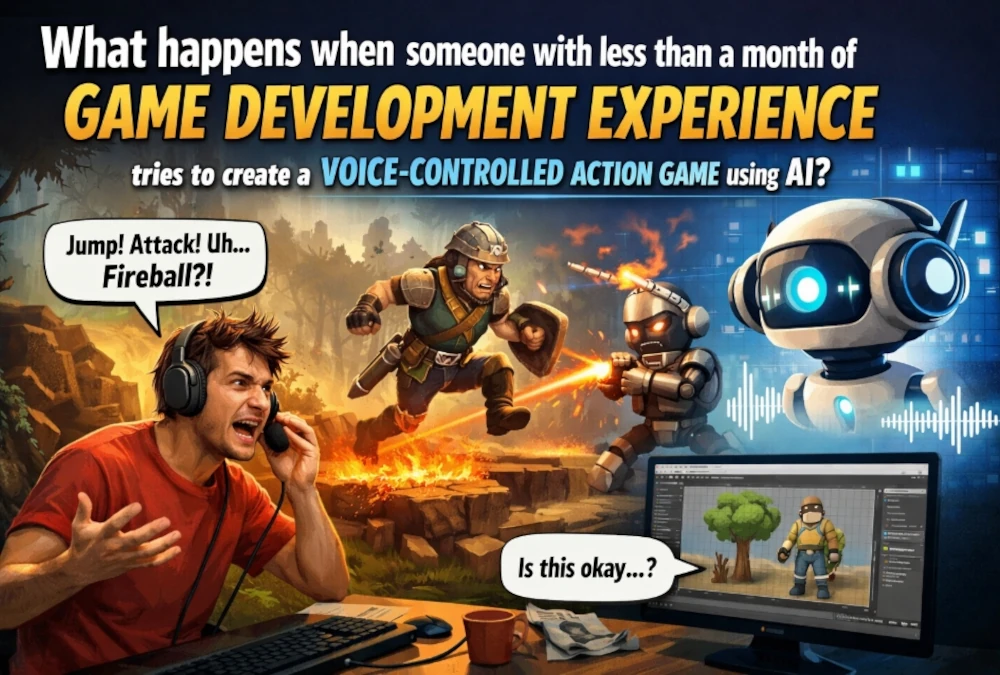
What happens when someone with less than a month of game development experience tries to create an action game controlled by voice input?
It probably does not go smoothly.
The design falls apart halfway through. The naming gets messy. You fix one thing, and something else breaks.
But I think that messy process is exactly where the real story of development shows up.
This time, I want to share some behind-the-scenes thoughts on the voice-input action game I am currently making. This is not so much a polished postmortem of a finished game, but more of a record of how a beginner actually struggles, where the time goes, and how the game slowly starts taking shape.
First, what kind of game am I making?
The game I am making is a side-scrolling action game where you cast magic by speaking words like “Fire,” “Water,” and “Wind.”
It looks cute on the surface, but the systems behind it are surprisingly ambitious.
Voice recognition to cast spells
Three basic magic types
Combined spells
Different enemy behavior patterns
Day/night and field variations
Support magic
Energy accumulation and gate creation
Stage clear sequences
Environmental gimmicks like campfires and fallen logs
For someone with less than a month of game development experience, I am probably trying to do too much.
And naturally, the more I added, the harder things became.
The most time-consuming part is not “adding new features” It is making everything work together naturally
This is the biggest thing I have learned while making the game.
When you are a beginner, moments like “I made magic appear!” or “The enemy moves!” are exciting. Those isolated features can be surprisingly fun to build.
But the real difficulty comes after that.
Take enemy behavior, for example.
Chase the player
Patrol within a certain range
Attack
Run away if there is a campfire nearby
Jump
Land on the ground properly
Turn in the right direction
Trying to make all of those behaviors coexist at the same time suddenly becomes very hard.
You get situations like:
“I added the fleeing behavior, and now it no longer attacks.”
“I restored the attack logic, but now it seems to prioritize the player over the fire.”
“It runs away from the fire, but its face is still turned toward the player, which looks weird.”
As a beginner, I realized there is a huge gap between writing individual pieces of logic and making the whole thing look natural as a game.
The thing I am struggling with most right now: the slime’s “campfire panic”
Lately, the thing I have spent the most time on is slime behavior.
In the night field, if you hit fallen logs or piles of dry branches with Fire magic, they ignite. I wanted slimes to react to that.
It sounded simple at first:
“If there is a burning campfire nearby, the slime runs in the opposite direction.”
But once I implemented that, a lot of other problems appeared.
Its patrol logic was still active, so even after fleeing, it would reach the edge and turn back
Its facing update was still tied to the player, so it ran away while still looking at the player
If I made it stop attacking while fleeing, it actually felt less alive
That last one was especially interesting.
At first glance, “a fleeing enemy should not attack” sounds logically correct. But when I actually watched it on screen, it felt unnatural.
So I ended up going in the opposite direction.
Now the slime panics and runs away, but still attacks in a desperate, reckless way. That made it feel less mechanical and more like a living creature.
This was the kind of adjustment I could not have figured out just by looking at code. I only understood it after watching it move in the actual game.
What matters more than “correct logic” is “logic that feels convincing”
One thing I have felt over and over during development is this:
What matters is not whether the logic is technically correct. What matters is whether the player can look at it and feel that it makes sense.
Take the campfire effect, for example.
At first, it worked functionally. Things burned, and slimes reacted.
But visually, the flames were too small.
From a system point of view, the fire existed. But on screen, it looked more like a little glow than an actual dangerous fire.
If the player cannot clearly read “that thing is burning,” then the slime running away from it does not feel justified.
So now I am adjusting it like this:
Piles of dry branches get flames at double size
Fallen logs get flames at triple size
That felt symbolic of a much bigger lesson.
In games, what matters is not what is happening internally. What matters is what the player can understand from the screen.
The most beginner-like weakness shows up in naming and organization
One area where I really feel my inexperience is in code organization.
As I keep adding new features, the number of conditionals grows rapidly. Different enemy types need different movement. Special fields need special logic. Certain attacks only work under certain conditions. Support magic overlaps with other systems.
And then you start getting situations like:
“Why does a piece of code named dragon affect slime behavior?”
That is very real beginner development.
At first, you build things with the mindset of “if it works, it works.” And honestly, that is not even wrong in the beginning. You need to make things move somehow.
But once the project grows, your future self starts getting confused.
There were moments while adjusting slime behavior when even I had trouble immediately understanding where I needed to edit things.
That made me realize something important:
The difficulty of development is not just in making enemy AI. It is also in keeping the code readable enough that you can still work on it later.
Voice-input games come with their own very specific problems
The core of this game is that it can be played using your voice. That sounds cool, but it is much more troublesome than it looks.
Voice recognition does not hear things the way you want it to.
So it is not enough to just detect the word “fire.”
In reality, I end up handling a lot of variations like:
fire
fir
firee
waterr
window (misrecognized instead of wind)
resurection (a broken version of resurrection)
That part has been surprisingly interesting.
Sometimes it feels like I am not just making a game. It feels like I am also gradually building a dictionary of likely mishearings.
As a beginner, I found that making voice input feel natural was in some ways harder than making the magic itself stronger or more interesting.
But at the same time, this is also what makes the game feel unique. Without that messy voice-recognition layer, it would just be another keyboard action game.
Because of that, it really feels like a game where words themselves hold power.
One of the most fun parts was not adding mechanics. It was making systems connect to each other
Personally, one of the most satisfying parts of development was not adding isolated features. It was seeing different features begin to connect.
For example:
Your Magic Experience Points increases your magic level
Higher magic levels unlock combined spells
Defeating enemies fills up Cosmos Energy
When Cosmos Energy is full, you can create a transfer gate
In the night field, Fire can burn fallen logs and branch piles
Slimes panic when they encounter those flames
Once these links started to appear, the world stopped feeling like a collection of test functions. It started to feel more like an actual game world.
One of my favorite parts is that magic no longer affects only enemies. It also affects the environment.
When beginners make games, it is easy for everything to stay trapped within the simple loop of “attack” and “enemy.” But the moment the player can affect the world itself, the game suddenly feels much more real.
That gave me a lot of confidence.
Trying to do too much is exhausting. But trying to do too much also taught me a lot
Honestly, for someone with less than a month of experience, putting all of this into one project is a lot.
Basic magic
Combined magic
Support magic
Three enemy types
Splitting slimes
Field variations
Campfire gimmicks
Voice input
Energy systems
Stage clear conditions
It probably would have been cleaner if I had made something much smaller. There would have been fewer bugs too.
But because I pushed too far, I learned something important very clearly:
Adding features and making the whole game hold together are completely different problems.
In that sense, maybe it was actually a good thing that I ran into this wall while I am still a beginner.
Right now, I do not think I am in the stage of “making it well”. I think I am in the stage of “learning how to fall properly”
If you look only at the level of polish, the game is still far from finished.
The priorities between systems still collapse sometimes. The visuals are still being adjusted. There are still many parts I want to go back and improve.
But I think that is okay.
What happens when someone with less than a month of game development experience tries to make a voice-controlled action game?
The answer is probably this:
You take a lot of detours. But those detours teach you things you could not learn any other way.
Things like:
what breaks when you change a certain piece of code
when to prioritize visuals over logic
why “technically working” is not enough if it does not feel good to play
why naming and structure matter if you want your future self to survive
why, in games, feeling convincing matters more than being theoretically correct
Those are the lessons I am learning right now, in real time.
The most interesting part of this game might be that it is still moving forward while still being immature
There is a lot to learn from highly polished development logs made by skilled developers. But that is not really the part I want people to see here.
What I want people to see is the process itself:
A person with less than a month of game development experience, trying to build something they do not fully understand yet, breaking it, fixing it, and slowly turning it into a game.
It is not clean. It is probably full of unnecessary detours. But because of that, it is real.
“This is what happens when a beginner makes a game.”
As a snapshot of that process, I think this project is being very honest.
It is not finished yet. But at least now, it feels like I have moved from the stage of just making things to the stage of trying to make them actually work together as a game.
In my previous article, I introduced a prototype of a game I created using generative AI.
In this article, I’ll share my personal experience—specifically, what actually happened during the development process and how far I was able to get as a complete novice in game development.
The focus of this article is not to compare the merits and demerits of each tool.
Rather, this is an article reflecting on my personal experience to answer the question: To what extent could a game development novice create something that actually feels like a game by using generative AI?
An overview of the completed game and the demo page are summarized in the introduction article.
My Background as a Beginner
First, I’ll outline my background.
No prior experience in game development
No prior experience in 3D data modeling
However, I have 17 years of professional experience as a systems engineer, IT help desk specialist, and systems administrator
About 3 years of experience using AI tools
In other words, I’m not completely new to IT.
However, this was my first time actually making a game.
I believe this background is significant.
This is because in many situations where I was able to get through this project, the foundation was not so much game development knowledge, but rather the instincts I acquired through IT work—such as setting up environments, troubleshooting errors, and being vigilant about specification discrepancies.
On the other hand, simply having the program run is not enough to make a game work.
It’s necessary to shape the game by incorporating visuals, sound, world-building, playability, and even presentation—and that was truly a challenge for a complete novice.
Time Taken to Complete the Prototype
As a rough estimate of production time, it took approximately 70 hours for the HTML version and about 90 hours for the Godot version to reach a playable prototype stage. This is not a precise measurement but a rough estimate based on the number of days and hours worked. Note that this does not include the time spent preparing for the demo release; it refers to the time from when I started building until the prototype was in a playable state after repeated revisions. In my experience, the Godot version, being modular in structure, presented more challenges during revisions and adjustments, and I feel that this difference was reflected in the time it took.
My Experience with the HTML Version
Challenges
The HTML version progressed quite quickly at the very beginning.
I remember feeling that “this might actually work” because it took far less time than I had imagined to get something up and running.
However, things weren’t easy from there on out.
What I struggled with most was getting the visuals to look exactly as I intended. Even when I specified specific processing steps, the visual fidelity was low; for instance, the receipts the ATM dispenses initially ended up looking like paper airplanes. It wasn’t enough for it to simply work—it took a significant amount of effort to make the visuals look “realistic.”
Sound was another area where I struggled.
I had to rewrite the audio generation program for each stage multiple times. The issues weren’t just with the code itself; sometimes the audio wouldn’t play due to where it was implemented, and even when it did play, it was often too hard for the player to hear. It’s not enough for the sound to simply play; we had to ensure it felt natural to the human ear, so I felt this was an area where relying solely on AI wasn’t sufficient.
Additionally, as the code grew larger, it became increasingly difficult to have it output the entire text continuously.
While we could generate everything at once up to a certain scale, as the number of lines increased, the output would often stop midway or omit necessary processing. From this point on, simply telling it to “output everything” no longer worked, and detailed incremental instructions became necessary.
Observations from Use
What I noticed while using it was that generative AI struggles in some situations to accurately grasp the final visual form based solely on text.
Especially for parts related to appearance, providing instructions while showing an image made it easier to achieve the intended result, and the accuracy of both input and output improved compared to using text alone. Color schemes also required more than just simple color specifications; adjustments were needed that included gloss and texture.
Another significant observation was that the AI tends to prioritize “working code” and lacks a strong optimization mindset.
Even for the same process, I got the impression that unless the human designer incorporates lightweight and high-speed design principles from the start, the implementation tends to become heavy and slow. I clearly understood that ‘working’ and “running smoothly” are two different things.
Effective Workflow
As conversations grew longer, responses became slower, and the system often stopped midway.
However, starting a new session at a natural breakpoint and resubmitting the entire code at that point tended to make things more stable.
Also, instead of generating the full text every time, specifying additions, deletions, before-and-after changes, reasons for the work, and target sections as differences made it easier to proceed even with large codebases.
With the HTML version, since it’s easy to grasp the whole picture on a single page, it was easier to see exactly what needed to be changed, and I felt the conversation flowed more smoothly than with the modular approach.
Experiences with the Modular Approach
Challenges with the Modular Approach
In modular development like Godot, we could proceed by outputting the entire code during the initial, lightweight stages, but as the processing load increased, outputting the full text tended to stall midway.
From that point on, it became a series of incremental revisions, and if the developer didn’t understand the structure themselves, it became impossible to keep up. In modular development, I felt that rather than leaving everything to the AI, humans need to proceed while maintaining an understanding of the big picture.
What stands out most in my memory is the implementation of the background music (BGM).
No matter how many times I revised the code, it didn’t improve. When I traced the cause, the problem wasn’t with the program itself, but with the file format I was using for the BGM. It wouldn’t play properly with wav, and it wasn’t until I switched to ogg that it finally played. I realized the importance of humans noticing when something is “off” and correcting the course, because generative AI can sometimes veer off track once it goes astray and continue moving in the wrong direction.
The same thing happened with visual adjustments.
The initial obstacles generated were quite simplistic: the airplane had unnatural wings, the juice looked like a stick, and the candy resembled little more than a colored box. By repeatedly adjusting these elements to convey their characteristics, we finally began to create a game that was visually clear and easy to play.
Insights from the Modular Approach
In the modular approach, it was crucial to clearly specify exactly what to change and where when adding, removing, or replacing parts of the program.
Even if the output seemed correct at first glance, upon later inspection, we sometimes found that parts of the generation were missing, so we couldn’t feel confident unless we provided detailed instructions.
However, what I strongly felt during this process was that the very act of developing a game using AI also served as a way to hone debugging skills and structural understanding.
While the AI made things easier, the experience of reviewing its output, making judgments, and making corrections directly translated into improved development skills. Compared to the old days of writing everything from scratch by myself, I feel that development speed has increased significantly.
Limitations I Encountered with the Modular Approach
When I shared the entire module and went through multiple rounds of feedback, there were instances where the AI noticed structural imbalances or processing bottlenecks.
However, for issues like BGM—where the root cause lay not in the code itself but in file formats or implementation conditions—the discussion would sometimes veer off track, leading to a series of irrelevant fixes. While generative AI is convenient, I felt that prioritizing and isolating problems still relies heavily on human judgment.
Additionally, I couldn’t ignore Godot-specific coding conventions, version differences, or UI variations.
Even when I provided the development environment details, it sometimes returned code with syntax errors, so I couldn’t trust it blindly and had to verify it with my own eyes at least once. While the modular approach is better suited for organized development, I felt that it also increases the difficulty for beginners trying to rely solely on AI.
Overall Summary
The Gap Between Initial Expectations and Reality
Before starting, I assumed that even with generative AI, the limit for beginners would be simple 2D games like Space Invaders or Pac-Man.
However, once I actually tried it, that assumption was overturned quite early on. The first step was surprisingly easy, and simply getting something functional up and running was much faster than I had imagined. Even without any game development experience, generative AI allows you to go from “nothing” to a “playable state” in one go. That speed of getting started was one of the things that surprised me the most this time.
However, the ease only lasted until the very beginning.
The more you build, the more issues—such as visuals, movement, sound, structure, and consistency—pile up all at once. Generative AI excels at laying the initial foundation. However, in the subsequent process of refining it into “what you actually want to create,” human understanding and judgment become crucial. In that sense, this experience taught me not that “generative AI can do everything automatically,” but rather that “even beginners can get started quickly, but the closer you get to completion, the more significant the human role becomes.”
Where Generative AI Shone
I felt generative AI was particularly strong in getting the initial prototype up and running and providing a large number of rough drafts for implementation.
Even for something that would take who knows how many years to write from scratch on my own, using generative AI allowed me to get it to the point where it functioned as a prototype in a short amount of time. This is huge. From the perspective of someone with no game development experience, the fact that it made me feel like “I can actually do this” was valuable in itself, but this time, I went beyond that and actually reached a stage where it looked like a real game.
I also felt that generative AI doesn’t just spit out code; its role changes depending on the user’s objectives.
It helped me organize my options when I wanted to think about implementation methods, served as a foundation for my work when I wanted to move forward, and helped me quickly create a rough draft when I had a clear idea of what I wanted to do. In other words, I feel that the strength of generative AI lies not in its versatility, but in its ability to amplify human intent.
Where Human Perseverance Was Needed
On the other hand, there were clearly situations where generative AI alone wasn’t enough.
The most challenging aspects were debugging and maintaining consistency. While it can generate code, when it comes to whether that code truly fits with the whole, whether it breaks other parts after being modified, or whether it works across different environments and versions, it suddenly becomes unreliable.
In fact, there were times when the AI itself would later point out issues with the code it had generated—such as “a definition is missing” or “there’s a duplicate function”—and I felt time and again that the momentum of the output and the stability of its consistency are two separate things.
Furthermore, as conversations grow longer, the burden on the human side increases.
Misreadings, oversights, and assumptions become more frequent, and there were times when we lost sight of the root cause of an error due to these factors. It’s not just a problem with generative AI; there are also difficulties on the human side when dealing with long texts. That’s why it was crucial to implement workflows such as breaking things down into segments, making incremental corrections, and reorganizing and resubmitting the existing code. While using generative AI certainly makes things easier, it doesn’t work if used carelessly; using it effectively requires persistence and organizational skills on the human side.
Where My IT Experience Came in Handy
What I realized once again this time was that even without game development experience, my previous IT work experience served as a solid foundation.
Whether it was understanding runtime environments, being vigilant about version differences, isolating errors, recognizing quirks in interfaces, or handling variations in tool specifications—I felt my past experience directly applied in areas separate from the game itself.
I believe the perspective of not just the program’s contents, but also “how to run that program” and “where to look for problems”, was a sense I could only have developed through my professional experience.
Conversely, I also felt that for someone with absolutely no IT experience, there’s an additional hurdle between having generative AI write the code and actually getting it to run.
What is a module? What is a development environment? What happens when versions differ? Without that foundational understanding, it’s easy to get stuck before you even start game production. Still, this experience demonstrated that even without game development experience, if you have an IT foundation, generative AI can be a very powerful tool.
Conclusion from a Beginner’s Perspective
To conclude from a beginner’s perspective, I believe that by using generative AI, even those with no game development experience can sufficiently reach the point of creating something that looks like a game.
At the very least, I feel we’ve entered an era where it’s realistic to aim to take an idea, bring it to life, test it, and present it as a playable prototype. This is a significant shift. Game development is no longer the exclusive domain of a select few experts; for anyone with a creative drive, the gateway to actually entering the field has widened considerably.
However, it’s not the case that anyone can create everything completely automatically.
As the scale increases, there are definitely areas where human persistence is required—such as consistency, debugging, understanding the environment, and refining the visuals. If your goal is to release a demo, as in this case, simply writing the code isn’t enough; you need to consider everything from testing the functionality to preparing the release environment and organizing how it will be presented.
Furthermore, if you’re looking to sell it on an app store, what comes next is no longer just about programming. A whole new set of practical tasks suddenly comes into play, including release procedures, app store submissions, legal compliance, terms of service, marketing, and ongoing improvements.
Even so, what I can clearly say from this experience is that generative AI has the power to turn a beginner’s challenge into a tangible reality.
Creating the “foundation” of a game has become far more realistic than before. However, the range of skills required varies greatly depending on whether you proceed to releasing a demo or take it all the way to sales. However, I definitely feel that generative AI has shortened the distance from taking that first step to actually shaping the project and releasing it to the world.
For me, generative AI was the force that turned “This might be impossible” into “Let’s just try to make it happen first.”
What I realized through this experience is that while generative AI provides a powerful boost for beginners, it is not a magic tool that can handle everything from start to finish.
Nevertheless, there is no doubt that it brings the possibility of creating a “playable” game—even for complete beginners—much closer to reality.
What I created this time is a prototype of a homemade game made using generative AI.
Rather than aiming for a finished product, I prioritized getting it to a point where it could actually be played.
As a game, I adjusted various elements—such as the movement, visuals, sound effects, BGM, and presentation for each stage—to create an experience that feels like a real game.
My goal was to create a prototype that goes beyond just moving screens, incorporating visual presentation, sound, and the way obstacles are displayed to ensure it holds together as a cohesive prototype.
What I Created
In this project, I utilized generative AI to incorporate the following key elements:
A basic system that functions as a game
Stage-specific visual effects
Implementation of sound effects and BGM
Adjustments to the appearance of obstacles and objects
Creating the overall atmosphere of the screen
Additionally, during the development process, we experimented with both HTML-based architecture and modular architecture.
For this release, we are focusing on the game itself as a showcase to give you a sense of “what we’ve created.”
As for development time, it took approximately 70 hours for the HTML version and about 90 hours for the Godot version to reach a playable prototype stage. These are not exact measurements but rough estimates based on the number of days and hours worked. Please note that this does not include the time spent preparing the demo for release; rather, it represents the time from when I started building until the prototype was in a playable state after repeated revisions. In my experience, the Godot version, being modular in structure, presented more challenges during revisions and adjustments, and I feel this difference was reflected in the time required.
What Was Created Using Generative AI
The key point here is that even even without game development experience, I was able to actually create a game prototype by leveraging generative AI.
While I used several generative AI tools, the focus of this article isn’t on comparing tools, but rather on
how far a beginner can take a project by using generative AI.
At first, I thought a simple 2D game would be the limit, but in reality, I was able to take it to a point where it felt quite like a game—including not just the mechanics but also visual effects, sound, and visual adjustments.
Of course, fine-tuning and debugging were necessary, but even so, I feel that the speed at which we went from “nothing” to a “playable state” is a major strength of generative AI.
Additionally, before actually creating a game like this one, I wrote an article simulating how to proceed if you were to create a game using generative AI. This project was also an effort to test just how far we could actually take a game into a tangible form using generative AI, based on the workflow and vision I had outlined in that article.
Highlights
What I want you to focus on in this prototype isn’t so much the level of polish, but rather the fact that a beginner was able to create this much using generative AI.
The highlights include the following points:
It’s actually playable
Although it’s a prototype, it’s not just a sample—it’s reached a state where you can actually play it.
I felt that even when using generative AI, it’s entirely feasible to turn an idea into a working prototype.
It captures the essence of a game, including sound and presentation
We also worked on creating the atmosphere of a game through sound effects, background music, and visual adjustments.
While the visuals and sound were areas where we struggled with adjustments, they are also the parts where we felt the most satisfaction as a prototype.
It’s a challenge from a beginner’s perspective
This project wasn’t undertaken by someone with prior game development experience; rather, it was an attempt to see how far I could go using generative AI starting from scratch.
For that reason, I believe the value lies not so much in the finished product, but in the fact that “a beginner’s challenge has taken shape to this extent.”
Demo Page Link | html type game & module type game
During the creation of this game, I made many more discoveries than I had anticipated—from visual adjustments and sound implementation to debugging and organizing the structure.
I’ve summarized these experiences in a separate article titled Development Experience.
If you’re interested in learning about the challenges I faced during development, how using generative AI helped me make progress, and my perspective as a beginner, please be sure to read that article as well.
Game development using generative AI isn’t magic that automatically completes everything for you.
Still, I felt it holds significant potential in helping beginners bring their ideas to life and progress to the point where they can release a playable prototype.
As a concrete example, I’m releasing a prototype of my own game here.
I hope you’ll take a look at the game itself first, and if you’re interested, please read the development experience article as well.
Excerpt If you want a Pokémon story that feels closer to the games, Pokémon Adventures is a great manga to start with. Also known as PokéSpe or Pocket Monsters SPECIAL, it’s region-by-region, game-inspired, and not afraid to raise the stakes while keeping the thrill of exploration front and center. This spoiler-light guide gives you a clean Red-first route, plus a few bonus side paths for official reading, subscription-friendly Pokémon games, and retro break-time picks.
Spoiler note This roadmap is spoiler-light. The games/subscription section names a few classic titles and lightly references later regions, but avoids major manga plot reveals.
Why Starting with Red Works So Well
Some manga ask you to trust the vibe first and the world later. Pokémon Adventures does the opposite: it drops you into a world that already feels familiar if you’ve spent any time with the games.
That’s why starting with Red feels so right. You start in Kanto, where the series lays down its core identity fast: a game-driven structure, a stronger sense of consequence, and a version of Pokémon that feels a little sharper, stranger, and more adventurous than the anime path many readers know best.
For a lot of readers, that makes the appeal click almost immediately:
“I love Pokémon, but I want something that feels closer to the games.”
“I want a long-running series, but I don’t want to start in a confusing place.”
“I want the charm and the stakes.”
Red is the answer.
The Red-First Reading Philosophy (3 Rules)
Rule #1 — Start with the Kanto foundation
Begin where the manga begins. The Kanto material gives you the cleanest feel for PokéSpe’s pacing, tone, and “game-first” storytelling style. It’s the best possible handshake.
Rule #2 — Treat each region like a season
One of the great joys of Pokémon Adventures is that it naturally breaks into satisfying chunks. Each region feels like its own season of a bigger journey, so you can binge hard, pause guilt-free, and always know where you are.
Rule #3 — Pick the format that matches your reading mood
Want a more classic manga-by-manga experience? Go with the standard volumes. Want a smoother binge with fewer book swaps? The Collector’s Edition line is your best friend.
Spoiler-Light Manga Roadmap: The Red Route (5 Phases)
This roadmap stays spoiler-light on purpose. Think of it less as a plot guide and more as a map of what makes each phase exciting.
Phase 1 — The Hook (Kanto “Red” era)
You feel the difference almost immediately.
The story moves fast. The world feels more game-shaped. The battles have a little more edge. And the series makes its first big promise to the reader: this is still Pokémon, but it’s not here to coast on familiarity.
If you want the moment where PokéSpe says, “Oh, you thought you knew this world?” — this is it.
Best format:
Standard Vol. 1 (Red & Blue)
or Collector’s Edition Vol. 1 if you want the binge-ready start
Phase 2 — The Sequel Energy (Johto era)
Once Kanto has you, Johto is where the series proves it’s not a one-region trick.
This phase has that wonderful sequel feeling: a broader world, fresh protagonists, and the sense that the setting keeps moving even when the cast changes. It’s one of the reasons PokéSpe becomes so easy to marathon—every new arc opens a fresh door without making the old one feel irrelevant.
Phase 3 — The Expansion Arc (Hoenn era + the bridge material)
This is the phase where the series really starts to open up.
Hoenn opens the series up in a bigger way, and the surrounding arcs deepen that long-running saga feel. The cast grows, the scale stretches, and PokéSpe starts turning more of the games’ systems, regions, and connective tissue into story momentum.
This is also where the roadmap feels especially rewarding if you started from Red, because now the series begins paying off that “one big world” sensation.
Phase 4 — The Modern Saga (Sinnoh → Unova era)
Now the machine is humming.
By this point, Pokémon Adventures starts to feel like a full-on long-form adventure saga. The arc-by-game structure is still there, but the reading experience gets richer: more serialization energy, more payoff for sticking with the series, and more of that uniquely PokéSpe trick where mechanics, regions, and character drama all lock together.
This is the phase where a casual read can quietly turn into a full obsession.
Phase 5 — Pick Your Region (Kalos and beyond)
Once you’ve got the core route under your belt, you’ve earned the luxury move: follow your favorite region.
Love Kalos? Jump into Pokémon Adventures: X•Y. Prefer later generations? You can keep climbing arc by arc. At this point, you’re not trying to “figure out where to start” anymore—you’re choosing what flavor of adventure you want next.
And that’s the best place to be.
Why PokéSpe Clicks So Fast for Game Fans
✅ It feels closer to the games
This is the biggest one. If your Pokémon heart lives in gym runs, regions, rivalries, and the sense of setting out on a real journey, PokéSpe clicks fast.
✅ It’s willing to raise the stakes
Not in an edgelord way—just in a way that gives the story more bite. The world can feel harsher, the consequences can land harder, and that extra tension is a big part of why the manga stands out.
✅ It’s incredibly easy to read in chunks
This is one of the easiest long manga to recommend because it naturally supports reading in bursts. You can finish a region, take a breather, and come back excited instead of overwhelmed.
✅ It rewards both nostalgia and curiosity
Starting in Kanto gives you that warm, familiar Pokémon spark. Continuing past it gives you the thrill of watching the series keep reinventing itself without losing its identity.
Read It Officially (Pokémon Adventures Editions from VIZ)
If you’re ready to start reading, going official is the easiest path.
Option A — Standard Volumes
If you like reading region by region and watching the shelf fill out one volume at a time, the standard editions are the straightforward route. VIZ organizes the series by arc, which makes it easy to follow the main path from Kanto onward.
Option B — Collector’s Edition
If you want the most binge-friendly option, go with the Collector’s Edition line. It’s tailor-made for binge-reading.
Option C — Region-Labeled Lines
Only care about one generation? That works too. VIZ also has region-labeled lines such as Pokémon Adventures: X•Y, which is perfect for readers who want to follow their favorite game era first.
Side Quest: Pokémon Games (Subscription-Friendly + Buy-Once Picks)
This is where the cross-media fun kicks in.
PokéSpe is such a game-flavored manga that it almost invites a rhythm like this:
read a few chapters → play something Pokémon → jump back in with fresh energy
It’s a great loop.
A) Subscription-Friendly: Pokémon games you can play via Nintendo Switch Online
If you want to keep the game-side fun rolling after PokéSpe, our 2026 guide to game subscriptions is a great next stop for comparing Nintendo Switch Online, Game Pass, PlayStation Plus, and Apple Arcade.
✅ Pokémon Trading Card Game
If you want a compact, charming detour, this is a great pick. It’s available through the Game Boy library and works especially well as a “one more thing before bed” Pokémon side quest.
✅ Pokémon Stadium 2
If you want something more arcade-like and wonderfully nostalgic, this is the big retro flex. It’s in the Nintendo 64 library and is a perfect palate cleanser between manga arcs.
Because PokéSpe is so closely tied to the games, these detours feel less like distractions and more like part of the same adventure. You’re not leaving the Pokémon mood—you’re extending it.
B) Buy-Once Picks
If you’d rather buy one Pokémon game and keep it on your shelf, here are three easy picks depending on the kind of adventure you want next.
Pokémon: Let’s Go, Pikachu! / Let’s Go, Eevee!
Best pick if you love the Kanto starting vibe and want a cheerful, welcoming return to that region.
Pokémon Legends: Arceus
Best pick if you want a more exploration-heavy adventure and like the idea of seeing Pokémon worldbuilding from a different angle.
Pokémon Scarlet / Pokémon Violet
Best pick if you finish this guide thinking, “Actually, I want the newest-feeling big adventure I can get.”
Bonus: Retro Game Subscriptions (Best “Break Time” for Long Journeys)
Long manga journeys are better when you plan little breaks on purpose.
Not the kind where you drift away from the series—the kind that recharge your enthusiasm and make jumping back in even more fun.
🕹 Nintendo Switch Online Classic Games Library
This is the easiest all-purpose break-time option: a huge retro library, quick-start sessions, and the kind of low-friction nostalgia that pairs beautifully with a long reading project.
🕹 PlayStation Plus Classics Catalog
If you also play on PlayStation, this is an easy retro break between bigger manga stretches.
It’s a cozy little side path if you want to stay in that same adventure-loving mood.
Traveling in Japan and want to turn that manga-and-games energy into a real-world treasure hunt? Our BOOKOFF Japan guide for travelers shows you where to browse manga, used games, and other fun finds in one stop.
Quick Recap: Extra Paths to Try
Once you’ve got your reading route in mind, the rest is just picking the kind of side path that sounds the most fun. You can read Pokémon Adventures officially through the standard VIZ volumes, go for the Collector’s Edition line if you want a smoother binge, or jump into a region-specific line if there’s a particular generation you already love.
If you want to keep the Pokémon mood going between arcs, a classic side game on Nintendo Switch Online makes an easy detour. And if you’re in the mood for a broader retro break, the classic game libraries on Switch or PlayStation can be a fun way to recharge before diving back in.
The main thing is simple: keep Pokémon Adventures at the center, and treat everything else as a bonus path you can take whenever the mood hits.
Where to Start
Want the easiest starting point? Begin with Pokémon Adventures (Red & Blue), Vol. 1—or pick up Collector’s Edition Vol. 1 if you want a more binge-friendly start.
Excerpt Want the easiest, most classic way to jump into Dragon Ball? Start with Goku. Begin at Chapter 1, follow the training-to-challenge rhythm, and watch the series grow from playful adventure into one of the biggest shōnen rides ever. This spoiler-light guide gives you a clean manga roadmap, plus a few bonus detours for official reading apps, Dragon Ball games, and retro break-time picks.
Spoiler note: This guide is spoiler-light. The game section may mention saga names, platforms, or features that lightly hint at later parts of the series.
Why Starting With Goku Is Just More Fun
If you are brand new to Dragon Ball, the cleanest way in is also the most fun: start with Goku.
Not because it is the “correct” way in some intimidating fan-rulebook sense. Because it lets you experience the series the way it feels best: as a climb.
Dragon Ball is built on an incredibly addictive rhythm: train, try, get stronger, face something bigger. That loop is simple, satisfying, and very hard to stop reading once it starts working on you.
And starting from the beginning means you get all the good stuff in the right order: the adventure, the weirdness, the comedy, the early martial arts flavor, the rivals, the rising scale, and that great feeling of realizing, “Wait, this is getting huge now.”
It is not just a collection of famous moments. It is a journey that gets cooler as it opens up.
If you are reading in English, this is also the least annoying route. Official platforms make it easy to begin at Chapter 1, so you can skip the “what order do I do this in?” spiral and just get moving.
The Goku-First Vibe Check (3 Rules)
Rule #1 — Think growth, not just fights
Yes, Dragon Ball has iconic fights. Obviously.
But the reason people get attached is not only the action. It is the feeling of progress. Training matters. Technique matters. Hitting a wall matters. Getting back up matters.
That is why Goku-first works so well: you are not just watching power happen. You are watching improvement happen.
Rule #2 — Read it in phases
Do not think of Dragon Ball as one giant brick.
Think of it like a ride with clearly different zones. Early on, it is playful and adventurous. Then it gets sharper, more competitive, bigger, heavier, and more explosive. Breaking it into phases keeps it fun and makes it way easier to binge.
Rule #3 — You do not need the whole franchise map right now
You do not need to solve Dragon Ball on day one.
You do not need a twelve-tab continuity spreadsheet. You do not need to pre-plan every branch. You do not need to decide your game tier, manga app loyalty, and future opinions before Chapter 1.
Start with the main road. Branch out later. That is the whole trick.
Your Spoiler-Light Dragon Ball Route (5 Easy Phases)
This roadmap keeps things spoiler-light and focuses on what each phase feels like.
Phase 1 — The “Oh, This Is Charming” Phase
Adventure, comedy, and martial arts basics
This is where you meet Dragon Ball in its original form: playful, funny, a little chaotic, and full of personality. You get the sense of adventure, the oddball charm, and the first taste of how training and technique matter.
If your only idea of Dragon Ball is “giant screaming and beams,” this phase is a very fun surprise.
This is the part where you may find yourself thinking: “Wait, this is way more fun than I expected.”
Phase 2 — The “Okay, Now I’m Locked In” Phase
Tournaments, rivals, pressure, and skill growth
This is where the series gets absurdly bingeable.
You get structure. You get clean rival energy. You get rules, pressure, progression, and the joy of watching someone actually improve instead of simply being treated as strong because the story said so.
This phase has a sporty, competitive pulse to it that makes pages disappear fast.
Phase 3 — The “Whoa, This Got Bigger” Phase
The tone widens and the stakes start hitting harder
Here is where Dragon Ball starts stretching.
The world feels larger. The tension lands more strongly. The series still has its energy and personality, but now it begins to show another gear. You can feel the atmosphere changing. You can feel the scale lifting.
This is often the point where “I’m checking out a classic” turns into “Okay, I fully get it now.”
Phase 4 — The “Just One More Chapter” Phase
Big sagas, huge momentum, and full Dragon Ball Z energy
This is the legendary big-stage zone.
Everything gets larger: the emotions, the danger, the cliffhangers, the “how are they getting out of this?” energy. This is the phase that helped define battle shōnen for a lot of fans around the world.
If Dragon Ball has ever felt like a giant cultural object hovering in the distance, this is where a lot of that aura comes from.
This is also the phase most likely to eat your night.
Phase 5 — The “I’m Still Not Done” Phase
Dragon Ball Super and the modern continuation
If you finish the classic run and immediately want more, Dragon Ball Super is the natural next stop.
It keeps the universe moving, opens up new directions, and gives you that excellent Dragon Ball feeling of the road getting wider again just when you thought you had reached the end.
Why This Route Hooks So Many English-Speaking Fans
The training arc appeal is real
Part of what makes Dragon Ball so appealing is that progress feels earned. Improvement is tied to effort, pressure, technique, and trying again. That idea lands so well because it is simple and satisfying.
You do not need a giant lore speech to understand why it works.
Rivalries stay fun
Dragon Ball knows how to make competition feel exciting without making everything feel miserable. Even when the series gets intense, there is still a sense of movement, challenge, and spark that keeps the whole thing lively.
It wants to thrill you, not exhaust you.
You can feel how influential it is
As you read, you may get that weird, fun sensation of realizing: “Oh. So this is where a lot of later stuff got it from.”
The escalating ladder, the training logic, the increasingly bigger stage, the dramatic momentum—it is all here in a form that still reads fast.
Where to Read It Officially
If you want the easiest official place to start in English, digital reading platforms are the way to go.
Option A — VIZ / Shonen Jump
Best for: anyone who wants a clean official English route VIZ is the straightforward option. It gives you an official way into Dragon Ball and Dragon Ball Super, and it is an easy choice if you just want to start reading without fuss.
This is the “open the front door and go” choice.
Option B — MANGA Plus
Best for: anyone who likes app-based reading and official manga platforms MANGA Plus is a strong companion option, especially if you already use manga apps and want an official platform in that ecosystem. It is particularly useful if you want to keep your reading setup simple and phone-friendly.
This is the “let me do this from my app and keep scrolling” choice.
Side Quest: Best Dragon Ball Game Paths
Sometimes you want to do more than read. Sometimes you want to punch something immediately. That is where games come in.
A) Subscription-Friendly Route
If you want a broader side-by-side breakdown before choosing a service, check out our 2026 guide to game subscriptions for a clearer look at how Game Pass, PlayStation Plus, Nintendo Switch Online, and Apple Arcade compare in real life.
Best for: “I already pay for a catalog, what can I try right now?”
PlayStation Plus
Dragon Ball Z: Kakarot has appeared in the PlayStation Plus Game Catalog before, so checking the current catalog is an easy low-commitment way to see what is available now. Because subscription lineups change, the safest move is to search the live catalog for Dragon Ball titles.
Xbox Game Pass
Same basic strategy here. Availability changes, so this works best as a “go search the current catalog” recommendation rather than a locked promise.
That way, the recommendation stays useful even as the catalog changes over time.
B) Buy-Once Picks
Best for: anyone who already knows what kind of experience they want
DRAGON BALL Z: KAKAROT
Best for: story-first fans, RPG players, “let me live in this world” energy
Kakarot is the pick if you want Dragon Ball as a journey. It leans into exploration, story progression, and the feeling of moving through the world rather than only dropping into isolated fights.
This is the most “I want to hang out inside Dragon Ball for a while” option.
Dragon Ball FighterZ
Best for: competitive players, combo enjoyers, spectacle lovers
FighterZ is the pick if you want speed, style, and anime fight energy turned all the way up. It is flashy, sharp, and perfect if you want the thrill of high-speed battles and strong visual impact.
This is the “I would like my Dragon Ball loud, please” option.
Tiny Bonus Round: Retro Breaks
A long manga journey is great. A quick retro break can be great too.
If you want a small change of pace between reading sessions, subscription libraries with classic games can be a fun extra.
Nintendo Switch Online — Classic Games Library A nice option if you want some old-school energy and a lighter detour between manga sessions.
PlayStation Plus Classics Catalog A good extra stop if you are in the mood for a nostalgic break on PlayStation without overthinking it.
And if you happen to be visiting Japan, our BOOKOFF Japan guide for travelers is a useful extra stop for finding manga, used games, and easy Dragon Ball-adjacent souvenir picks in one treasure-hunt-style shop visit.
Quick Recap
If you want the easiest way to jump into Dragon Ball, here’s the order that makes the most sense.
Start with the official manga, since that’s the main thing this article is about:
Read Dragon Ball on VIZ
Read Dragon Ball Super on VIZ
Read Dragon Ball Super on MANGA Plus
Next, check the subscription libraries if you want a low-commitment way to try a game:
Check the current PS Plus catalog for Dragon Ball
Check the current Game Pass catalog for Dragon Ball
If you already know you want to buy a game, these are the strongest picks:
Get DRAGON BALL Z: KAKAROT
Get Dragon Ball FighterZ
And if you want a few bonus options, there are also some retro extras worth a look:
If you want the most classic, satisfying way to get into ONE PIECE, the best starting point is probably the simplest one: follow Luffy first.
You do not need to memorize the world. You do not need to study the power structure before chapter one. You do not need to learn every faction, island, or mystery before you are “ready.”
Just start with Luffy.
Watch how he smiles, how he moves forward, how he trusts people, and how quickly the story begins to feel bigger without losing its heart. Because ONE PIECE may be famous as a pirate epic, but what makes people stay is something warmer than that.
At its core, this is a story about freedom, loyalty, and the found-family energy of a crew that becomes impossible not to care about.
This guide keeps things spoiler-light and focuses on a simple question: Where does ONE PIECE become unforgettable if you follow Luffy’s journey first?
And because this is a long adventure, we are not stopping at manga alone. Part of the fun is how ONE PIECE can open into other kinds of entertainment:
reading the manga officially
getting pulled into the used manga / collector side of the hobby
checking out ONE PIECE games through subscription services
and even taking a break with retro game libraries when you want a breather between big story stretches
That is the real appeal here. ONE PIECE is not just something to start. It is something that can expand your entertainment world.
Spoiler Note
The manga roadmap below is spoiler-light. The game sections may mention arc names or lightly suggest the vibe of later material.
Why Starting With Luffy Works So Well
ONE PIECE is huge. That is part of the magic, but it can also be intimidating from the outside.
There are a lot of characters. A lot of history. A lot of worldbuilding. And from a distance, it can look like the kind of series you need to “prepare” for.
You do not.
The easiest way in is not through lore. It is through emotional momentum. And Luffy is the character who gives the story that momentum from the very beginning.
He is not complicated in a way that keeps you at arm’s length. He is clear. Direct. Instantly readable. You understand very quickly what kind of person he is, what matters to him, and what kind of story forms around someone like that.
That matters because ONE PIECE gets larger and larger as it goes, but Luffy keeps it grounded. He gives readers a constant center of gravity.
So “Luffy-first” is not just a beginner-friendly route. It is one of the most natural ways to experience what makes ONE PIECE special in the first place.
The Luffy-First Philosophy: 3 Simple Rules
Rule #1 — Read it as a story about freedom and found family
If you read ONE PIECE as “just a pirate manga,” you will miss the thing people fall in love with most.
Yes, there is adventure. Yes, there is action. Yes, there is a giant world.
But the emotional engine is the crew. It is the bonds, the loyalty, and the moments where those relationships are tested.
Follow Luffy first, and that emotional core becomes obvious very quickly.
Rule #2 — Treat each arc like a season of a long-running show
ONE PIECE is a long journey, but it is not one endless blur. Different arcs hit in different ways.
Some are light and joyful. Some are all momentum. Some quietly sneak up on you. Some hit like a tidal wave.
If you think of each major arc as its own “season,” the experience becomes much easier to enjoy without feeling overwhelmed.
Rule #3 — In the beginning, only remember three things
You do not need to remember everything at once.
Early on, these three anchors are enough:
Luffy’s dream
the crew’s bond
the fact that the world is larger and more layered than it first appears
That is more than enough to get hooked.
A Spoiler-Light Manga Roadmap: The Luffy Route in 5 Phases
This roadmap avoids plot spoilers and focuses on the feeling of each phase—what it gives you, and why it matters.
Phase 1 — The Hook
This is where you fall for the atmosphere.
The early stretch is about tone, charm, and emotional trust. This is where you learn who Luffy is, what kind of energy surrounds him, and why people start gathering around him in the first place.
The story is not operating at full scale yet, and that is exactly why this stage works so well. It feels close. Warm. Personal.
It is funny. It is adventurous. It is more emotional than you expect. And before long, you realize you already want to stay on this ship.
The first thing you are supposed to love in ONE PIECE is not the complexity. It is the feeling of being there.
Phase 2 — First Big Proof
This is where the world starts feeling much bigger.
The series begins to widen its scope here. The sense of adventure remains, but now you can feel the world breathing around the crew. The story no longer feels like a string of fun encounters—it starts feeling like a real, living world.
What makes this phase so effective is that the scale increases without losing the warmth that got you invested in the first place.
This is often the point where readers realize: “Oh, this can actually become something massive.”
Phase 3 — The Defining Turn
This is where many readers understand the obsession.
This stage is where several of ONE PIECE’s strengths start firing at once: loyalty, rebellion, payoff, emotional clarity, and Luffy’s ability to pull people forward through action rather than speeches.
This is also the kind of stretch that tends to rank very high with English-speaking fans, because it showcases the series at its cleanest and most emotionally satisfying.
For many readers, this is the point where the series stops being “good” and becomes deeply personal.
You are no longer reading to see what happens next. You are reading because you do not want to leave these characters behind.
Phase 4 — Emotional Detonation
This is where the story proves it can really hurt.
ONE PIECE is often remembered for its fun, freedom, and adventure—but this phase reminds you that those things carry weight.
The scale is larger. The emotional cost is sharper. The world feels heavier.
This is the kind of material that changes the way readers see both Luffy and the world around him. It is not just dramatic. It feels consequential.
Spoiler-light version: this is where your affection for the series often becomes something more lasting.
Phase 5 — Modern Payoff and Spectacle
This is where the long journey starts paying you back in full.
A long-running series only earns its length if that investment eventually comes back as something bigger, richer, and more rewarding.
This phase is where ONE PIECE shows what it can do when years of emotional setup, worldbuilding, and character attachment all begin to pay off at scale.
It is large, intense, visually huge, and emotionally loaded in the best way. And if you came in through Luffy, this is where you really feel the power of having followed that path from the start.
It gives you one of the most satisfying feelings a long series can offer: “I’m glad I stayed.”
Why English-Speaking Fans Connect With Luffy So Easily
Luffy is simple—but never shallow
Luffy is one of those rare protagonists who can cross language and culture barriers almost effortlessly.
He is easy to understand, but not thin. He is funny, but never unserious. He is direct, but not boring.
That clarity makes him an ideal anchor for international readers.
The found-family side of ONE PIECE travels extremely well
Many of the arcs that English-speaking fans consistently celebrate are not just “the biggest” arcs. They are the ones that hit hardest on loyalty, trust, sacrifice, and emotional payoff.
That is exactly why a Luffy-first route works. It leads readers straight into the strongest emotional current in the series.
He keeps the story readable even when the world gets huge
ONE PIECE gets broader, denser, and more ambitious over time. But Luffy keeps the reading experience from becoming cold or overly technical.
No matter how large the world becomes, you still know what the heart of the story feels like.
That is a big reason so many readers stick with it.
Start Officially, Then Expand Into Print and Used Manga Collecting
The cleanest entry point for most English-speaking readers is still the official route.
It is easy. It is safe. It supports the creators. And it lets people try the series without friction.
Option A — Start with MANGA Plus
If you want the easiest “just try it” path, this is a strong place to begin.
Option B — Move to VIZ / Shonen Jump if you start binging
Some readers only need a small taste before they know they are in. If that is you, the binge-friendly route matters.
Then comes the fun expansion: print, used manga, and collector energy
This is where the article can widen from “reading guide” into something more entertaining.
Because ONE PIECE is not just a series people read. It is a series many people eventually want to own.
You find a favorite stretch and want it on your shelf. You want to flip through certain volumes physically. You want the spines lined up. You want that satisfying feeling of building the journey in your own space.
And that is where the used manga market becomes more than a budget option. It becomes part of the fun.
If you ever want to turn that shelf-building impulse into a real treasure hunt—especially in Japan—our BOOKOFF Japan guide shows one of the easiest ways to browse used manga and games in one stop.
For a long-running series like ONE PIECE, used manga can feel like the gateway into a collector mindset:
hunting for sets
finding good-condition volumes
building a shelf gradually
turning reading into collecting
That is the key framing. This is not only about saving money. It is about expanding the way you enjoy the series.
Read it officially first. Then, if the story really grabs you, let it spill into print, used sets, and collector-style shelf appeal.
That is when the entertainment experience starts branching outward.
Side Quest: ONE PIECE Games
When reading turns into playing
Long manga journeys have a rhythm to them. Some days you want to read for hours. Other days you still want the energy of the series, but not necessarily more pages.
That is exactly where games become a fun detour.
And with ONE PIECE, the jump from manga to games feels natural. You are not leaving the world behind. You are just engaging with it from a different angle.
A) Subscription-friendly: the fun of checking what is available right now
If you are not sure which service fits your platform or play style, our 2026 game subscriptions guide helps you compare Game Pass, PlayStation Plus, Nintendo Switch Online, and Apple Arcade before you start browsing.
Xbox Game Pass
ONE PIECE titles have appeared through Game Pass-related availability before, which makes it a very natural “check here first” category.
But the important part is the wording: do not promise a title is included. Tell readers to check the current catalog.
That framing is both safer and more clickable, because it turns the subscription angle into part of the experience:
Maybe it is there right now. Maybe you discover something new.
PlayStation Plus
The same idea works here. Instead of making outdated claims, guide readers toward the official A–Z catalog and let discovery do the work.
That keeps the article useful over time while still making the subscription path feel active and fun.
B) Buy-once picks: two easy directions
ONE PIECE: PIRATE WARRIORS 4
This is the pick for days when you want pure momentum.
It is loud, flashy, fast, and satisfying in a very immediate way. If reading gives you the emotional attachment, this kind of game gives you the release.
Best for readers who want:
huge action
lots of characters
pure hype energy
ONE PIECE ODYSSEY
This one leans more into RPG adventure energy.
If what you like most is the crew dynamic, the journey, and the feeling of moving through a world with the Straw Hats, this is an easier tonal match.
Best for readers who want:
JRPG pacing
party-based adventure
a more exploratory vibe
Bonus Detour: Retro Game Subscriptions as the Perfect Break
This is where the article can widen even further in a fun way.
ONE PIECE is a long journey. And long journeys are better when they have rest stops.
That is what retro game subscriptions are in this kind of entertainment path: a small harbor between major story stretches.
You spend time with a huge modern manga. Then, instead of jumping immediately into another giant thing, you pick up a short, classic game for an hour. The contrast is part of the pleasure.
Nintendo Switch Online — light, nostalgic, easy-to-dip-into fun
Retro libraries work especially well when you want something compact.
You may not want another giant commitment. You may just want a little burst of fun between major manga phases.
That is why classic game libraries fit so well into this article’s entertainment arc. They keep the hobby moving without exhausting the reader.
PlayStation Plus Classics Catalog — nostalgia as a side path
This has a slightly different appeal. It is not just about playing old games. It is about revisiting a different era of entertainment while you are deep inside a modern fandom journey.
That contrast can be genuinely refreshing.
ONE PIECE gives you the long-form emotional adventure. Retro libraries give you quick, self-contained bursts of play.
Together, they create a broader entertainment loop rather than a single-track recommendation article.
Quick Recap: How the Entertainment Path Expands
This is the real shape of the article:
Start reading ONE PIECE
Get attached enough to want volumes on your shelf
Discover the fun of used manga and collector-style buying
Branch into ONE PIECE games through subscriptions or buy-once picks
Take retro gaming breaks between big story phases
That is why this concept works.
It is not just a “how to start ONE PIECE” piece. It is a guide to how one fandom entry point can expand into a broader entertainment lifestyle.
And that is the success condition: the fun keeps widening.
Primary Sources
Official manga reading (subscriptions)
MANGA Plus – ONE PIECE title page https://mangaplus.shueisha.co.jp/titles/100020/ Summary: Official page for reading ONE PIECE via MANGA Plus with free-access windows described on the platform.
ONE PIECE official “Links / First Entrance” hub https://one-piece.com/op/links_eng/ Summary: Official hub that points to comics/anime/game entry routes.
Xbox Game Pass games catalog page (search/verify availability) https://www.xbox.com/en-US/xbox-game-pass/games Summary: Official catalog view; notes availability varies over time/region/plan/platform.
PlayStation Plus games A‑Z (official discovery page) https://www.playstation.com/en-us/ps-plus/games/ Summary: Official A‑Z discovery page for PS Plus offerings (Game Catalog / Classics Catalog sections).
Context / Reference
ORICON (regional weekly Top 5 note for WT100) https://us.oricon-group.com/news/8026/ Summary: Reports that in regions outside Japan, Luffy leads the weekly regional rankings (Japan differs).
Metroid is Nintendo’s original sci-fi exploration classic: first released in Japan in 1986 for the Famicom Disk System and internationally on the NES in 1987. For new players, the simplest way to understand it is this: you land on a hostile planet, explore a maze-like world, find permanent upgrades, and gradually unlock the path to the final objective. This guide breaks down the game’s release history, story, structure, password system, and the reasons it still feels important today.
Metroid (1986/1987) at a Glance
Category
Information
Title
Metroid
First release
August 6, 1986 (Japan, Famicom Disk System)
International release
August 15, 1987 (North America, NES) / January 15, 1988 (Europe, NES)
Platforms
Famicom Disk System / Nintendo Entertainment System (NES)
Genre
Single-player action-adventure
Core structure
Exploration, permanent upgrades, and backtracking
Setting
Planet Zebes
Protagonist
Samus Aran
Main objective
Destroy Mother Brain and stop the Metroid threat
Password system
Password-based continuation
Modern availability
Nintendo Switch Online
Quick Facts About Metroid (1986/1987)
Original release (Japan, Famicom Disk System):August 6, 1986.
NES release (North America):August 15, 1987.
NES release (Europe):January 15, 1988.
Genre and format: single-player action/adventure built around exploration and upgrades.
Save style on NES: password-based continuation (not battery saves).
Modern access: included in Nintendo’s official NES classics lineup on Switch Online, listed as “Metroid (1987)”.
Metroid Story Summary: What Happens on Planet Zebes?
The story opens with a classic sci‑fi emergency: a deep‑space research ship is attacked, and a capsule containing an unknown life-form from Planet SR388 is stolen by Space Pirates. That life-form can multiply rapidly if exposed to beta rays for 24 hours, which turns the theft into a potential galaxy-wide catastrophe.
The pirates’ headquarters is discovered on Planet Zebes, described as a natural fortress with a complicated maze-like interior. A direct assault fails, so the last-resort plan is to send one elite hunter in alone: Samus Aran, tasked with destroying the central control entity known as Mother Brain.
A beginner-friendly way to think about the plot: it’s not about complicated politics; it’s a “break in, stop the bio-weapon, shut down the brain” mission with a strong sense of urgency. The manual also plays coy about Samus, calling the true identity “shrouded in mystery,” and even uses male pronouns in places—one of those old-school twists that became legendary later.
How Metroid Gameplay Works
Metroid isn’t a straight line of levels. It’s a connected world made of zones linked by doors and elevators, where routes fold back on themselves like a big, hostile subway map. The game’s design pushes exploration by placing obstacles that are impossible at first, then making them doable after you find the right upgrade.
The official manual emphasizes “hunt out the Power Items” because upgrades are the real keys—more than raw reflexes. Early Samus has limited range and limited options; later Samus becomes mobile, tanky, and dangerous, and the planet starts feeling smaller in a satisfying way.
Backtracking is a feature, not busywork. New abilities often unlock multiple earlier doors or hidden routes, so old rooms turn into shortcuts, treasure stops, or gateways deeper into the planet. That design also means the game naturally supports different routes: experienced players can reach areas earlier than “intended,” which later fed the speedrunning culture around the series.
Why the NES Version of Metroid Uses Passwords Instead of Saves
On NES, Continue brings up a password entry screen, and a password is shown when the game ends so you can resume later. That’s not just a cute retro quirk—passwords were a common solution when cartridges didn’t include persistent save hardware.
The manual even teaches the process step-by-step: choose START or CONTINUE, enter letters/numbers with the cursor, and retry if the entry is wrong. This matters for beginners because it changes the rhythm: progress is measured by what you discovered and which upgrades you secured, then encoded into a password so the game can reconstruct a restart state later, rather than relying on an autosave file.
The password system also helped create a side culture of famous codes and strange effects—some legitimate, some accidental, some chaotic. Even if you never use any special passwords, understanding that your progress is “encoded” explains why the game feels different from modern checkpoint-heavy design.
What Is the Goal in Metroid?
The mission goal is straightforward: destroy Mother Brain in the planet’s central base and prevent the Metroid life-form from being weaponized. Getting there is the real adventure: Zebes is a maze, and the path forward is blocked by threats, gates, and environmental challenges that require upgrades to overcome.
The manual breaks the planet into major zones and frames progression as clearing the early regions before pushing into the central base. A beginner-friendly mental model:
Explore → get stronger → reach deeper areas → repeat, until the central base finally opens up.
That structure is why the game can feel “aimless” for the first hour and then suddenly feel very directed—because the direction comes from what your new tools let you do. Once the route clicks, the game’s pace accelerates, and the earlier confusion turns into confident movement across areas you used to fear.
Metroid Endings Explained: Why Completion Time Matters
Metroid explicitly ties the “final outcome” to how long the mission took, as stated in the official manual. That design decision quietly encourages replays: once you finish, the game naturally invites the question, “How much faster can this be?”
This time-based ending concept also reinforced the idea that routes and efficiency matter, not just survival. Later sources document more detailed thresholds and multiple ending variants, but the key confirmed point is the existence of time-based outcome changes.
For beginners, the best takeaway is simple: the game is happy to reward improvement. Finishing once is the “graduation,” and finishing cleaner/faster becomes the fun extra challenge. That replay-friendly structure is one reason Metroid remained culturally loud long after the original hardware era ended.
Why Samus Is Called a “Space Hunter”
Nintendo’s Japanese catalog description refers to Samus as a space hunter, anchoring the term as part of the franchise’s early identity. That label fits the premise: Samus is essentially hired to do what fleets can’t—surgical infiltration and total shutdown.
Retrospectives citing developer interviews also mention “Space Hunter” as an early working title before “Metroid” was finalized, often explained as a blend of “metro” and “android.” That naming story matches how the game feels: underground corridors and tech-heavy sci‑fi vibes, with a protagonist that early materials treat as more “mysterious cyborg” than “fully defined character.”
The manual’s language around Samus also reflects that early ambiguity—identity kept vague, pronouns inconsistent, mystery emphasized. All of this helped create one of gaming’s most famous early surprises without needing a big cinematic reveal.
Where to Play Metroid Today
Nintendo’s official Switch Online NES classics page lists Metroid (1987) among the included games, keeping the original readily accessible. That modern availability is important because it preserves the original experience while removing the hardest part of retro gaming: tracking down working vintage hardware and cartridges.
Playing it today also helps explain why later entries (2D and otherwise) treat upgrades, exploration, and atmosphere as sacred. The game still stands as a clear example of “power-up gated exploration,” where the map is a puzzle box that opens gradually as your kit expands.
It also remains a neat historical contrast: modern games often mark objectives and map everything, while Metroid expects you to learn the planet like a place you’ve actually been. That difference is exactly why some players bounce off… and why others get totally hooked.
If you’re comparing Nintendo Switch Online with other modern game subscription services, this broader guide breaks down how it stacks up against Game Pass, PlayStation Plus, and Apple Arcade in 2026: The Ultimate 2026 Guide to Game Subscriptions (US).
Why Metroid Is Still So Fun
The “From Fragile to Fearsome” Power Curve
Metroid starts with Samus underpowered—short range, limited options, and lots of danger per step. Then upgrades arrive, and each one feels like a personal cheat code you earned: longer reach, better mobility, and more ways to survive Zebes’ nastiness.
The manual directly calls out the importance of collecting Power Items and describes how they add new attack methods and strengthen Samus. That design makes progress feel physical: you can remember the exact moment the game went from “please don’t touch me” to “okay, I’m the problem now.”
Exploration That Feels Like Solving a Location
Zebes works like a maze with logic: doors, corridors, and elevators connect big regions, and your understanding of how they link becomes a skill. Instead of giving constant hints, the game uses obstacles and gating to teach you what you need, then dares you to find it.
The fun comes from building a mental map: “this door needs missiles,” “this hallway has a suspicious block,” “this elevator connects the next zone.” Once you know the layout, the same world that felt confusing becomes a playground for routing and efficient movement.
Atmosphere: Isolation With Teeth
The manual sets the stage as a fortress planet with traps and enemies waiting around corners, which matches the game’s lonely, hostile feel. Metroid’s world design leans into tension: narrow corridors, sudden threats, and the constant sense that you’re deep inside something that doesn’t want you there.
Even without modern cinematic storytelling, the premise—one hunter versus a planet—creates strong mood through pacing and layout alone. That atmosphere became a core identity for the franchise and is still recognizable in later entries.
Replay Value Built Into the Ending
Because completion time affects the ending outcome, the game rewards mastery naturally. That makes replays feel purposeful: faster routes, fewer mistakes, better upgrade order, cleaner execution.
This design also nudges you into experimenting: alternative paths, early pickups, and “can I reach that area sooner?” thinking. It’s one of the early console examples of a game gently encouraging speed and efficiency without calling it a “mode.”
The Joy of Finding “The One Item”
Some upgrades don’t just make you stronger—they change what the world means. Suddenly a previously useless corridor becomes a gateway. That moment—when a new item makes the map “click”—is the heartbeat of Metroid’s design.
The manual’s guidance about finding hidden rooms and power items lines up with how the game rewards curiosity. The satisfaction isn’t only beating enemies; it’s realizing you’ve outsmarted the planet and unlocked another layer of it.
What is Metroid (1986/1987)? Metroid is the first game in Nintendo’s sci-fi action series. It began on the Famicom Disk System in Japan in 1986 and later released on the NES internationally in 1987, combining action, exploration, hidden upgrades, and backtracking in a way that became hugely influential.
When was the original Metroid released? The original Metroid launched in Japan on August 6, 1986 for the Famicom Disk System. It released in North America on August 15, 1987 for the NES, and in Europe on January 15, 1988.
What is the story of Metroid? The story centers on the theft of a dangerous life-form called Metroid from Planet SR388. The Space Pirates take it to Planet Zebes, where they plan to weaponize it, and Samus Aran is sent in alone to infiltrate the planet and destroy Mother Brain.
How does Metroid gameplay work? Metroid is built around exploration. Players move through a connected world, find permanent upgrades, revisit earlier areas, and use new abilities to open paths that were previously blocked. Progress comes from learning the map as much as from defeating enemies.
Does the NES version of Metroid have saves? Not in the modern sense. The NES version uses a password system instead of battery-backed saves, letting players continue by entering a code that reconstructs a restart state based on their progress.
Why does Metroid feel confusing at first? Because the game gives very little direct guidance. It expects players to experiment, test suspicious walls, revisit old areas after getting upgrades, and slowly build a mental map of Zebes. That lack of hand-holding is part of the design.
Why is Metroid still important today? It helped establish the template for exploration-focused action games built around permanent upgrades and nonlinear progression. Its structure, atmosphere, and progression loop are a major reason later games were described with the genre label “Metroidvania.”
Can beginners still enjoy Metroid today? Yes, but it helps to know what kind of game it is. Metroid rewards patience, curiosity, and backtracking more than constant forward momentum. Players who enjoy exploration and discovery usually find that it becomes more satisfying the longer they play.
Primary Sources
1) Official NES Instruction Booklet (Nintendo PDF) URL:https://www.nintendo.co.jp/clv/manuals/en/pdf/CLV-P-NAAQE.pdf Summary: Explains the SR388 discovery and theft, beta-ray multiplication risk, Zebes infiltration plan, and the mission to destroy Mother Brain; provides detailed START/CONTINUE password instructions; notes that the total time taken changes the final outcome.
3) Nintendo Official Japan Famicom Software Page — URL:https://www.nintendo.com/jp/famicom/software/fmc-met/index.html Summary: Official Nintendo JP catalog entry for the Famicom version; highlights Samus Aran and the start of the mission and describes Samus with the “space hunter” label.