The Hidden World of Japanese Home Cooking with Cookpad
2026年9月5日
Updated for 2026
–
Japanese food has become part of everyday life far beyond Japan.
Sushi, ramen, tempura, teriyaki, matcha, and Japanese curry are now familiar to millions of people. But there is a much larger side of Japanese cooking that is still relatively unexplored outside Japan: the food Japanese people actually cook at home.
That is where Cookpad becomes especially interesting.
Cookpad is not simply a collection of polished restaurant-style recipes. Instead, it reflects how people actually cook at home. Its huge archive includes quick dinners, family recipes, bento dishes, inexpensive meals, seasonal soups, and vegetable sides. You can also find countless ideas for using leftovers.
Japanese food’s international presence remains substantial. Japan’s Ministry of Agriculture, Forestry and Fisheries counted approximately 181,000 Japanese restaurants outside Japan in its 2025 survey, while JETRO research has also found that many international visitors already purchase Japanese foods in their home countries.
But eating Japanese food at a restaurant and understanding how Japanese households cook are two different things.
This guide is designed to bridge that gap.
Rather than replacing Cookpad recipes, we will use Cookpad as the recipe library and explain the ingredients, meal structure, substitutions, cooking logic, cultural background, and approximate cost of making Japanese food in an English-speaking country.
Explore Cookpad’s Japanese recipe collection
Why Cookpad Is So Useful for Learning Real Japanese Home Cooking
International Japanese recipe websites tend to focus on a relatively small group of famous dishes.
Cookpad is different because its Japanese database reflects what people actually cook.
Search for something as ordinary as miso soup and you will find an enormous variety of combinations involving tofu, wakame, mushrooms, potatoes, onions, cabbage, clams, daikon, aburaage, seasonal vegetables, and whatever happens to be available in the refrigerator.
Explore miso soup recipes on Cookpad
The same is true for dishes such as oyakodon, ginger pork, karaage, tamagoyaki, tonjiru, curry, and kinpira gobo.
This is important because there is no single universal version of most Japanese home dishes.
A household in Hokkaido may cook differently from a household in Osaka. One family may prefer sweet tamagoyaki, while another prefers savory dashi-flavored egg. Some cooks put potatoes in curry; others deliberately avoid them. One miso soup may contain tofu and wakame while another uses cabbage and onion.
That diversity is not a problem.
It is the point.
Cookpad allows international cooks to see Japanese cuisine as a living home-cooking culture rather than a fixed restaurant menu.
Start with the Japanese Meal Structure
Before choosing recipes, it helps to understand how many Japanese meals are assembled.
A typical home meal might contain:
Rice + soup + one main dish + one or more small side dishes
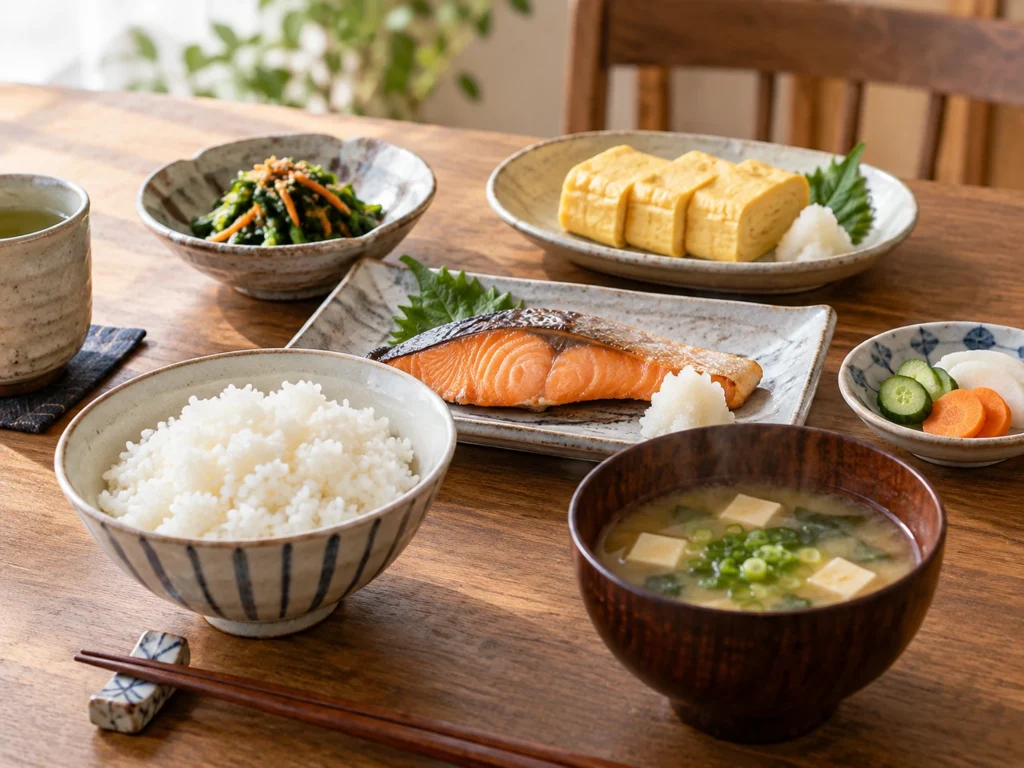
It does not have to follow this formula perfectly.
For example:
- Steamed rice
- Miso soup
- Ginger pork
- Shredded cabbage
- A small vegetable side dish
Or:
- Rice
- Grilled salmon
- Tamagoyaki
- Pickles
- Miso soup
Or simply:
- Oyakodon
- Miso soup
Japanese home cooking often feels varied because several relatively simple components are combined rather than making one enormous centerpiece.
That also makes the cuisine very adaptable to meal planning.
Make one pot of rice, prepare one protein dish, add soup, and use leftover vegetables for a small side dish.
The Essential Japanese Pantry
You do not need an enormous Japanese pantry to begin.
A surprisingly large number of Japanese home recipes are built from a small group of ingredients.
Soy Sauce
Japanese soy sauce provides saltiness, aroma, color, and umami.
For most recipes, ordinary Japanese-style soy sauce works perfectly.
If a Cookpad recipe simply says 醤油 (shoyu), regular Japanese soy sauce is normally appropriate unless the recipe specifically requests light soy sauce or another type.
Mirin
Mirin contributes sweetness, gloss, and a mild fermented flavor.
It appears constantly in sauces for:
- Oyakodon
- Teriyaki
- Simmered vegetables
- Ginger pork
- Fish
- Donburi dishes
If authentic mirin is unavailable, mirin-style seasoning can work for everyday cooking.
A little sugar combined with sake or water can reproduce some of its functional sweetness, although the flavor will not be identical.
Cooking Sake
Sake is frequently used to reduce strong meat or fish aromas while adding complexity.
You will see 酒 (sake) throughout Japanese Cookpad recipes.
If you do not use alcohol, water or stock can often be substituted, although the final flavor will change.
Miso
Miso is much more than an ingredient for miso soup.
It can be used in:
- Soups
- Marinades
- Vegetable dressings
- Stir-fries
- Meat sauces
- Glazes
- Hot pots
White miso tends to be sweeter and milder.
Red or darker miso tends to be stronger and saltier.
Awase miso blends characteristics of different styles and is a convenient general-purpose choice.
Dashi
Dashi is one of the foundations of Japanese cooking.
It may be made using kombu, bonito flakes, dried sardines, dried mushrooms, or combinations of ingredients.
For beginners, instant dashi powder is perfectly practical.
Cookpad home recipes frequently use instant dashi because ordinary Japanese families also value convenience.
Potato Starch — Katakuriko
When a Japanese recipe says 片栗粉 (katakuriko), modern recipes usually mean potato starch.
This is especially useful for:
- Karaage
- Thickening sauces
- Crispy coatings
- Meat preparation
Cornstarch can sometimes substitute, but potato starch generally produces a more characteristic crisp texture in dishes such as karaage.
Eight Japanese Home Foods Worth Learning First
1. Oyakodon — Chicken and Egg Rice Bowl
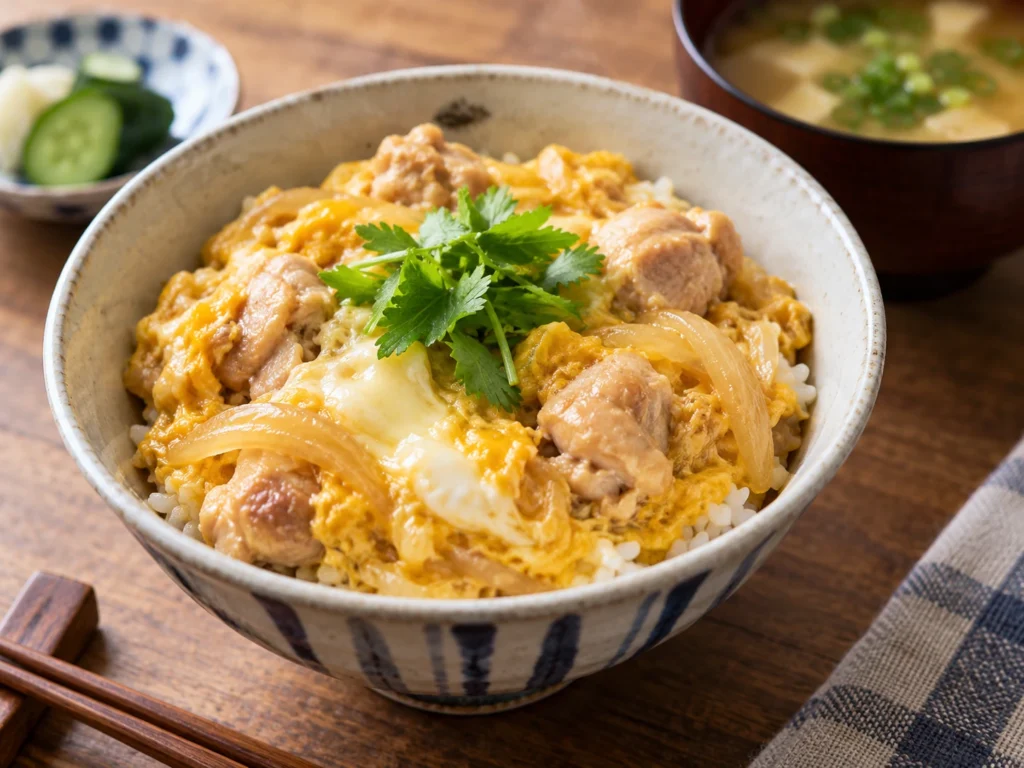
Oyakodon is one of the best introductions to Japanese home cooking.
Chicken and sliced onion are gently simmered in a mixture typically containing soy sauce, mirin, dashi, sake, and a little sugar. Beaten egg is then added and cooked until softly set before everything is served over hot rice.
The name is famous for its playful meaning:
oya = parent
ko = child
don = donburi rice bowl
Chicken and egg — parent and child — together in one bowl.
Why it is excellent for beginners
Oyakodon requires relatively ordinary ingredients.
The core ingredients are usually:
- Chicken thigh
- Eggs
- Onion
- Rice
- Soy sauce
- Mirin
- Dashi
- Sugar
It can also be prepared in around 20–30 minutes once you understand the technique.
Explore thousands of Japanese oyakodon ideas on Cookpad
Explore Cookpad oyakodon recipes available in English
The important technique
Do not treat the egg like scrambled eggs.
The goal is usually a soft layer of egg that partially absorbs the simmering liquid while still remaining tender.
For food safety, cook eggs and chicken according to the guidance appropriate to your country and the products you use.
2. Karaage — Japanese Fried Chicken
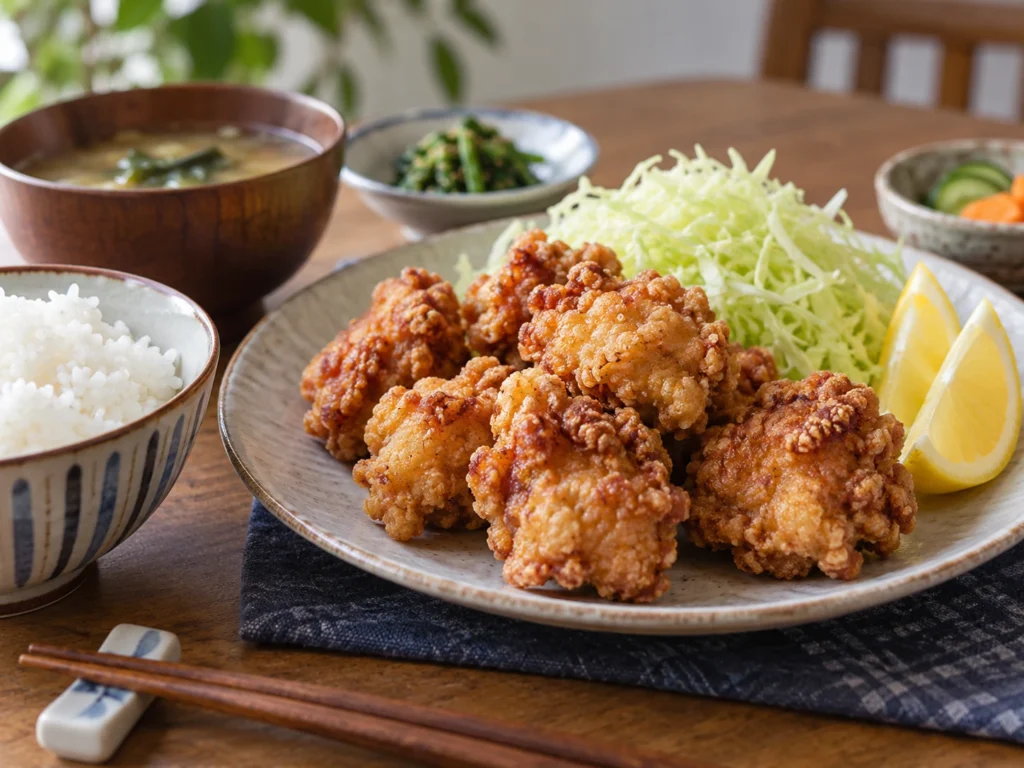
Karaage is one of the easiest Japanese dishes to love.
Chicken is normally seasoned with some combination of:
- Soy sauce
- Ginger
- Garlic
- Sake
It is then coated with potato starch, flour, or a mixture and fried.
The result should be juicy inside with a light, crisp exterior.
Explore Japanese karaage recipes on Cookpad
Explore karaage recipes on Cookpad in English
Karaage is not simply “Japanese fried chicken”
The seasoning is usually inside the meat rather than relying primarily on a heavily seasoned crust.
Japanese karaage coatings are also often thinner than American Southern-style fried chicken coatings.
That gives it a different ratio of crisp coating to juicy meat.
What to serve with karaage
Try:
- Steamed rice
- Shredded cabbage
- Lemon
- Japanese mayonnaise
- Miso soup
- Cucumber salad
Karaage is also extremely common in bento.
3. Japanese Curry Rice
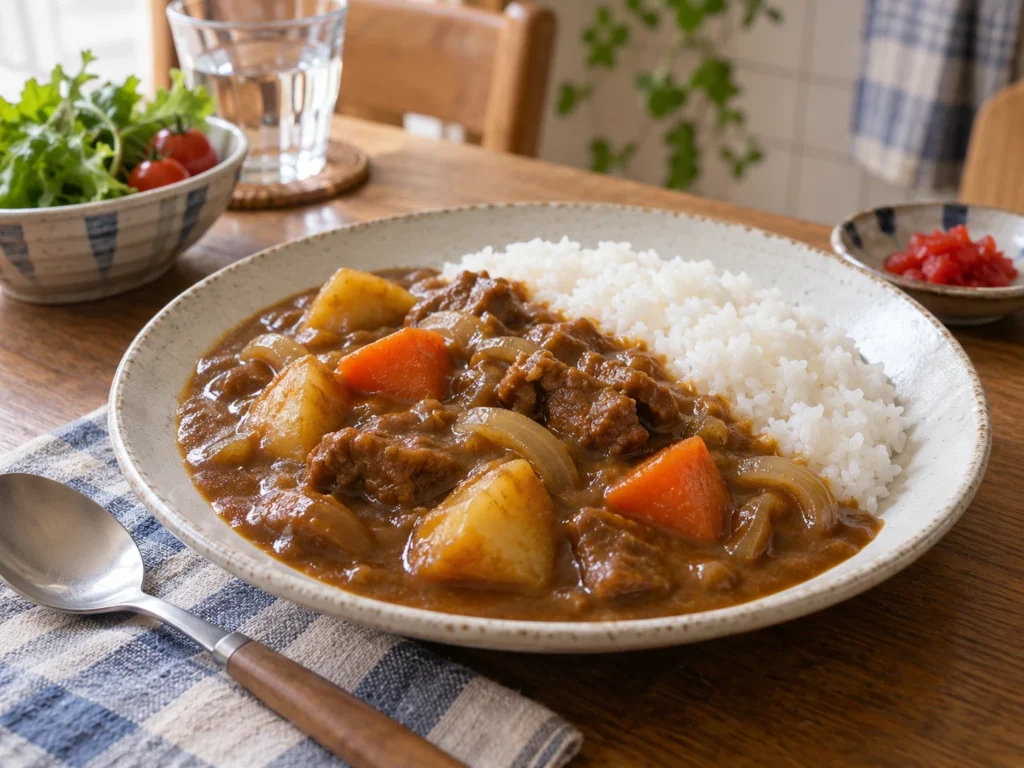
Unlike many other curries, Japanese curry is usually thicker, darker, slightly sweet, and relatively mild.
It is usually thicker, darker, slightly sweet, deeply savory, and relatively mild.
A classic home version often contains:
- Onion
- Carrot
- Potato
- Beef, pork, or chicken
- Japanese curry roux
- Rice
Commercial curry roux is not a shortcut that somehow makes the dish “inauthentic.”
Using boxed curry roux is completely normal Japanese home cooking.
Explore Japanese curry ideas on Cookpad Japan
Explore Japanese curry recipes on Cookpad in English
Why Japanese curry is excellent for meal prep
Curry can be cooked in a large pot and served across multiple meals.
Leftover curry can become:
- Curry udon
- Curry bread filling
- Curry gratin
- Curry pasta
- Curry omelet rice
Cookpad is particularly useful here because Japanese home cooks publish countless leftover transformations.
4. Miso Soup
Many people outside Japan imagine miso soup as a fixed recipe.
It is better understood as a framework.
The structure is roughly:
Dashi + ingredients + miso
The ingredients change constantly.
Classic possibilities include:
- Tofu and wakame
- Onion and potato
- Daikon and aburaage
- Mushroom
- Cabbage
- Clams
- Green onion
Cookpad’s Japanese miso soup collection demonstrates exactly how flexible the dish can be.
Explore Japanese miso soup recipes on Cookpad
Explore miso soup recipes on Cookpad in English
A useful rule
Do not violently boil miso for a long period after adding it.
Many cooks dissolve the miso toward the end of cooking to preserve more of its aroma.
5. Onigiri — Japanese Rice Balls
Onigiri may be one of the greatest convenience foods ever invented.
At its simplest:
Rice + salt
Add nori and a filling, and you have a portable meal.
Common fillings include:
- Salted salmon
- Tuna mayonnaise
- Umeboshi
- Kombu
- Bonito flakes with soy sauce
- Mentaiko
- Takana
But modern variations are almost unlimited.
Cookpad Japan contains an enormous ecosystem of onigiri ideas, reflecting bento culture, school lunches, family breakfasts, travel food, leftovers, and convenience-store inspiration.
Explore Japanese onigiri recipes on Cookpad
Explore onigiri recipes from Japan translated on Cookpad
Choosing rice matters
Japanese short-grain rice naturally sticks together.
Long-grain rice such as basmati will not behave the same way.
Look for:
- Japanese short-grain rice
- Sushi rice
- Calrose rice when Japanese rice is unavailable
Do not confuse the seasoning used for sushi rice with the plain rice typically used for onigiri.
6. Shogayaki — Japanese Ginger Pork
Shogayaki is exactly the kind of dish international Japanese-food coverage often overlooks.
Yet it is classic everyday Japanese food.
Thin slices of pork are cooked with a ginger-forward sauce typically involving soy sauce, mirin or sake, and sometimes sugar.
It is commonly served with shredded cabbage and rice.
Explore Japanese shogayaki recipes on Cookpad
Try Cookpad Japan’s English ginger pork recipe
The ingredient problem outside Japan
Japanese supermarkets sell very thinly sliced pork intended for dishes like this.
Many Western supermarkets do not.
A simple solution is to place pork loin in the freezer briefly until firm but not frozen solid, then slice it thinly with a sharp knife.
This one technique unlocks a surprising number of Japanese recipes.
7. Tonjiru — Pork and Vegetable Miso Soup
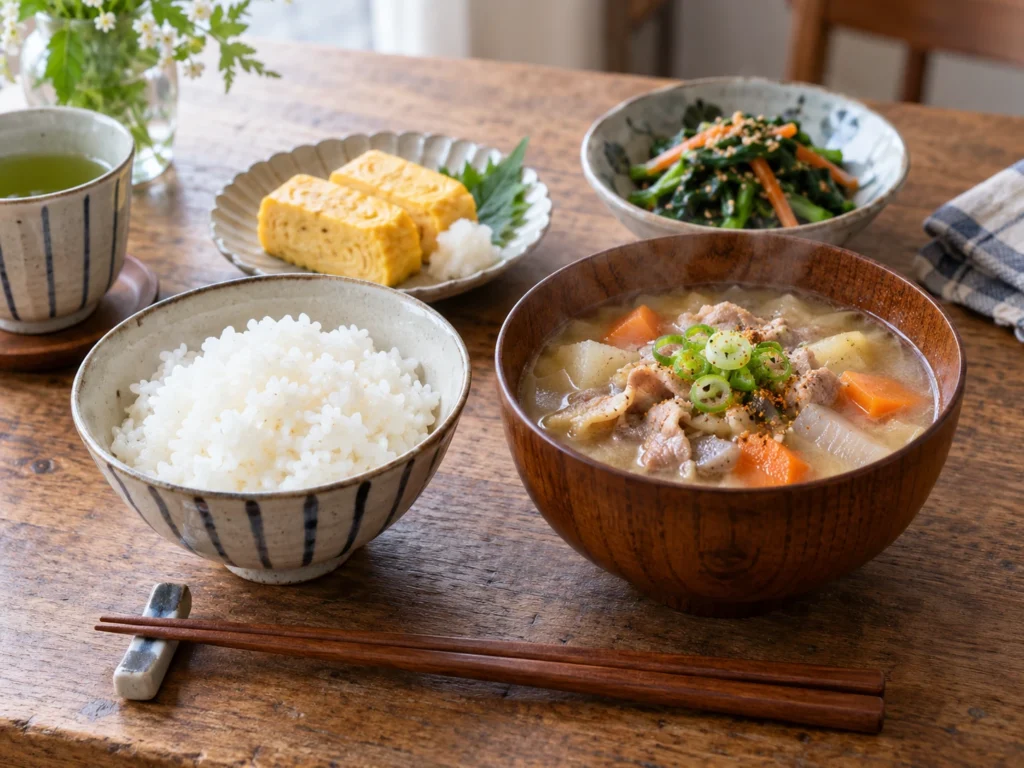
Tonjiru is a much more substantial relative of ordinary miso soup.
It generally includes pork plus several vegetables, such as:
- Daikon
- Carrot
- Burdock root
- Onion
- Konnyaku
- Tofu
- Green onion
The result can function almost as a meal.
Explore Japanese tonjiru recipes on Cookpad
See a detailed Cookpad tonjiru recipe in English
Tonjiru is especially useful for understanding an important aspect of Japanese food:
Japanese meals are not necessarily delicate or tiny.
Home cooking can be rustic, filling, inexpensive, and built around whatever vegetables need to be used.
8. Tamagoyaki and Dashimaki Tamago
Tamagoyaki is a rolled omelet made by cooking thin layers of egg and rolling them together.
There are major regional and household differences.
Some versions are sweet.
Others emphasize dashi.
Some use soy sauce or mirin.
Others are extremely simple.
Explore tamagoyaki recipes from Japanese cooks on Cookpad
Explore dashi tamagoyaki recipes translated into English on Cookpad
Tamagoyaki may appear in:
- Breakfast
- Bento
- Sushi
- Side dishes
- Sandwiches
Do not worry if your first attempt is ugly.
Japanese home cooks also learn through repetition.
A rectangular tamagoyaki pan is helpful but not strictly necessary.
Go Deeper: Kinpira Gobo
Once the basics feel comfortable, explore dishes that reveal ingredients less familiar outside Japan.
Kinpira gobo is an excellent example.
Burdock root and carrot are cut into strips and cooked with seasonings such as soy sauce, mirin, sugar, sesame oil, chili, and sesame seeds.
It is often served as a small side dish and works extremely well in bento.
Explore thousands of kinpira gobo variations on Cookpad Japan
Explore English-language kinpira gobo recipes on Cookpad
This is where Cookpad’s Japanese database becomes especially valuable.
The internationally famous dishes are only the entrance.
The deeper you search, the more you discover the enormous world of Japanese side dishes, preserved foods, vegetable preparations, regional cooking, and family recipes.
How to Read a Japanese Cookpad Recipe Even If You Do Not Speak Japanese
A Japanese recipe page becomes much easier once you recognize a few repeated terms.
| Japanese | Meaning |
|---|---|
| 醤油 | Soy sauce |
| 味噌 | Miso |
| みりん | Mirin |
| 酒 | Cooking sake |
| 砂糖 | Sugar |
| 塩 | Salt |
| 酢 | Vinegar |
| ごま油 | Sesame oil |
| だし | Dashi |
| 片栗粉 | Potato starch |
| 小麦粉 | Wheat flour |
| 玉ねぎ | Onion |
| 長ねぎ | Japanese long onion |
| 大根 | Daikon |
| ごぼう | Burdock root |
| にんじん | Carrot |
| 鶏もも肉 | Chicken thigh |
| 豚肉 | Pork |
| 卵 | Egg |
| ご飯 | Cooked rice |
| 適量 | Appropriate amount / as needed |
| 少々 | A small amount / pinch |
| 大さじ | Tablespoon |
| 小さじ | Teaspoon |
Once you know these terms, many recipes become surprisingly readable even before translation.
Cookpad also exposes recipes originating in Japan through translated international pages, making it easier to move between authentic Japanese recipes and English-language cooking instructions.
Japanese Ingredients That May Need Substitutions
Gobo — Burdock Root
Burdock has a distinctive earthy flavor and fibrous texture.
Asian supermarkets are the best place to look.
There is no perfect substitute.
Carrot, parsnip, or another root vegetable can reproduce the cooking method, but not the actual flavor of gobo.
Daikon
Daikon is now available in many Asian and large Western supermarkets.
Turnip can sometimes perform a similar structural role in soups, but its flavor is different.
Aburaage
Aburaage is thin deep-fried tofu.
It is commonly added to:
- Miso soup
- Udon
- Rice dishes
- Simmered vegetables
If unavailable, ordinary tofu can still provide protein and texture, although it is not a direct replacement.
Konnyaku
Konnyaku has a distinctive springy texture and is frequently used in stews and soups such as tonjiru.
It does not have an obvious Western equivalent.
Fortunately, most dishes can simply omit it if necessary.
What Does It Cost to Cook Japanese Food at Home?
Restaurant Japanese food can be expensive.
Japanese home cooking does not have to be.
In fact, many traditional household meals are built around rice, eggs, inexpensive cuts of meat, seasonal vegetables, tofu, and small quantities of strongly flavored seasonings.
Food prices vary enormously by city and country, so the following is an illustrative U.S. supermarket calculation rather than a national price quotation.
That distinction matters: U.S. food-at-home prices were still rising year over year in mid-2026, and rice prices in particular were running higher than a year earlier.
Example 1: Oyakodon for Four People
Assume:
| Ingredient | Estimated cost used |
|---|---|
| 1.5 lb chicken thighs | $5.24 |
| 8 eggs | $2.40 |
| 1 onion | $0.70 |
| Japanese rice | $2.12 |
| Soy sauce, mirin, dashi and sugar used | $1.30 |
| Total | $11.76 |
$11.76 ÷ 4 = approximately $2.94 per serving
Add simple miso soup:
| Ingredient | Estimated amount used |
|---|---|
| Miso | $1.04 |
| Tofu | $1.25 |
| Wakame | $0.40 |
| Dashi | $0.50 |
| Green onion | $0.40 |
| Total | $3.59 |
$3.59 ÷ 4 = approximately $0.90 per serving
Oyakodon plus miso soup therefore comes to roughly:
$2.94 + $0.90 = $3.84 per person
Again, this is an example basket, not a promise that every U.S. shopper can reproduce the same price.
Example 2: Japanese Curry for Six
Illustrative basket:
- Chicken: $6.98
- Curry roux: $4.00
- Onion, carrot and potato: $4.00
- Rice: $3.17
Estimated total: $18.15
$18.15 ÷ 6 = approximately $3.03 per serving
This becomes even cheaper if curry is used again the next day in another dish.
Example 3: Karaage Dinner for Four
Illustrative basket:
- Chicken thighs: $6.98
- Potato starch/flour: $0.50
- Soy sauce, ginger, garlic and seasoning: $0.90
- Cooking oil allocated to the meal: $0.70
- Rice: $2.12
- Cabbage or vegetable garnish: $0.80
Estimated total: $12.00
$12.00 ÷ 4 = about $3.00 per person
The broader lesson is simple:
Japanese home cooking can be very economical once you own the basic pantry ingredients.
Soy sauce, miso, rice vinegar, mirin, dashi, sesame oil, and potato starch are not purchased for a single meal. They are used repeatedly across dozens of dishes.
The Japanese Pantry Has Strong “Ingredient Network Effects”
This is one reason Japanese cooking becomes much cheaper after the first few meals.
Buy soy sauce for oyakodon.
You also use it for:
- Ginger pork
- Teriyaki
- Kinpira
- Karaage
- Simmered vegetables
Buy miso for miso soup.
You can also use it for:
- Tonjiru
- Miso-glazed vegetables
- Meat marinades
- Stir-fries
Buy mirin for oyakodon.
You can also use it for:
- Fish
- Teriyaki
- Donburi
- Simmered dishes
The pantry gradually becomes a reusable flavor system.
A Beginner Japanese Home-Cooking Week
Here is one practical way to start.
Monday — Oyakodon
Learn:
- Donburi
- Soy/mirin balance
- Soft egg technique
Serve with miso soup.
Tuesday — Ginger Pork
Learn:
- Thinly sliced meat
- Quick pan sauce
- Shredded cabbage as a side
Use the same rice and soy sauce from Monday.
Wednesday — Japanese Curry
Make a large batch.
Serve with rice.
Save leftovers.
Thursday — Curry Udon or Leftover Curry Rice
Do not cook an entirely new meal.
Japanese home cooking contains a strong culture of intelligently reusing prepared food.
Friday — Karaage
Learn:
- Marinades
- Potato starch
- Japanese-style fried food
Serve with rice and cabbage.
Saturday — Tonjiru
Use vegetables left from the week.
Add pork and miso.
Make a large pot.
Sunday — Onigiri and Tamagoyaki
Use remaining cooked rice and pantry ingredients.
This is also an excellent introduction to Japanese bento-style thinking.
Do Not Assume Japanese Food Must Be Perfectly Authentic
Authenticity is valuable.
But home cooking has always adapted to:
- Region
- Budget
- Season
- Family preference
- Available ingredients
- Time
Cookpad makes this visible.
One recipe may be extremely traditional, while another might rely on a microwave for convenience. Some cooks reduce the salt, whereas others substitute chicken breast for thigh meat. In addition, leftover curry may be transformed into an entirely different meal.
That flexibility is part of genuine home cooking.
The objective should not be:
“Can I reproduce one idealized Japanese dish perfectly?”
A better question is:
“Can I understand how Japanese cooks use these ingredients and techniques, then make them work in my own kitchen?”
Why Search Cookpad Japan Even If You Prefer English
For globally famous dishes, English-language Cookpad searches are often sufficient.
But searching Japanese Cookpad becomes extremely valuable when you want:
- More regional variations
- Bento dishes
- Vegetable side dishes
- Seasonal recipes
- Very specific ingredient combinations
- Leftover ideas
- Budget meals
- Family-style variations
For example, Japanese Cookpad currently contains extremely large collections around everyday categories such as onigiri, tamagoyaki, karaage, curry, and miso soup.
That depth is difficult to reproduce with a conventional editorial recipe site.
Frequently Asked Questions About Japanese Home Cooking and Cookpad
Is Cookpad useful if I cannot read Japanese?
Yes.
Start with translated Cookpad recipes where available, then gradually use Japanese search pages when you want more variety.
Learning twenty or thirty common ingredient words also makes Japanese recipe pages dramatically easier to navigate.
Do I need Japanese cooking equipment?
Usually not.
A rice cooker is convenient but optional.
A regular saucepan can cook Japanese rice.
A rectangular tamagoyaki pan is helpful but not essential.
A donabe is wonderful but unnecessary for beginners.
Start with the equipment you already own.
Do I need a rice cooker?
No.
Japanese short-grain rice can be cooked in a normal pot with a lid.
A rice cooker becomes useful primarily because Japanese cooking uses rice frequently and the machine makes consistency and timing easier.
What rice should I buy?
Look for Japanese short-grain rice.
Calrose is a practical alternative in North America.
Avoid using basmati or jasmine rice when the recipe depends on sticky Japanese rice texture, particularly for onigiri.
Is sushi rice the same as Japanese rice?
“Sushi rice” can refer to the rice variety or to rice already seasoned with sushi vinegar.
For ordinary Japanese meals, you normally want plain cooked short-grain rice without sushi seasoning.
Is Japanese curry the same as Indian curry?
No.
Japanese curry developed into its own style.
It is typically thicker, sweeter, milder, and commonly served over Japanese rice.
Commercial roux blocks are extremely common in Japanese households.
Can I make Japanese curry without boxed roux?
Yes.
You can build a roux from fat, flour, curry powder, spices, stock, and seasonings.
But using commercial roux is not somehow less legitimate for home cooking.
What is the easiest Japanese meal for a complete beginner?
Oyakodon is difficult to beat.
It requires only a few ingredients, uses one pan, teaches several fundamental Japanese seasonings, and produces a complete rice bowl.
Japanese curry is another excellent beginner dish.
What is the cheapest Japanese meal to start with?
Rice, miso soup, eggs, and simple vegetable dishes can be extremely inexpensive.
Tamagoyaki, onigiri, and basic donburi also have relatively low ingredient costs.
Why do Japanese recipes use so much mirin, sake, soy sauce and dashi?
Together they create a flavor structure that appears repeatedly throughout Japanese home cooking.
Instead of learning a completely new sauce for every meal, you gradually learn how proportions change.
That is why owning a small Japanese pantry opens up so many recipes.
What can I substitute for mirin?
Mirin-style seasoning is the simplest substitute.
A small amount of sugar combined with sake or water can imitate some of its sweetness, but the flavor will not be identical.
What can I substitute for sake?
Depending on the recipe, water or stock can be used.
Dry sherry is sometimes used as a culinary substitute, but it will produce a different flavor.
Is miso soup always tofu and seaweed?
Absolutely not.
That is only one famous version.
Japanese home cooks use an enormous variety of vegetables, mushrooms, seafood, tofu products, and seasonal ingredients.
See how varied Cookpad’s Japanese miso soup recipes really are
Is Japanese food always healthy?
No cuisine is automatically healthy.
Japanese cuisine includes fried dishes, sugary sauces, salty preserved foods, rich ramen, mayonnaise-heavy foods, sweets, and large portions just like other cuisines.
The advantage of home cooking is that you control portions and ingredients.
What is the difference between restaurant Japanese food and home Japanese food?
Restaurant menus naturally emphasize dishes people are willing to go out and pay for.
Home cooking places much more emphasis on:
- Speed
- Cost
- Leftovers
- Seasonal vegetables
- Small side dishes
- Bento
- Family preference
Cookpad is valuable precisely because it exposes this less internationally visible side of Japanese cuisine.
What should I search after learning the basics?
Try searching Cookpad for:
- 肉じゃが — Nikujaga
- きんぴらごぼう — Kinpira gobo
- 炊き込みご飯 — Takikomi gohan
- 筑前煮 — Chikuzen-ni
- ほうれん草の胡麻和え — Spinach with sesame dressing
- 焼きおにぎり — Yaki onigiri
- 豚汁 — Tonjiru
- 生姜焼き — Shogayaki
- 親子丼 — Oyakodon
- 卵焼き — Tamagoyaki
Each of these opens another part of Japanese household cooking.
Cookpad Is Best Used as a Gateway, Not Just a Recipe Page
The real value of Cookpad is not finding one recipe.
It is being able to compare ten, fifty, or hundreds of ways that home cooks approach the same dish.
Read several versions of oyakodon and you begin to understand which ingredients are fundamental and which are optional.
Compare several miso soups and you realize that the ingredients change constantly.
Look at dozens of tamagoyaki recipes and you discover how strongly sweetness, dashi, texture, and seasoning vary by household.
That is something a single cookbook cannot easily reproduce.
Cookpad becomes a window into the collective cooking knowledge of ordinary kitchens.
And for cooks outside Japan, that may be one of the most interesting ways to move beyond sushi and ramen and begin exploring Japanese food as Japanese people actually live with it.
Start Exploring
Oyakodon recipes on Cookpad Japan
Karaage recipes on Cookpad Japan
Miso soup recipes on Cookpad Japan
Onigiri recipes on Cookpad Japan
Ginger pork recipes on Cookpad Japan
Tonjiru recipes on Cookpad Japan
Tamagoyaki recipes on Cookpad Japan
Kinpira gobo recipes on Cookpad Japan
Japanese curry recipes available in English on Cookpad
Oyakodon recipes available in English on Cookpad
Onigiri recipes available in English on Cookpad
Karaage recipes available in English on Cookpad
Japanese food is far larger than the dishes most commonly exported overseas.
Cookpad gives us access to that larger world.
The next step is simply to cook.